Highlight
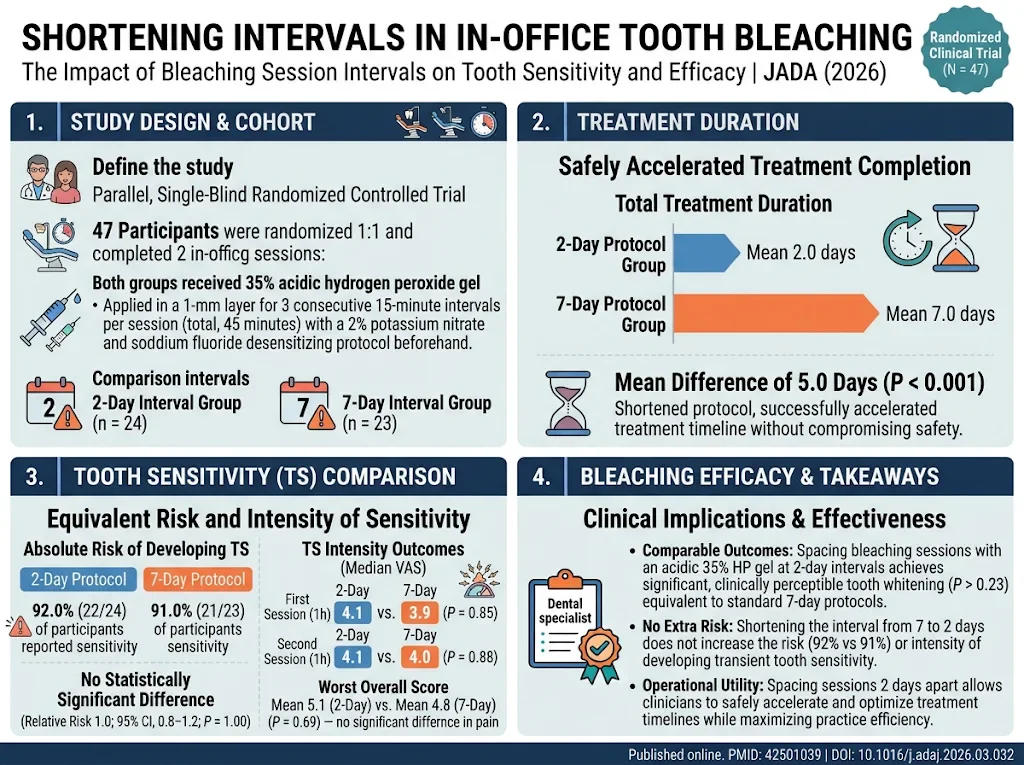
This clinical trial investigated whether shortening intervals between in-office bleaching sessions using an acidic pH 35% hydrogen peroxide gel affects tooth sensitivity and treatment efficacy.
Key findings indicate that a 2-day interval does not increase tooth sensitivity intensity or risk compared to a 7-day interval.
Both treatment schedules resulted in clinically meaningful tooth whitening without compromising efficacy.
Shortening the interval can safely accelerate bleaching treatment completion, optimizing dental office time.
Study Background
Tooth bleaching is a prevalent cosmetic dental procedure aimed at improving dental aesthetics by lightening tooth color. In-office bleaching typically employs high concentrations of hydrogen peroxide gels, which act as oxidizing agents to decolorize chromogens within dental tissues. However, one of the most commonly reported side effects is tooth sensitivity (TS), which can limit patient comfort and acceptance.
Conventional protocols often schedule bleaching sessions one week apart to mitigate sensitivity and allow enamel recovery. Recent developments include use of acidic pH bleaching gels, which may potentially accelerate bleaching kinetics but raise questions about safety and side effects when intervals between sessions are shortened.
This study addresses a clinically relevant question: can the interval between in-office bleaching sessions be safely reduced from 7 days to 2 days without increasing TS or compromising bleaching effectiveness? Determining this could optimize treatment time, improve patient convenience, and increase clinical throughput.
Study Design
The study was a randomized clinical trial enrolling 47 participants seeking in-office teeth bleaching. Participants were randomly allocated into two parallel groups:
- 2-day interval group: Received two bleaching sessions with an acidic 35% hydrogen peroxide gel spaced 2 days apart.
- 7-day interval group: Received two bleaching sessions spaced 7 days apart.
The primary outcome was intensity and risk of tooth sensitivity, assessed using a visual analog scale (VAS) from 0 (no sensitivity) to 10 cm (worst imaginable sensitivity) at 1 hour, 24 hours, and 48 hours post-treatment.
Secondary outcome was bleaching efficacy measured objectively by color assessments at baseline and one month post-treatment using two standardized shade guides (VITA Classical and VITA Bleachedguide 3D-MASTER) and a digital spectrophotometer.
Statistical analyses included independent sample t tests for continuous variables (treatment duration, TS intensity, color change) and Fisher exact test for absolute risk of tooth sensitivity, with significance threshold set at α = .05.
Key Findings
Treatment Duration: Total time to complete bleaching sessions was significantly shorter in the 2-day interval group compared to the 7-day interval group (P < .001), as expected since sessions were closer together.
Tooth Sensitivity: There was no statistically significant difference in the worst sensitivity VAS scores between the two groups after either session. The relative risk (RR) of developing sensitivity in the 2-day interval group compared to the 7-day group was 1.0 (95% CI, 0.8 to 1.2; P > .30), indicating no increased risk.
Time-course analyses at 1, 24, and 48 hours post-treatment showed comparable sensitivity patterns between groups.
Bleaching Efficacy: Both groups showed significant and clinically perceptible color improvement from baseline to one month post-treatment using both shade guides and spectrophotometric analysis. There was no difference in magnitude of color change between the 2-day and 7-day groups (P > .23).
Safety and Tolerability: No adverse events beyond transient sensitivity were reported. The acidic pH gel was well-tolerated across both interval schedules.
Expert Commentary
This well-conducted randomized trial provides compelling evidence that reducing intervals between in-office bleaching sessions with an acidic pH 35% hydrogen peroxide gel does not exacerbate tooth sensitivity or diminish bleaching outcomes. This finding challenges the conservative approach of longer waiting periods traditionally recommended to minimize sensitivity.
Biologically, while acidic pH bleaching gels may accelerate oxidation reactions enhancing bleaching efficacy, concerns regarding pulpal irritation and enamel demineralization have historically limited aggressive treatment schedules. The absence of increased sensitivity here suggests the protocol is safe in the short term, though long-term enamel and pulp health were not assessed.
Limitations include the relatively small sample size and single-blinded design. Further studies with larger cohorts, longer follow-up for durability of bleaching and safety, and patient-centered outcomes such as satisfaction and quality of life would strengthen generalizability.
Conclusion
Shortening the interval between in-office bleaching sessions using an acidic pH 35% hydrogen peroxide gel from 7 days to 2 days accelerates treatment completion without increasing the intensity or risk of tooth sensitivity. Importantly, bleaching efficacy is maintained, suggesting clinicians can reliably consider condensed bleaching schedules to optimize chair time and enhance patient convenience.
These findings support the adoption of shorter interval protocols in clinical practice while underscoring the need for continued monitoring of long-term safety and enamel health.
Funding and Clinical Trials Registration
This clinical trial was registered at ClinicalTrials.gov with the identifier NCT06394557. The study was conducted following ethical standards; however, specific funding sources were not disclosed in the abstract.
References
- da Costa SAGF, da Costa Ferreira Silva C, Amado TVS, et al. Influence of tooth sensitivity on shortening the interval between in-office bleaching sessions with acidic pH gel: A randomized clinical trial. J Am Dent Assoc. 2026 Jul 25;157(11):1334-1342.e3. PMID: 42501039.
- Joiner A. The bleaching of teeth: A review of the literature. J Dent. 2006;34(7):412-419.
- Cai S, Chen J, Li Y, et al. Effect of bleaching gels at different pH on enamel surface roughness and microhardness. J Dent. 2014;42(5):595-602.
- Kwon SR, Wertz PW. Review of the mechanism of tooth whitening. J Esthet Restor Dent. 2015;27(5):240-257.
- Moraes RR, Garcia Lde F, Consani S, et al. Effect of hydrogen peroxide concentration and acid etching on tooth sensitivity and bleaching efficacy: A clinical study. Oper Dent. 2011;36(2): 160-167.
Specialty calculators
For clinical reference; use professional judgment.