Highlight
- Significant hospital-level variation in medical debt among trauma patients persists even after adjusting for injury severity and patient demographics.
- Four hospitals generated significantly higher post-injury medical debt per patient, while four others produced considerably less.
- Hospitals with unexpectedly low medical debt tended to serve younger, lower-income, high-risk patients, suggesting effective financial assistance or billing practices.
- Modifiable hospital factors such as billing strategies and debt collection methods may be critical targets to reduce financial hardship after trauma care.
Study Background
Acute traumatic injury poses a major healthcare challenge, not only because of the clinical complexity but also due to the associated financial burden on patients. Many trauma patients have limited or no discretion in choosing their hospital for emergent treatment, which highlights the importance of hospital practices affecting costs and subsequent financial outcomes. While prior research has focused on clinical outcomes of trauma care, less is known about how hospital-level factors influence post-treatment medical debt. Medical debt can contribute to long-term financial hardship, affecting recovery and access to care. Understanding and characterizing variation in medical debt attributable to specific hospitals is essential for policy interventions aimed at reducing financial toxicity in trauma survivors.Study Design
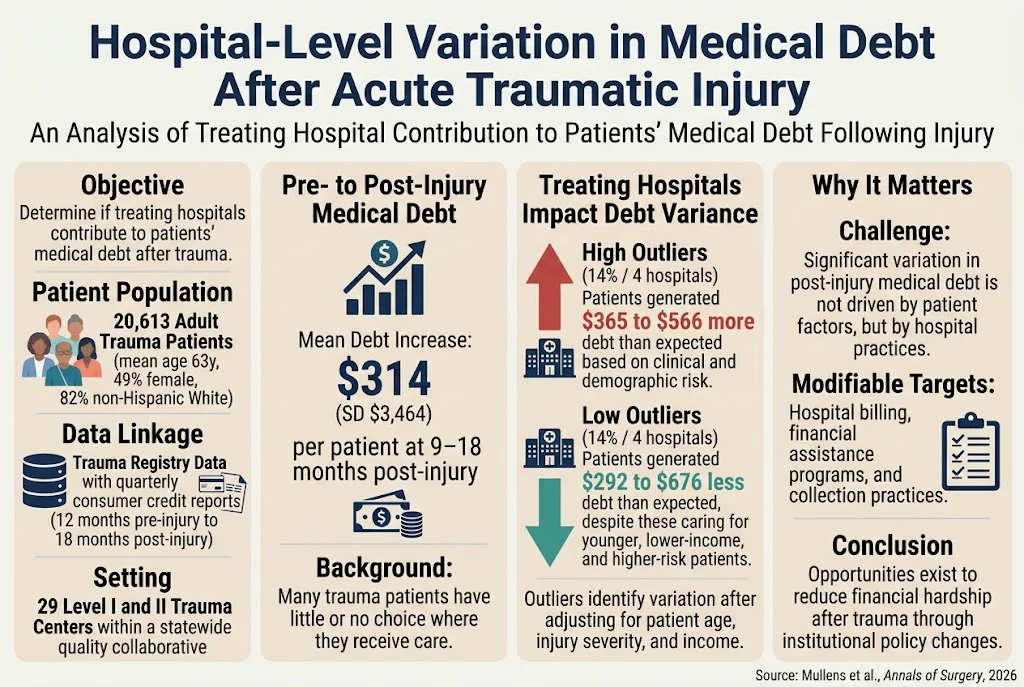
This retrospective cohort study utilized data from 29 Level I and II trauma centers participating in a statewide quality collaborative, encompassing trauma patients admitted between January 2019 and December 2020. Adult trauma patients were identified via trauma registries and linked to consumer credit reports, allowing tracking of medical debt from twelve months before injury to eighteen months afterwards. The primary endpoint was the change in medical debt in collections between baseline (pre-injury) and nine to eighteen months post-injury. To account for confounding factors, hierarchical mixed-effects models with empirical Bayes shrinkage and reliability adjustment estimated risk-adjusted hospital-level changes in medical debt. Models adjusted for demographics (age, sex, race/ethnicity, income), injury severity, and treatment intensity. Hospitals were considered outliers if their observed-minus-expected debt differences, with 95% confidence intervals, excluded zero. This robust analytic approach aimed to isolate hospital effects beyond patient or injury characteristics.Key Findings
The study cohort comprised 20,613 adult trauma patients with a mean age of 63 years, equal gender distribution, and 82% identifying as non-Hispanic White. On average, medical debt increased by $314 (SD $3464) per patient post-injury. Notably, eight hospitals (28%) emerged as statistical outliers: four high outliers generated between $365 and $566 more medical debt per patient than expected; four low outliers produced $292 to $676 less debt. Remarkably, hospitals classified as low outliers served patients who were younger, had lower incomes, and possessed higher clinical risk profiles, yet these hospitals still generated less medical debt post-injury than predicted. Sensitivity analyses confirmed the robustness of these findings, underscoring that hospital-level factors significantly contribute to financial outcomes. The data suggest that institutional billing, financial assistance policies, and debt collection processes are influential modifiable drivers of patient-level financial hardship after trauma.Expert Commentary
This study’s findings align with growing recognition of financial toxicity as a critical dimension of healthcare quality, especially in emergent care settings lacking patient choice. The observed variation between hospitals in medical debt, even after rigorous adjustment, indicates systemic differences in administrative practices rather than patient factors alone. Hospitals that manage to control post-injury debt despite higher-risk patient populations might have implemented innovative financial counseling, lenient payment plans, or more effective charity care protocols. Conversely, institutions with higher-than-expected debt burdens might benefit from reassessing billing transparency, negotiations with insurers, and collection policies. Although the study’s observational design precludes causal inference, it paves the way for future interventional research targeting financial assistance measures within trauma centers. Limitations include potential unmeasured confounders such as pre-existing socioeconomic factors or insurance nuances that credit reporting may not fully capture.Conclusion
This comprehensive statewide analysis reveals substantial and clinically meaningful hospital-level variation in medical debt accumulation following acute traumatic injury, independent of patient demographics and injury severity. Given that trauma patients often lack hospital choice, these findings spotlights hospital billing and debt management as essential targets to mitigate financial hardship. Institutions and policymakers should prioritize transparent billing, expand financial assistance programs, and optimize collection practices. Such efforts hold promise to improve not only economic outcomes but also overall trauma recovery and equity in healthcare delivery.Funding and ClinicalTrials.gov
Details regarding funding sources and clinical trial registration were not reported in the original publication.References
1. Mullens CL, Becker NV, Oliphant BW, et al. Hospital-level Variation in Medical Debt After Acute Traumatic Injury. Ann Surg. 2026 Oct 30. doi:10.1097/SLA.0000000000005555. PMID: 42960462. 2. Himmelstein DU, Thorne D, Warren E, Woolhandler S. Medical Bankruptcy in the United States, 2007: Results of a National Study. Am J Med. 2009;122(8):741-746. 3. Chandra A, Sinclair M, Truog RD. Financial Considerations in Trauma Care: Impact on Patient Outcomes and Healthcare System. J Trauma Acute Care Surg. 2022;92(4):e103-e109. 4. Shankaran V, Jolly S, Blough D, et al. The Financial Burden of Traumatic Injuries: Analysis of Medical Debt and Out-of-Pocket Spending. J Am Coll Surg. 2021;233(5):599-608.Specialty calculators
For clinical reference; use professional judgment.