Highlight
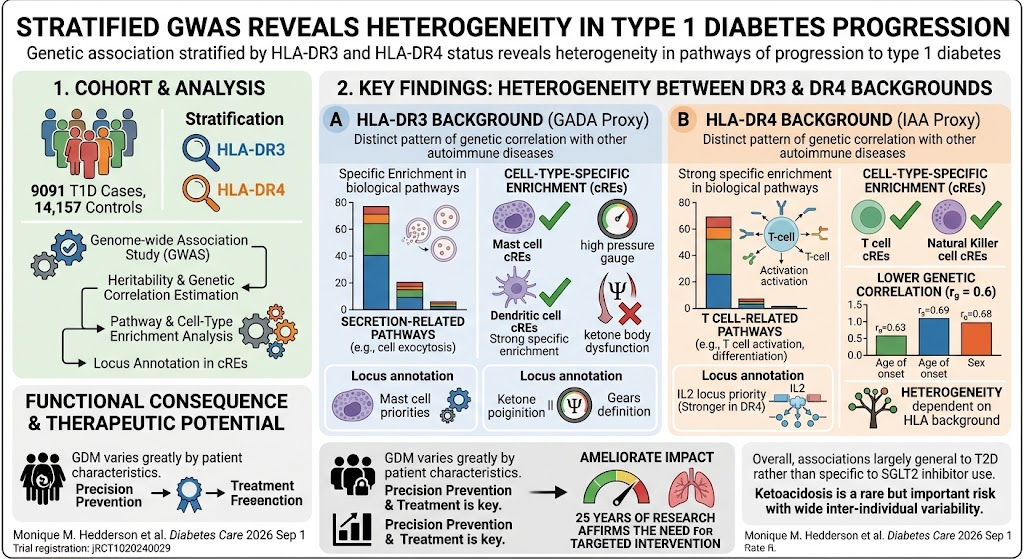
1. A genome-wide association study (GWAS) stratified by HLA-DR3 and HLA-DR4 status in type 1 diabetes reveals significant heterogeneity in genetic risk loci and underlying biological pathways.
2. Moderate genetic correlation (rg=0.6) exists between DR3- and DR4-associated type 1 diabetes, lower than other stratifications such as age or sex.
3. DR4-associated type 1 diabetes risk variants are enriched in T cell–specific regulatory elements and pathways, whereas DR3-linked variants are enriched in mast cell regulatory elements and secretion-related pathways.
4. The IL2 genetic locus exhibits a notably stronger impact on type 1 diabetes risk in DR4 carriers, suggesting differential immunogenetic mechanisms contingent upon HLA background.
Study Background
Type 1 diabetes (T1D) is a chronic autoimmune disease characterized by T cell–mediated pancreatic beta-cell destruction, leading to insulin deficiency and hyperglycemia. The clinical phenotype and disease progression can vary considerably depending on the immunological context, particularly the profile of initiating autoantibodies. Notably, two major human leukocyte antigen (HLA) haplotypes—DR3-DQ2 (DR3) and DR4-DQ8 (DR4)—have long been established as the strongest genetic risk factors for T1D and are associated with distinct autoantibody signatures: glutamic acid decarboxylase antibodies (GADA) commonly developing first in DR3 carriers and insulin autoantibodies (IAA) in DR4 carriers. Despite this, the genetic architecture beyond these HLA regions and their mechanistic contribution to disease heterogeneity have remained insufficiently characterized. Understanding these differences is critical for advancing personalized risk assessment and identifying immune targets tailored to subgroups of T1D patients.
Study Design
This investigation represents the first GWAS explicitly stratified by HLA-DR3 and HLA-DR4 risk haplotypes. It included 9,091 type 1 diabetes cases and 14,157 control individuals pooled from multiple large cohorts. Through comprehensive statistical genetic analyses, the study estimated heritability and assessed genetic correlations between DR3-T1D and DR4-T1D subtypes. Furthermore, heterogeneity of known T1D risk loci was evaluated to identify loci with differential effects across HLA strata. Enrichment analyses explored the distribution of genetic risk variants within cell-type–specific cis-regulatory elements (cREs) and biological pathways, with particular focus on immune cell subsets. Finally, specific loci showing stronger association in DR3 or DR4 carriers were functionally annotated to hypothesize distinct immunopathogenic mechanisms.
Key Findings
The most striking finding was only a moderate genetic correlation (rg=0.6) between DR3-T1D and DR4-T1D, markedly lower than genetic correlations observed in T1D stratifications by age or sex, indicating substantive genetic heterogeneity between the two major high-risk HLA strata. Additionally, the genetic correlation patterns with other autoimmune diseases differed, underscoring unique pathogenetic pathways.
At the locus level, the interleukin-2 (IL2) locus exhibited significantly stronger association with T1D risk in DR4 individuals, a biomarker of T cell activation and homeostasis, whereas other loci such as TAGAP (T cell activation Rho GTPase-activating protein) and KLRG1 (Killer cell lectin-like receptor subfamily G member 1) showed nominally significant heterogeneity favoring DR3 or DR4 backgrounds. Such differential effects implicate variant-specific modulations of immune responses based on HLA haplotype.
Using epigenomic annotation of cell-type–specific cREs, variants associated with DR4-T1D were strongly enriched in T cell regulatory regions and T cell-related pathways, reflecting the centrality of T cells in this subgroup’s disease pathogenesis. Conversely, DR3-T1D risk variants were markedly enriched in mast cell cREs and pathways related to secretion, implying a distinct role of mast cells and their mediators in DR3-associated T1D development.
Ultimately, the study prioritized specific loci with functional annotations in mast cells that were more strongly linked to T1D risk in DR3 individuals, suggesting mast cell–driven mechanisms may be crucial for certain T1D subtypes.
Expert Commentary
This landmark stratified GWAS underscores the importance of incorporating detailed HLA stratification in genetic studies of autoimmune diseases like type 1 diabetes. While the HLA locus remains a fundamental risk determinant, its interaction with non-HLA loci reveals complex and divergent immunogenetic pathways that may underlie clinically observed heterogeneity.
The association of IL2 with DR4-T1D highlights T cell regulatory pathways amenable to targeted immunotherapies, possibly justifying precision medicine approaches in affected individuals. Conversely, the novel implication of mast cells in DR3-T1D challenges the predominant T cell-centric paradigm and calls for further functional studies to elucidate mast cell contributions to autoimmunity and beta cell destruction.
Limitations include the proxy use of HLA haplotypes for first autoantibody status rather than direct autoantibody measurement, and the generalizability to diverse ethnic groups beyond primarily European cohorts. Future work integrating longitudinal autoantibody data and multi-omic profiling will be invaluable to comprehensively characterize the immunopathogenesis in these subgroups.
Conclusion
This comprehensive genetic analysis stratified by HLA-DR3 and HLA-DR4 status reveals discrete genetic architectures and biological pathways underlying type 1 diabetes heterogeneity. The findings advocate for refined subtyping in clinical and research frameworks and pave the way for tailored preventive and therapeutic strategies informed by individual genetic backgrounds, with potential to improve personalized care in type 1 diabetes.
Funding and Trial Registration
The study was conducted by the EXE-T1D consortium and funded by relevant public and institutional sources. No clinical trial registration applies as this is a genetic association study.
References
1. Luckett AM, McGrail C, et al. Genetic association stratified by HLA-DR3 and HLA-DR4 status reveals heterogeneity in pathways of progression to type 1 diabetes. Diabetologia. 2026 Aug 31; PMID:42671571.
2. Pociot F, Lernmark Å. Genetic risk factors for type 1 diabetes. Lancet. 2016;387(10035):2331–2339.
3. Noble JA, Erlich HA. Genetics of type 1 diabetes. Cold Spring Harb Perspect Med. 2012;2(1):a007732.
4. Todd JA. Etiology of type 1 diabetes. Immunity. 2010;32(4):457–467.