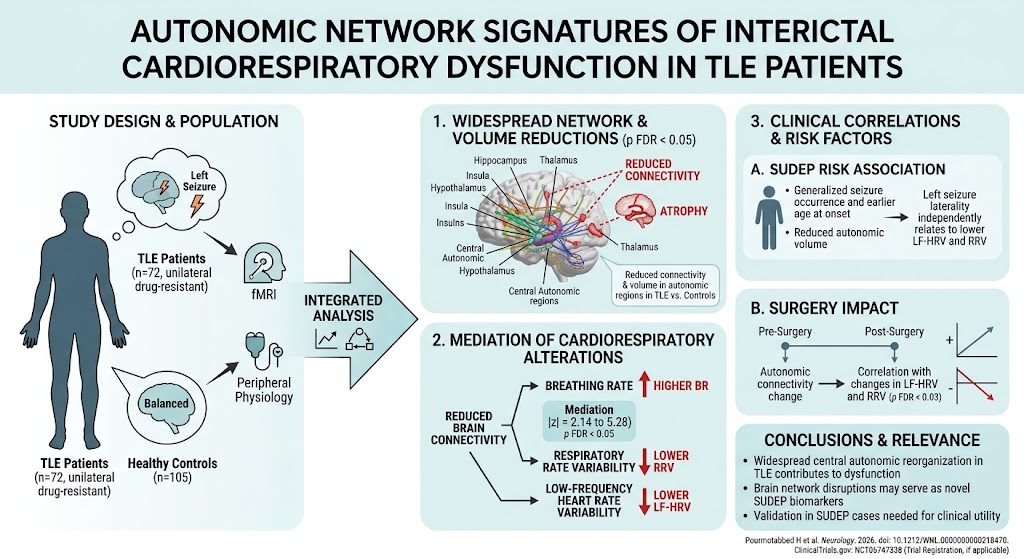
Highlight
- Temporal lobe epilepsy (TLE) patients display widespread reductions in central autonomic network connectivity and volume compared to healthy controls.
- Central autonomic network disruptions mediate interictal cardiorespiratory abnormalities, including increased breathing rate and decreased heart rate and respiratory rate variability.
- Left-sided seizure focus is strongly associated with impaired autonomic function, linked to higher SUDEP risk factors such as generalized seizures and early disease onset.
- Postsurgical changes in autonomic connectivity correlate with improvements or alterations in cardiorespiratory function, suggesting potential for targeted interventions.
Study Background
Temporal lobe epilepsy (TLE), a common form of drug-resistant epilepsy, is often complicated by impaired autonomic regulation and respiratory dysfunction during interictal periods — times between seizures. These dysfunctions have been implicated as risk factors for sudden unexpected death in epilepsy (SUDEP), a devastating and poorly understood complication. Although seizure activity is known to induce reorganization within central autonomic circuits extending beyond the temporal lobe, the specific neural network alterations underlying chronic, interictal cardiorespiratory dysfunction remain unclear. This knowledge gap limits the development of predictive biomarkers and targeted therapies to mitigate SUDEP risk.
Study Design
This investigation enrolled 72 patients diagnosed with drug-resistant unilateral TLE (49% female, mean age 40.0 ± 12.8 years) alongside 105 age- and sex-matched healthy controls (53% female, mean age 36.7 ± 12.8 years). The researchers performed simultaneous functional magnetic resonance imaging (fMRI) and peripheral physiologic monitoring focusing on autonomic markers: high-frequency heart rate variability (HF-HRV), low-frequency heart rate variability (LF-HRV), breathing rate (BR), and respiratory rate variability (RRV).
Using mediation and correlation analyses, the team examined how functional connectivity strength and structural volume within central autonomic network regions related to cardiorespiratory abnormalities in TLE. They further explored relationships with clinical variables and established SUDEP risk factors. A subgroup of 34 patients underwent postsurgical evaluation to assess whether surgical modification of autonomic connectivity influenced cardiorespiratory outcomes.
Key Findings
Widespread reductions in autonomic connectivity and volume in TLE
Compared to controls, TLE patients exhibited significant decreases in both functional connectivity and structural volume across multiple central autonomic network regions (pFDR < 0.05). This widespread disruption supports the concept of seizure-induced network reorganization extending beyond the epileptogenic temporal lobe.
Autonomic network disruptions mediate interictal cardiorespiratory dysfunction
Functional connectivity reductions mediated characteristic TLE interictal autonomic abnormalities: elevated breathing rate, reduced respiratory rate variability, and lower LF-HRV (|z| = 2.14 to 5.28, pFDR < 0.05). These findings implicate central autonomic network dysfunction as a mechanistic contributor to chronic cardiorespiratory impairment between seizures.
Left-sided seizure focus linked to autonomic impairment and SUDEP risk
Independent of other factors, left seizure laterality was associated with more pronounced reductions in LF-HRV and RRV (Cohen’s f = 0.42, 0.45; pFDR = 0.0055, 0.0046). Canonical correlation analysis revealed that atrophy within autonomic regions correlated with generalized seizure occurrence and earlier age at epilepsy onset (r = 0.61, pFWER = 0.018), both known risk factors for SUDEP.
Postsurgical autonomic network changes correlate with cardiorespiratory outcomes
In the postsurgical subgroup, alterations in autonomic connectivity following surgery positively correlated with changes in LF-HRV and RRV (Spearman’s ρ = 0.52, 0.41; pFDR = 0.0076, 0.029), suggesting surgical modulation of brain networks can influence autonomic control mechanisms.
Expert Commentary
This study provides compelling evidence linking central autonomic network reorganization with interictal cardiorespiratory dysfunction in TLE, illuminating important pathophysiological substrates contributing to SUDEP risk. The finding that left seizure laterality exacerbates autonomic impairment resonates with prior work implicating hemispheric differences in autonomic control.
Nevertheless, limitations include the observational design that precludes causal inference, and the need for longitudinal validation in SUDEP cohorts to confirm predictive utility. Future research should explore whether therapeutic interventions aimed at restoring autonomic connectivity can reduce cardiorespiratory abnormalities and ultimately lower SUDEP risk.
Conclusion
This study advances understanding of how temporal lobe epilepsy disrupts central autonomic networks, resulting in chronic interictal impairments in heart rate and respiratory regulation associated with SUDEP risk factors. Mapping these network signatures offers a promising translational avenue for developing biomarkers and novel interventions to improve autonomic function and clinical outcomes in drug-resistant TLE.
Funding and ClinicalTrials.gov
Details regarding funding sources and trial registration were not provided in the original publication.
References
1. Pourmotabbed H, Doss DJ, Sainburg LE, et al. Autonomic Network Signatures of Interictal Cardiorespiratory Dysfunction in Patients With Temporal Lobe Epilepsy. Neurology. 2026 Sep 3;107(6):e218470. doi: 10.1212/WNL.0000000000001500.
2. Devinsky O, Hesdorffer DC, Thurman DJ, Lhatoo S, Richerson G. Sudden unexpected death in epilepsy: epidemiology, mechanisms, and prevention. Lancet Neurol. 2016 Sep;15(10):1075-88.
3. Macey PM, Macey KE, Kumar R, Harper RM. A method for removal of global effects from fMRI time series. Neuroimage. 2004 Jan;22(1):360-6.
4. Lhatoo SD, Sander JW, Shorvon SD. Sudden unexpected death in epilepsy: a review of incidence and risk factors. Epilepsia. 1997 Dec;38(12):1121-8.