Highlights
- Sustained intraocular VEGF-A suppression by continuous ranibizumab delivery via the Port Delivery System (PDS) effectively treats diabetic macular edema (DME) in the majority of patients.
- Resolution of retinal edema can be slow and prolonged, which may lead to a mistaken diagnosis of anti-VEGF treatment unresponsiveness.
- Quantitative imaging via optical coherence tomography reveals gradual intraretinal and subretinal fluid clearance, underscoring the importance of long-term follow-up.
- The term “unresponsive to anti-VEGF-A” in DME treatment should be reconsidered as “slowly responsive,” potentially impacting clinical management decisions.
Background
Diabetic macular edema (DME) is a leading cause of vision impairment in patients with diabetic retinopathy worldwide. Characterized by leakage and accumulation of fluid in the macula, DME impairs central vision and quality of life. Vascular endothelial growth factor A (VEGF-A) is a key mediator of vascular permeability and neovascularization in diabetic retinal disease. Anti-VEGF agents such as ranibizumab have revolutionized DME management, improving visual and anatomical outcomes. However, frequent intravitreal injections impose substantial treatment and visit burdens on patients and healthcare systems, resulting in suboptimal adherence and outcomes. The Port Delivery System with ranibizumab (PDS) is a surgically implanted, refillable drug delivery device designed to provide continuous, sustained intraocular release of ranibizumab. Recent trials have demonstrated noninferior visual outcomes compared to monthly intravitreal injections while potentially reducing visit frequency. Understanding the time course of DME resolution under sustained VEGF-A suppression with PDS is clinically important to optimize patient management and to clarify the phenomenon of treatment “nonresponsiveness.”Key Content
Chronological Development of Evidence
The Pagoda trial (NCT04108156) represents a milestone randomized, phase 3 study investigating the efficacy and safety of continuous ranibizumab delivery via PDS compared to monthly ranibizumab injections for DME. Rustam et al. (2026) conducted a retrospective analysis of this prospective clinical trial to assess the incidence of poor responsiveness by closely examining changes in central subfield thickness (CST) and best-corrected visual acuity (BCVA) over time. Earlier results from the Pagoda trial (Rustam et al., JAMA Ophthalmol 2025) confirmed the noninferiority of PDS Q24W (refill every 24 weeks) to monthly injections in visual outcomes through 64 weeks, highlighting durable efficacy with reduced treatment burden. The more recent analysis extended follow-up to beyond 100 weeks and incorporated detailed optical coherence tomography (OCT) analyses to evaluate the kinetics of fluid resolution.Evidence from the Pagoda Trial: Clinical and Imaging Outcomes
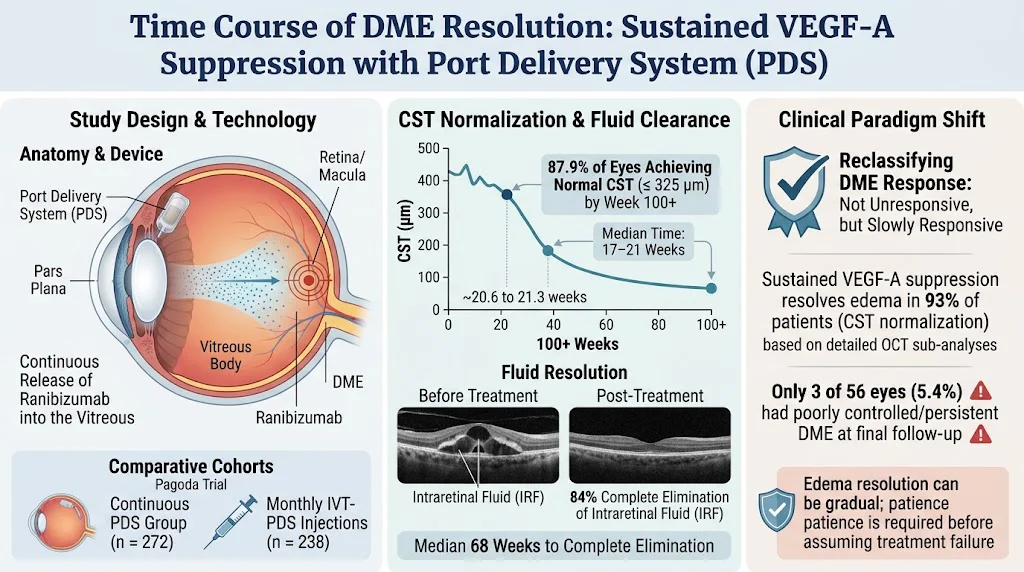
The adjusted intent-to-treat (aITT) population in Pagoda included 272 subjects in the PDS arm and 238 in the intravitreal injection arm. Mean follow-up durations were 107.7 and 100.7 weeks, respectively. By study end, 87.9% of eyes in the PDS arm and 85.3% in the injection arm achieved normalization of CST (defined as ≤325 µm), with mean times to normalization of 21.3 and 20.6 weeks. Importantly, while all eyes experienced CST reduction, some showed fluctuations, and a few exhibited initial improvement followed by worsening at final follow-up. A subset of 56 PDS-treated patients underwent detailed OCT review, revealing that 93% achieved CST normalization at a median of 17 weeks. Elimination of intraretinal fluid within the central 1 mm was achieved in 84%, but only at a median of 68 weeks, indicating slower clearance kinetics for retinal edema resolution. Only 3 eyes remained poorly controlled, highlighting the rarity of true nonresponsiveness under sustained VEGF suppression.Comparative Safety and Efficacy with Monthly Intravitreal Ranibizumab
The PDS demonstrated a similar visual acuity gain (+9.6 letters at weeks 60/64) compared to monthly injections (+9.4 letters), confirming noninferior efficacy. Adverse events of special interest were more frequent in the PDS group (27.5%) than injections (8.9%) but no cases of endophthalmitis or retinal detachment were reported. This safety profile supports the clinical feasibility of sustained delivery via PDS.Broader Context: PDS in Diabetic Retinopathy Management
In addition to DME, the PDS has been evaluated for nonproliferative diabetic retinopathy (NPDR) without macular edema (Pavilion trial), showing significant improvement in retinopathy severity with continuous ranibizumab delivery (Rustam et al., JAMA Ophthalmol 2025). These findings reinforce the therapeutic potential of sustained VEGF blockade in diabetic retinal diseases beyond edema.Expert Commentary
The sustained VEGF-A suppression achieved by PDS represents a paradigm shift in DME treatment, alleviating the treatment burden while maintaining efficacy. The findings by Rustam et al. provide nuanced insight into edema resolution kinetics, revealing that some patients experience prolonged fluid persistence despite effective VEGF blockade. Clinically, this slow fluid clearance may be misinterpreted as treatment failure, potentially leading to premature therapy switching or invasive procedures. Importantly, the analysis suggests that true VEGF-nonresponsive DME is uncommon. This supports a shift in clinical terminology from “unresponsive” to “slowly responsive,” emphasizing the need for patience and adherence in management. Mechanistically, the protracted clearance of intraretinal fluid could reflect complex tissue remodeling, extracellular matrix changes, or residual inflammation beyond VEGF-mediated permeability. The continuous VEGF suppression by PDS may thus unmask these slower biological processes, requiring prolonged therapy durations. Limitations include retrospective OCT analyses in a subset of patients and the need for longer-term real-world data. Safety concerns unique to the PDS implantation, such as bleb-related complications, require vigilant monitoring.Conclusion
Sustained intraocular delivery of ranibizumab via the Port Delivery System effectively treats diabetic macular edema, achieving edema normalization in most patients over a protracted time course. The kinetics of fluid resolution can be slow, whereby initial fluid persistence does not necessarily indicate treatment failure. Recognizing this slow responsiveness is critical to avoid misclassification and to guide appropriate clinical decision-making. Future research should focus on elucidating the biological mechanisms underlying slow fluid clearance and optimizing patient selection and follow-up protocols to personalize DME management.References
- Rustam Z, Khanani AM, Mojumder O, Huddleston S, Scott M, Marcus DM, Kapoor KG, Whitaker S, Awh CC, Walden L, Clark WL, Saini AM, Graff J, Miranda MC, Lin A, Blotner S, Rabena M, Gune S, Campochiaro PA. Time Course of Resolution of Diabetic Macular Edema by Sustained Suppression of VEGF-A with the Port Delivery Platform with Ranibizumab. Am J Ophthalmol. 2026 Oct 27; PMID: 42946032. https://pubmed.ncbi.nlm.nih.gov/42946032/
- Rustam Z, Khanani AM, Mojumder O, Huddleston S, Scott M, Marcus DM, et al. Continuous Ranibizumab via Port Delivery System vs Monthly Ranibizumab for Treatment of Diabetic Macular Edema: The Pagoda Randomized Clinical Trial. JAMA Ophthalmol. 2025 Apr 1;143(4):326-335. PMID: 40048197. https://pubmed.ncbi.nlm.nih.gov/40048197/
- Rustam Z, Khanani AM, Mojumder O, et al. Port Delivery System With Ranibizumab vs Monitoring in Nonproliferative Diabetic Retinopathy Without Macular Edema: The Pavilion Randomized Clinical Trial. JAMA Ophthalmol. 2025 Apr 1;143(4):317-325. PMID: 40048178. https://pubmed.ncbi.nlm.nih.gov/40048178/
Specialty calculators
For clinical reference; use professional judgment.