Introduction
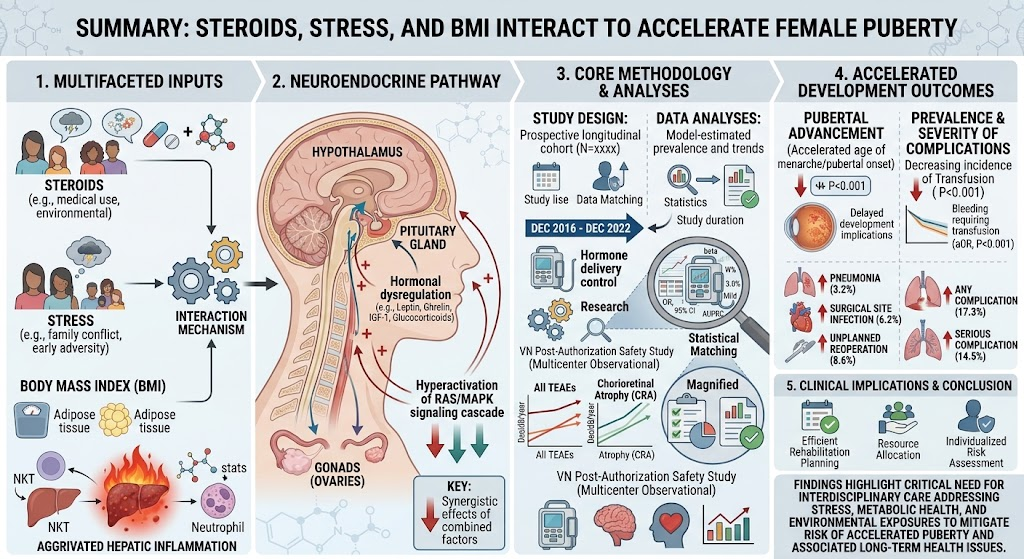
Pubertal development in girls is primarily driven by estrogens, hormones that trigger the physical transformations marking adolescence. However, recent research suggests the timing of puberty is influenced not solely by estrogens but also by a broader array of steroid metabolites, including glucocorticoids, androgens, and progesterone. These steroids may respond to external factors such as psychological stress and changes in body mass index (BMI), thereby altering the onset and progression of puberty.
Understanding how these factors interplay is critical given the observed secular trend toward earlier pubertal development globally. Early puberty can have implications on physical and mental health, including increased risks for metabolic syndrome, psychological distress, and certain cancers. This article discusses a longitudinal study investigating the relationship between steroid metabolome patterns, stress, BMI, and their combined effect on accelerating female puberty.
Study Design and Methods
The LEGACY Girls Study is a longitudinal cohort research project tracking girls from early childhood through adolescence to examine factors influencing pubertal timing. This analysis included 327 girls ages 5 to 13 years at baseline.
Researchers collected two urine samples from each participant: one before puberty onset and one during puberty. They measured 36 steroid metabolites across four classes: glucocorticoids (stress hormones), androgens (male sex hormones also present in females), progesterone (a reproductive hormone), and estrogens (female sex hormones).
Parents were asked to report the age at which their daughters began breast development, known medically as thelarche—a key milestone in puberty. Clinical assessments using Tanner staging were performed on a subset to validate parental reporting.
The study utilized height and weight measurements to calculate BMI and administered questionnaires assessing child stress, measured through the Internalizing Composite Scale—a standardized parental proxy.
Advanced statistical models (Weibull survival models) were applied to estimate hazard ratios (HRs), quantifying the effect of doubling steroid metabolite levels on the ages at different pubertal milestones: thelarche (breast development), pubarche (pubic hair growth), and menarche (first menstruation). The models also tested how stress and BMI modified these relationships.
Key Findings
The study found a strong association between accelerated breast development and higher prepubertal urinary metabolites of several steroids:
– Glucocorticoids: HR = 1.9 (95% CI: 1.5–2.5)
– Androgens: HR = 3.9 (95% CI: 2.7–5.6)
– Progesterone: HR = 6.7 (95% CI: 4.1–10.9)
These hazard ratios indicate that doubling the level of these metabolites nearly doubles to sextuples the likelihood of earlier thelarche.
Importantly, girls exhibiting high glucocorticoid metabolites combined with elevated BMI and high stress levels reached thelarche approximately 7 months earlier than girls with low levels in these parameters. This suggests a compounded effect where hormonal signals, body composition, and psychosocial stress converge to hasten pubertal onset.
Implications of the Findings
Traditional research on pubertal timing has focused on estrogens, age at menarche, and BMI as primary influencers. This study broadens the perspective by highlighting the significant role of androgens and stress-related glucocorticoids and progesterone metabolites in initiating earlier breast development.
These findings imply that the steroid metabolome pattern could serve as a biomarker for identifying girls at risk of early puberty, especially in contexts of increased stress and higher BMI. Early puberty is linked with greater risk for psychological issues such as anxiety and depression, as well as long-term medical conditions including type 2 diabetes and breast cancer. Therefore, understanding these interactions supports preventive strategies and timely interventions.
Biological Mechanisms
Steroid hormones regulate a wide array of physiological processes. Glucocorticoids, released during stress, can influence the hypothalamic-pituitary-gonadal (HPG) axis, which controls the onset of puberty.
High levels of glucocorticoids might alter the secretion patterns of gonadotropin-releasing hormone (GnRH), accelerating maturation. Androgens, traditionally considered male hormones, are also critical in female pubertal development, contributing to the growth of pubic hair and potentially stimulating breast tissue changes.
Progesterone, typically involved later in the menstrual cycle, may have an unexpected role in earlier pubertal changes when metabolite levels are elevated. The interactions among these hormones, compounded by increased adiposity (high BMI) and psychological stress, shape the neuroendocrine environment, fine-tuning the timing of puberty.
Clinical and Public Health Considerations
From a clinical standpoint, assessing steroid metabolites could become a tool in prognosticating pubertal timing, allowing for monitoring and support of girls at risk of precocious puberty.
Public health strategies need to consider environmental and psychosocial factors contributing to stress and obesity in children, as these are modifiable. Intervention programs promoting healthy weight and stress management in childhood could mitigate early pubertal onset and its associated risks.
Further research is needed to explore therapeutic approaches targeting hormonal pathways and to understand long-term outcomes of accelerated puberty influenced by these combined factors.
Conclusion
This study reveals that elevated urinary metabolites of glucocorticoids, androgens, and progesterone are strongly associated with earlier breast development in girls. It also demonstrates that higher BMI and stress amplify this relationship.
By expanding the focus beyond estrogens and menarche, these findings provide a more comprehensive understanding of the complex hormonal and environmental interactions that regulate female pubertal timing. This knowledge is essential for early identification and management of girls undergoing accelerated pubertal development, with potential long-term health benefits.
Reference
Houghton LC, Siegel E, Wei Y, Wudy SA, Hartmann MF, Stanczyk F, Knight JA, Andrulis IL, Bradbury AR, Schwartz L, Buys SS, Daly MB, John EM, Chung WK, Santella RM, Romeo RD, Terry MB. Steroids, stress, and body mass index interact to accelerate female pubertal development. J Clin Endocrinol Metab. 2026 Aug 13;111(9):2456-2465. doi: 10.1210/clinem/dgag086. PMID: 41955216; PMCID: PMC13466949.