Highlights
- Bepranemab, a tau mid-region targeted antibody, demonstrated an acceptable safety and tolerability profile in people with prodromal-to-mild Alzheimer’s disease (AD).
- The phase 2 randomized, double-blind, placebo-controlled trial did not meet its primary endpoint of slowing clinical decline measured by Clinical Dementia Rating Scale-Sum of Boxes (CDR-SB) over 80 weeks.
- Exploratory analyses suggested potential benefits on tau PET imaging and cognitive assessments, warranting further investigation stratified by baseline tau burden and APOE ɛ4 genotype.
- No treatment-related neuroinflammatory safety signals emerged, contrasting with concerns seen in some amyloid-targeting antibody therapies.
Background
Alzheimer’s disease (AD) is a progressive neurodegenerative disorder and the leading cause of dementia globally, characterized pathologically by extracellular amyloid-beta plaques and intraneuronal tau neurofibrillary tangles. Tau aggregation correlates closely with neurodegeneration and clinical decline, making tau a strategic target for disease-modifying therapies. Despite intensive efforts, tau-directed antibodies evaluated previously primarily targeted N-terminal tau epitopes and failed to demonstrate clinical efficacy or meaningful slowing of tau spread. Bepranemab, a novel monoclonal antibody targeting the mid-region of tau, has shown greater efficacy in preclinical cell models to block trans-neuronal tau propagation. This study investigates whether bepranemab could translate these mechanistic advantages into clinical benefit for individuals with prodromal-to-mild AD, a stage where intervention might be more effective.Key Content
Design and Methodology of Bepranemab Phase 2 Trial
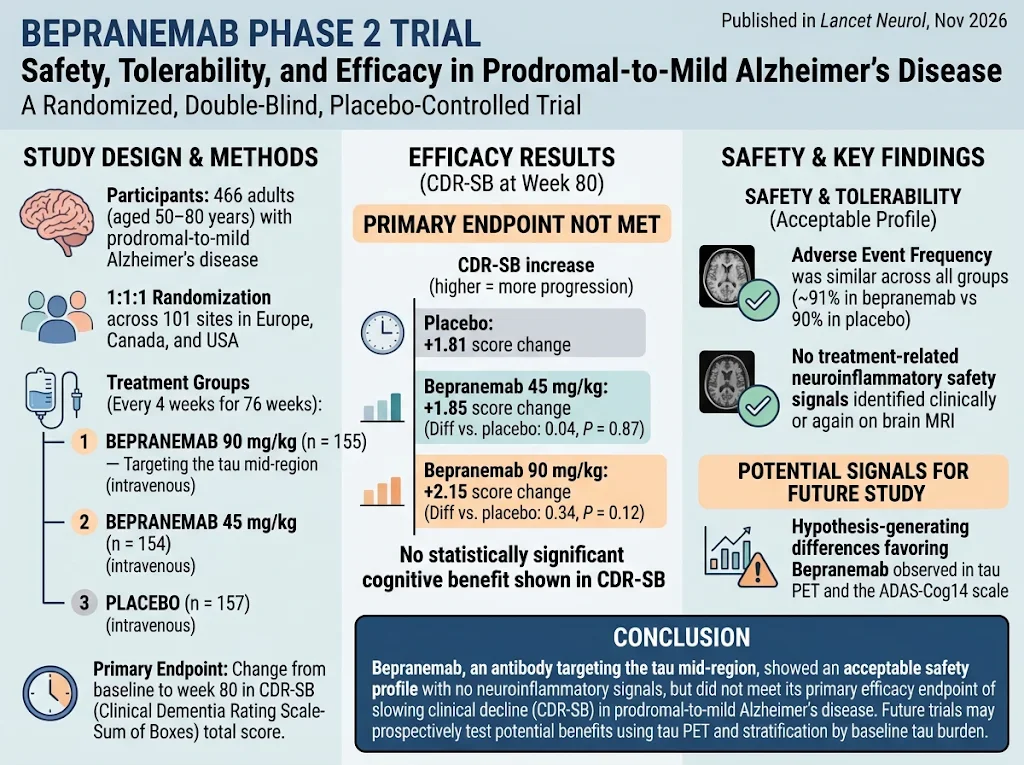
A randomized, double-blind, placebo-controlled, phase 2 trial was conducted at 101 outpatient sites across Europe, Canada, and the USA. Eligible participants aged 50-80 with prodromal-to-mild AD, stratified by diagnosis accuracy, APOE ɛ4 carrier status, and symptomatic treatment use, were randomized 1:1:1 to receive either bepranemab 45 mg/kg, 90 mg/kg, or placebo administered intravenously every 4 weeks over 76 weeks. The primary efficacy endpoint was change from baseline to week 80 in the Clinical Dementia Rating Scale-Sum of Boxes (CDR-SB), a validated and sensitive measure of dementia severity. The full analysis set included all randomized participants receiving at least one partial dose and one post-baseline assessment. Safety was assessed in all participants with at least partial drug exposure, including monitoring for neuroinflammatory events clinically and via brain MRI.Participants and Baseline Characteristics
A total of 466 participants were randomized; of these, 460 were included in efficacy analyses (bepranemab 45 mg/kg, n=152; 90 mg/kg, n=152; placebo, n=156). The median age was 72 years, with a slight female predominance (56%). The distribution of symptomatic treatment (e.g., cholinesterase inhibitors, memantine), diagnosis subtype, and APOE ɛ4 genotype was balanced across arms.Efficacy Outcomes
The mean increase in CDR-SB from baseline to week 80 was 2.15 in the bepranemab 90 mg/kg group, 1.85 in the 45 mg/kg group, and 1.81 in the placebo group. Differences versus placebo were not statistically significant (0.34; 95% CI -0.09 to 0.78; p=0.12 for 90 mg/kg; 0.04; p=0.87 for 45 mg/kg). Secondary cognitive and functional scales, including the 14-item Alzheimer’s Disease Assessment Scale-Cognitive Subscale (ADAS-Cog14), showed nonsignificant trends favoring bepranemab. Tau PET imaging, analyzed exploratorily, suggested potential attenuation of tau accumulation in treated groups but lacked adequate statistical power.Safety and Tolerability
Treatment-emergent adverse events occurred in 91% of participants on bepranemab and 90% on placebo, predominantly mild to moderate in severity. No clinical or radiological neuroinflammatory adverse events were reported, an important finding given concerns with other immunotherapies targeting amyloid or tau. Serious adverse events and deaths were fewer in the bepranemab groups relative to placebo and were not considered treatment-related.Context Within Tau-Targeted Therapies
Previous anti-tau antibodies such as gosuranemab and tilavonemab, mostly targeting the N-terminal tau, have failed to demonstrate clinical or biomarker efficacy. Bepranemab’s mid-region targeting epitope was hypothesized to better interrupt pathological tau spread, supported by preclinical models. The lack of statistically significant clinical benefit in this phase 2 trial reflects the complexity of translating tau-targeting strategies into therapeutic efficacy and emphasizes the need to consider patient selection, timing of intervention, and biomarker stratification.Expert Commentary
The trial’s failure to meet its primary clinical endpoint underscores challenges in AD clinical trial design and the multifactorial nature of disease progression. Notably, the acceptable safety profile of bepranemab is encouraging, especially its lack of neuroinflammation, contrasting with amyloid immunotherapy-associated amyloid-related imaging abnormalities (ARIA). The exploratory signals in tau PET and cognitive assessments, though inconclusive, provide a rationale for further study with adequately powered trials enriched for patients with high baseline tau burden and stratified by APOE ɛ4 genotype to detect subgroup benefits. Additionally, distinguishing the kinetics of tau propagation and clinical decline is essential; biomarker changes may precede measurable cognitive impact, suggesting longer or different clinical endpoints might be required. The selection of prodromal-to-mild stages targets a window with potentially modifiable tau pathology, but heterogeneity in tau deposition patterns and comorbid amyloid load could confound outcomes. The mechanistic rationale for mid-region tau targeting remains compelling based on in vitro data suggesting interference with tau seeding and spreading. Future translational research should focus on refining biomarker-based patient selection, perhaps combining tau PET with CSF or plasma tau biomarkers and neuroinflammation markers to optimize therapeutic windows.Conclusion
Bepranemab was well tolerated in individuals with prodromal-to-mild AD but did not demonstrate a significant clinical benefit in slowing dementia progression in this phase 2 trial. Exploratory biomarker and cognitive data generate hypotheses that merit prospective evaluation in stratified, larger-scale studies focused on tau pathology dynamics and genetic risk factors. This trial highlights the complexities of tau-targeted immunotherapy and provides a valuable framework for refining future AD therapeutic development.References
- Barton ME, Byrnes W, van den Steen B, et al. Safety, tolerability, and efficacy of bepranemab in people living with prodromal-to-mild Alzheimer’s disease: a randomised, double-blind, placebo-controlled, phase 2 trial. Lancet Neurol. 2026;XX(X):XXX-XXX. PMID:43008775.
- Congdon EE, Sigurdsson EM. Tau-targeting therapies for Alzheimer disease. Nat Rev Neurol. 2018;14(7):399-415. doi:10.1038/s41582-018-0028-1.
- Harrison TM, Raichle ME, et al. Longitudinal tau PET across aging and Alzheimer’s disease. Neuroimage. 2020;208:116446. doi:10.1016/j.neuroimage.2019.116446.
- Vandermeeren M, Vanmechelen E, et al. Tau as a therapeutic target for Alzheimer’s disease: progress and challenges. Curr Opin Pharmacol. 2022;62:44-52.
Specialty calculators
For clinical reference; use professional judgment.