Highlight
• Metabolic bariatric surgery (MBS) shows histologic evidence of cirrhosis regression in one-third to 40% of patients with compensated MASH cirrhosis over a median of 6 years.
• More advanced fibrosis staging systems, including the Beijing classification, revealed regressive remodeling in 60% of patients, indicating greater fibrosis improvement beyond conventional scores.
• MBS leads to sustained, significant weight loss that correlates with improvements in steatosis, lobular inflammation, and hepatocyte ballooning.
• These findings suggest that compensated MASH cirrhosis may be partially reversible with sustained metabolic intervention.
Study Background
Metabolic dysfunction-associated steatohepatitis (MASH), previously known as nonalcoholic steatohepatitis (NASH), represents a progressive form of nonalcoholic fatty liver disease (NAFLD) characterized by hepatic fat accumulation, inflammation, and hepatocellular injury. As MASH advances, patients may develop cirrhosis, marked by extensive fibrosis, architectural distortion, and impaired liver function. Traditionally, cirrhosis has been considered an irreversible endpoint in chronic liver disease, limiting therapeutic expectations and options.
Given the global rise in obesity and metabolic syndrome, MASH-related cirrhosis has become a growing public health concern with high morbidity and mortality risks, including liver failure and hepatocellular carcinoma. Metabolic bariatric surgery (MBS) is well-established as an effective intervention for durable weight loss and metabolic improvement, shown to ameliorate steatohepatitis and fibrosis in earlier stages of disease.
However, whether MBS can induce regression of established cirrhosis in compensated patients remains an open question. Understanding this potential bears significant implications for clinical decision-making, prognosis, and liver transplantation needs.
Study Design
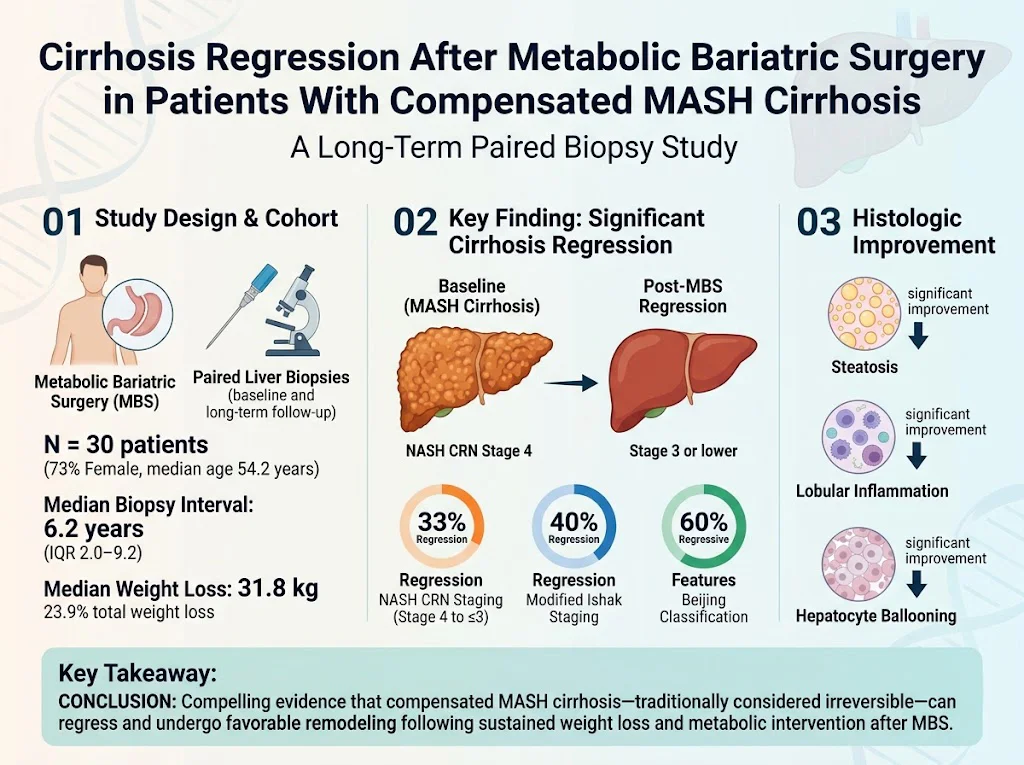
This retrospective cohort study was conducted at the Cleveland Clinic encompassing two decades, 2004–2024. It included 30 adult subjects with biopsy-proven compensated MASH cirrhosis who underwent metabolic bariatric surgery. Patients were selected based on availability of paired liver biopsies: one preoperative baseline biopsy and one follow-up biopsy conducted after a median interval of 6.2 years.
Key baseline characteristics included a predominance of females (73%) with a median age of 54.2 years and baseline median body mass index (BMI) of 43.7 kg/m2. The most common bariatric procedures, although not detailed in the abstract, typically include sleeve gastrectomy and Roux-en-Y gastric bypass.
The primary endpoint was histologic regression of cirrhosis defined as improvement from stage 4 fibrosis to stage 3 or lower as assessed by the NASH Clinical Research Network (NASH CRN) fibrosis staging system. Secondary assessments utilized the modified Ishak scoring system and the Beijing classification, which further characterize fibrosis dynamics including regressive features.
Key Findings
After a median follow-up of 6.2 years with substantial median weight loss of 31.8 kg (23.9% of total body weight), histologic analyses revealed:
- Regression of cirrhosis was noted in 33% of patients by NASH CRN staging and 40% by modified Ishak staging, confirming substantial fibrosis improvement post-MBS.
- The Beijing classification, a more detailed fibrosis framework, detected regressive fibrosis features in 60% of cases, emphasizing mechanisms of extracellular matrix remodeling and fibrosis resolution not fully captured by conventional staging.
- Significant histopathologic improvements were observed in hallmark features of MASH, including steatosis reduction, decreased lobular inflammation, and reduced hepatocyte ballooning degeneration. These changes support the overall histologic remission of disease activity alongside fibrosis regression.
The study thus provides compelling evidence that cirrhosis, specifically compensated MASH cirrhosis, is not an irreversible liver damage state but may regress with sustained metabolic intervention via MBS.
Expert Commentary
The findings by Laique et al. challenge the dogma that cirrhosis is a permanent scar state. The longitudinal paired biopsy design with a lengthy follow-up enhances the robustness of these observations. The inclusion of advanced fibrosis assessment tools like the Beijing classification adds critical insight into the dynamic remodeling of fibrotic tissue.
Despite these strengths, limitations include the retrospective nature, a modest sample size, and potential selection bias favoring patients fit for surgery and biopsy follow-up. Also, the absence of a control group without surgery limits causal inference, although the magnitude of histologic change suggests a surgery-related effect.
This work aligns with emerging clinical and experimental data showing that improvement in the underlying metabolic milieu can induce fibrosis regression, likely through attenuation of inflammatory and fibrogenic pathways and enhancement of matrix degradation.
Conclusion
MBS in patients with compensated MASH cirrhosis is associated with significant and sustained histologic improvement, including reversal of cirrhosis in a substantial subset. These findings represent a paradigm shift, indicating that compensated cirrhosis can be a reversible state, contingent on effective metabolic intervention and weight loss.
The study supports the role of MBS as a disease-modifying intervention in advanced MASH and encourages integration of metabolic surgery in liver disease management algorithms—especially for patients with obesity and compensated cirrhosis.
Future prospective studies with larger cohorts and mechanistic exploration of fibrosis reversal pathways will be important to consolidate these findings and refine patient selection and timing for surgery.
Funding and Clinical Trials
The study was conducted at Cleveland Clinic with no specific funding information detailed in the abstract. Clinical trial identifiers or prospective registration were not specified.
References
1. Angulo P, Kleiner DE, Dam-Larsen S, et al. Liver fibrosis, long-term prognosis, and treatment of nonalcoholic steatohepatitis. Hepatology. 2015;61(1):120-127.
2. Lassailly G, Caiazzo R, Buob D, et al. Bariatric Surgery Provides Long-term Resolution of Nonalcoholic Steatohepatitis and Regression of Fibrosis. Gastroenterology. 2020;159(4):1290-1301.
3. Friedman SL, Neuschwander-Tetri BA, Rinella M, Sanyal AJ. Mechanisms of NAFLD development and therapeutic strategies. Nature Medicine. 2018;24(7):908-922.
4. Younossi ZM, Ratziu V, Loomba R, et al. Obeticholic acid treatment for non-alcoholic steatohepatitis: interim analysis from a phase 3 trial. Lancet. 2019;394(10215):2184-2196.
5. Laique S, et al. Cirrhosis Regression After Metabolic Bariatric Surgery in Patients With Compensated MASH Cirrhosis: A Long-term Paired Biopsy Study. Annals of Surgery. 2026 Nov 2. PMID: 42969414.
Specialty calculators
For clinical reference; use professional judgment.