Highlight
The deep medial collateral ligament (dMCL) displays a robust load-to-failure capacity, surpassing prior estimates when considering its full anteromedial extent. Failure predominantly occurs in the meniscotibial portion rather than at osseous attachments, providing critical insights for reconstructive surgery of the medial knee, especially in the context of anteromedial rotatory instability.
Study Background
The medial collateral ligament (MCL) complex is pivotal in maintaining knee joint stability, particularly against valgus stress and rotational forces. Traditionally, the deep medial collateral ligament (dMCL) has been described as a capsular thickening beneath the superficial MCL with a limited anatomical footprint. However, emerging evidence suggests the dMCL has a broader anteromedial pathway that plays an essential role in knee stability, particularly resisting anteromedial rotatory instability. Despite its clinical relevance, detailed biomechanical characterization—including failure thresholds and stiffness—remains incomplete. Understanding these properties is vital for improving surgical reconstruction techniques and graft fixation strategies in medial knee injury management.
Study Design
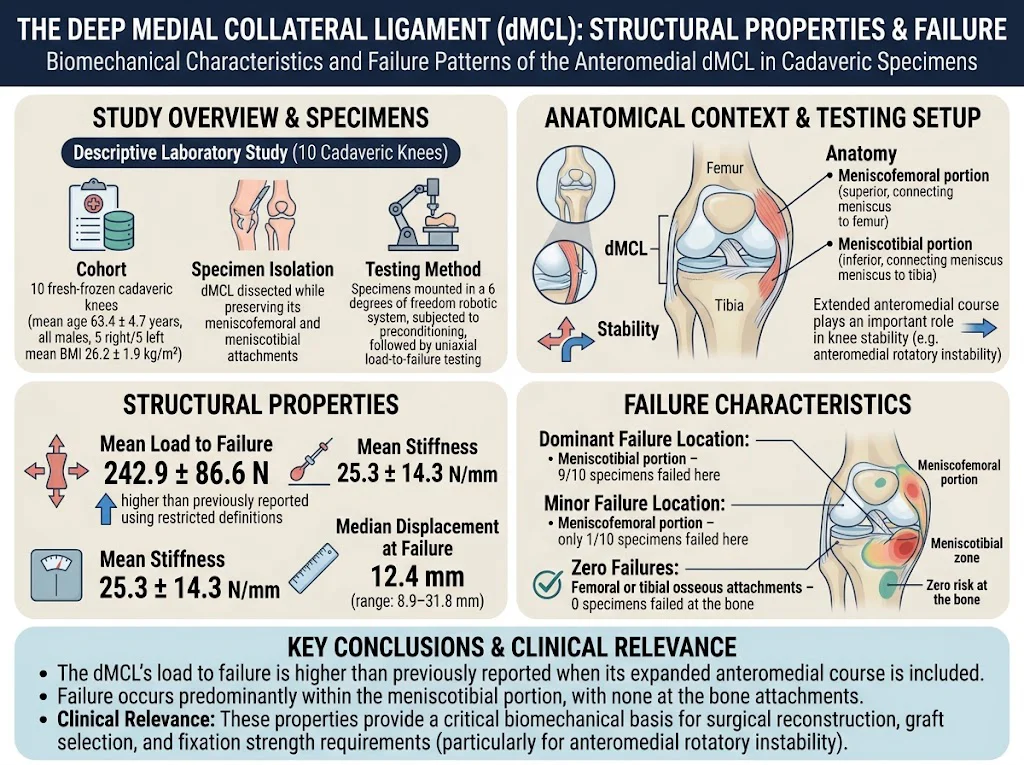
This descriptive laboratory study dissected ten fresh-frozen cadaveric knees to isolate the dMCL while preserving its anatomical meniscofemoral and meniscotibial attachments. The specimens (all male donors, mean age 63.4 years) were subjected to uniaxial load-to-failure testing using a six degrees of freedom robotic system, enabling precise measurement of load, displacement, stiffness, and failure location. Preserving native anatomy was critical to reflect physiological properties. The primary endpoints included peak load to failure, ligament stiffness, displacement at failure, and the anatomical site of failure.
Key Findings
The study reported a mean load to failure of 242.9 ± 86.6 Newtons for the expanded dMCL, significantly higher than earlier reports that used narrower anatomic definitions. The stiffness averaged 25.3 ± 14.3 N/mm, and displacement at failure had a median of 12.4 mm, varying from 8.9 to 31.8 mm among specimens. Notably, nine out of ten specimens failed within the meniscotibial portion of the ligament, with just one failure in the meniscofemoral segment. No failures were observed at the femoral or tibial bone attachment sites, indicating that the ligament substance, particularly the meniscotibial fiber bundle, is most susceptible to injury under load. These findings highlight a distinct biomechanical vulnerability pattern essential for guiding surgical reconstruction approaches.
Expert Commentary
These data refine our understanding of the dMCL’s biomechanical role, emphasizing its structural resilience and complex failure behavior, which diverges from prior assumptions that focused primarily on attachment site failures. The predominance of meniscotibial failure suggests that reconstructive efforts should prioritize restoring this fiber bundle’s functionality and fortify graft fixation in this region to improve outcomes. However, this study’s sample size and demographic limitation to an older male cohort may limit generalizability; further biomechanical studies including diverse populations and dynamic loading conditions could offer complementary insights. Additionally, the isolated ligament testing does not fully replicate in vivo joint kinematics and musculotendinous influences, which should be accounted for in surgical planning.
Conclusion
The expanded anatomical delineation of the deep medial collateral ligament reveals superior load-bearing properties and a characteristic failure pattern predominantly involving the meniscotibial fibers. This enhanced biomechanical knowledge supports the development of tailored surgical reconstruction and fixation strategies aimed at restoring anteromedial knee stability, especially in cases of anteromedial rotatory instability. Incorporation of these findings into clinical practice may optimize graft selection, tensioning, and fixation techniques, potentially improving surgical outcomes. Future research is warranted to corroborate these findings in vivo and to explore biomechanical interactions within the entire medial knee complex under physiological conditions.
Funding and Clinical Trials
The study was supported by institutional grants; no clinical trials were reported.
References
- Super JT, Murray IR, Wilebski BJ, Carlson MR, Retzer NK, Tollefson LV, Gaye CE, LaPrade CM, LaPrade RF. The Deep Medial Collateral Ligament: Part 2, Structural Properties and Failure Characteristics. Am J Sports Med. 2026 Nov 3. PMID: 42975047.
- LaPrade RF, et al. Anteromedial rotatory instability of the knee: origin and treatment. Clin Sports Med. 2005;24(1):59-71.
- DePhillipo NN, Moatshe G, Brady AW, LaPrade CM, LaPrade RF. Medial Knee Injuries: Anteromedial Corner and Posteromedial Corner. Arthroscopy. 2019;35(2):671–687.
Specialty calculators
For clinical reference; use professional judgment.