Highlight
- Orthopedic special tests alone have limited sensitivity and specificity for diagnosing Long Head of the Biceps Tendon (LHBT) pathologies.
- Qualitative high-resolution ultrasound (HRUS) demonstrates promising diagnostic accuracy, especially for full-thickness tears and tendon dislocation/subluxation.
- Combining qualitative HRUS with clinical orthopedic tests and patient age further enhances sensitivity and specificity.
- Quantitative HRUS diagnostic performance depends on cut-off values; the surface area measurement (>21 mm²) showed the best results.
Study Background
The long head of the biceps tendon (LHBT) is a common source of anterior shoulder pain and dysfunction. Pathologies such as tendinopathy, partial or full-thickness tears, and dislocation or subluxation frequently contribute to shoulder complaints that challenge clinicians due to overlapping clinical presentations and variability of diagnostic accuracy from physical examinations and imaging modalities.
Accurate preoperative diagnosis is essential for guiding appropriate surgical or conservative management, optimizing outcomes, and preventing unnecessary interventions. While various orthopaedic clinical tests (e.g., Speed’s, O’Brien’s, Uppercut, and Yergason’s tests) are routinely employed, their diagnostic reliability is debated.
Moreover, high-resolution ultrasound (HRUS) offers a non-invasive, accessible, and cost-effective imaging tool to assess LHBT morphology and pathology. However, prior studies have reported inconsistent findings regarding its qualitative and quantitative utility. This study aimed to prospectively validate the diagnostic characteristics of clinical tests alongside qualitative and quantitative HRUS, using surgical assessment as the gold standard.
Study Design
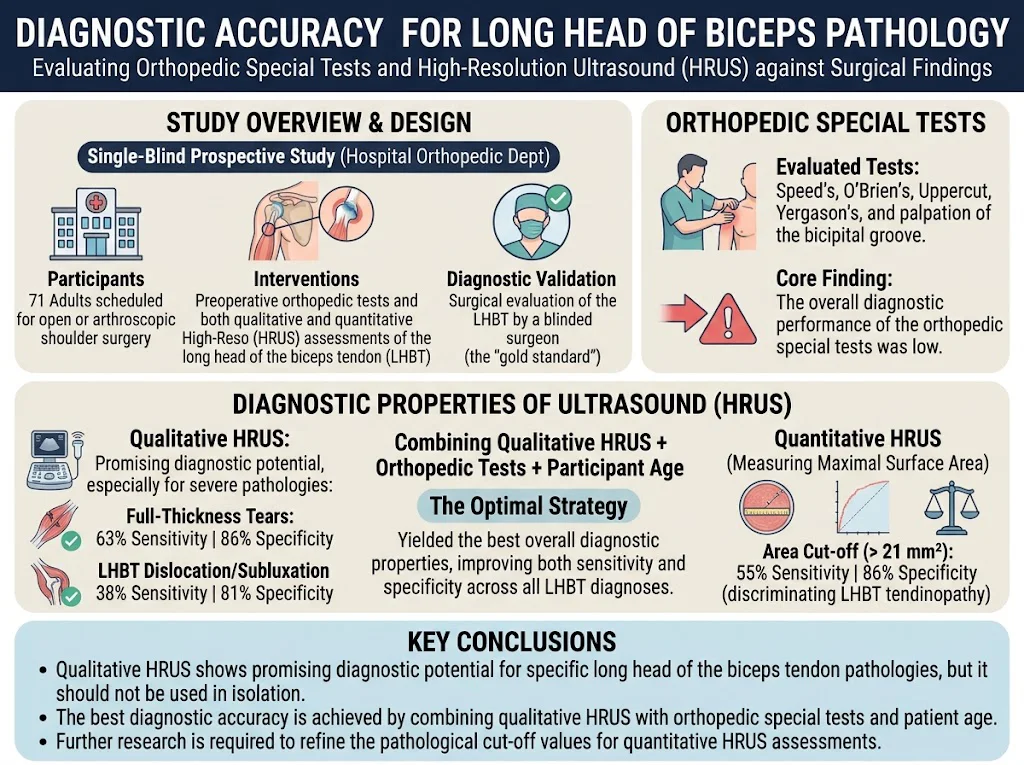
This single-blind, prospective study enrolled 71 adults scheduled for open or arthroscopic shoulder surgery within six weeks. Participants underwent a standardized preoperative examination comprising four orthopedic special tests (Speed’s, O’Brien’s, Uppercut, Yergason’s), palpation of the bicipital groove, and a comprehensive ultrasound assessment.
The ultrasound evaluation entailed both qualitative analysis (subjective assessment for tears, dislocation, or subluxation) and quantitative measurement (surface area of the tendon). Surgeons performing the operations were blinded to the clinical and ultrasound findings, providing an unbiased intraoperative diagnosis as the reference standard.
Primary outcomes included sensitivity, specificity, and diagnostic accuracy of individual orthopedic tests, combinations of tests, qualitative HRUS, combined clinical and qualitative HRUS assessments, and quantitative HRUS using receiver operating characteristic (ROC) curve analysis to determine optimal cut-off values.
Key Findings
Diagnostic Performance of Orthopedic Tests:
The sensitivity and specificity of individual orthopedic tests were generally low for detecting LHBT pathologies, limiting their standalone diagnostic utility. For example, none of the special tests exceeded sufficient thresholds to reliably confirm or exclude tendon lesions.
Qualitative HRUS Accuracy:
Qualitative HRUS showed promising results, particularly for full-thickness tears (sensitivity 63%, specificity 86%) and LHBT dislocation or subluxation (sensitivity 38%, specificity 81%). While the sensitivity for detecting dislocation/subluxation was modest, the specificity remained high, indicating HRUS effectively ruled out these conditions when negative.
Combined Clinical and Ultrasound Assessment:
Integration of qualitative HRUS data with orthopedic test results and participant age improved diagnostic accuracy notably across all LHBT pathologies. This multimodal approach enhanced both sensitivity and specificity compared to individual modalities.
Quantitative HRUS and Cut-Off Analysis:
Quantitative evaluation, specifically measuring the maximal surface area of the tendon, yielded variable diagnostic results depending on cut-offs. The optimal threshold identified was >21 mm², which produced a sensitivity of 55% and specificity of 86%. Lower cut-offs compromised specificity, while higher cut-offs reduced sensitivity.
Clinical Implications:
The study underscores limitations inherent in relying solely on clinical special tests for LHBT pathology diagnosis. HRUS offers superior specificity and moderate sensitivity and adds value when combined with clinical findings and demographic data. Quantitative HRUS shows potential but requires further validation to establish standardized pathological thresholds.
Safety Considerations:
As an observational diagnostic accuracy study, no adverse events were associated with the diagnostic procedures documented.
Expert Commentary
The findings reflect ongoing challenges in shoulder diagnostics, where overlapping symptomatology and variable test performance complicate decision-making. The moderate sensitivity yet high specificity of qualitative HRUS aligns with its role as a confirmatory rather than screening test.
Current orthopedic guidelines recognize ultrasound as a useful adjunct in evaluating biceps tendon disorders but vary on its standalone role. This study reinforces a nuanced approach, integrating physical examination, imaging, and patient factors for comprehensive assessment.
The researchers correctly highlight the need for larger multicenter trials to validate quantitative HRUS parameters and to harmonize measurement techniques. Quantitative HRUS holds promise for objective, reproducible markers of tendon pathology if standardized cut-offs can be agreed upon.
Limitations include the single-center design and relatively small sample size, which may impact generalizability. Additionally, some orthopedic tests might have operator-dependent variability, potentially contributing to lower accuracy.
Conclusion
In summary, this prospective study demonstrates that orthopedic special tests alone insufficiently diagnose LHBT pathologies. Qualitative HRUS provides improved diagnostic specificity and moderate sensitivity, particularly for full-thickness tears and tendon dislocations, and significantly enhances accuracy when combined with orthopedic tests and patient age.
Quantitative HRUS shows potential, especially with tendon surface area metrics above 21 mm², but further research is warranted to validate cut-off values and optimize diagnostic protocols.
Ultimately, integrating clinical examination with advanced ultrasound assessment offers a more reliable diagnostic strategy to guide treatment decisions in patients with suspected LHBT disorders. Continued research is necessary to refine ultrasound criteria and confirm their clinical utility across diverse populations.
Funding and ClinicalTrials.gov
The original publication did not specify funding sources or clinical trial registration information.
References
- Green B, Roy V, Boulila C, et al. Evaluation of Clinical and Ultrasound-Based Diagnosis of the Long Head of the Biceps Pathologies-A Prospective Study. Arch Phys Med Rehabil. 2026;107(11):3097-3107. doi:10.1016/j.apmr.2026.05.021
- Darrieutort-Laffite C, et al. Ultrasound characteristics and clinical utility of the long head of the biceps tendon diagnosis. J Shoulder Elbow Surg. 2019;28(9):1829-1838.
- Martin-Hervás C, et al. Diagnostic accuracy of clinical tests for biceps tendinopathy. Phys Ther Sport. 2020;45:45-52.
Specialty calculators
For clinical reference; use professional judgment.