Highlights
A large multi-platform study of sporadic Hirschsprung disease (HSCR) identified a predominant molecular subgroup, affecting 79.6% of patients, characterized by coordinated repression of neurogenesis-related transcriptional programs.
PRDM9 emerged as a mechanistic candidate: it was downregulated in aganglionic colon, showed promoter hypermethylation, and its perturbation in zebrafish, mice, and human induced pluripotent stem cell-derived enteric neural crest cells (ENCCs) impaired enteric neuronal differentiation and gut motility.
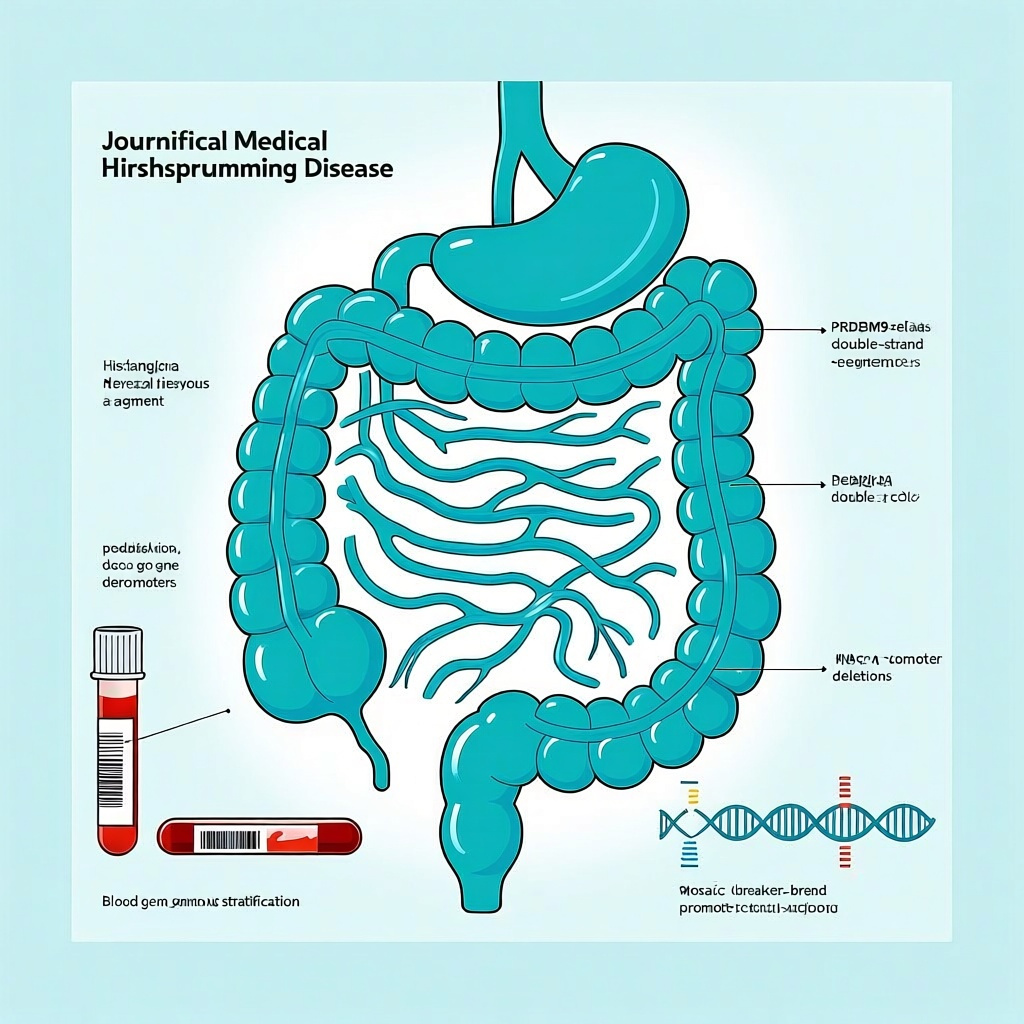
Loss of PRDM9 redirected DNA double-strand breaks toward promoters and enhancers, producing mosaic promoter deletions (MPDs) at neurogenesis loci and linking genomic damage to transcriptional repression.
A blood-derived MPD score discriminated HSCR from controls in both discovery and validation cohorts, and performance improved further when combined with a polygenic risk score (PRS), supporting noninvasive molecular stratification.
Background and Clinical Context
Hirschsprung disease is a congenital enteric neuropathy defined by absence of enteric ganglion cells in the distal bowel, resulting in functional obstruction, severe constipation, abdominal distension, delayed passage of meconium, and risk of Hirschsprung-associated enterocolitis. Although surgical pull-through is standard care, morbidity remains substantial, and long-term bowel dysfunction is common. The disease is classically understood as a developmental disorder of enteric neural crest cell migration, proliferation, survival, and differentiation.
From a genetic perspective, HSCR is heterogeneous. Pathogenic variants in genes such as RET, EDNRB, EDN3, SOX10, PHOX2B, and others explain many familial or syndromic cases, but a large proportion of sporadic disease remains unexplained by conventional germline testing. This gap has driven interest in non-canonical mechanisms, including epigenetic dysregulation, somatic or mosaic genomic events, and polygenic susceptibility.
The study by Zhu and colleagues addresses two clinically important questions. First, is there a mechanistically coherent molecular subgroup within sporadic HSCR that is not captured by standard germline models? Second, can such biology be translated into a blood-accessible biomarker that improves molecular classification without requiring bowel tissue?
Study Design and Methods
This was an integrative translational genomics study centered on human tissue profiling, orthogonal validation in animal models, mechanistic interrogation in stem cell-derived cellular systems, and biomarker development in blood-based whole-genome sequencing datasets.
Human cohorts and transcriptomic profiling
The investigators performed RNA sequencing on paired aganglionic and ganglionic colon specimens from 103 patients with sporadic HSCR and compared them with control colons from 22 individuals. This paired design is important because it reduces between-patient variability and allows disease-segment-specific inference.
Genomic profiling
Blood whole-genome sequencing was available for 41 of the RNA-seq-profiled patients. Colon whole-genome sequencing was performed in 30 HSCR cases, with matched blood available in 27. For blood biomarker analyses, the authors assembled a discovery cohort of 89 HSCR cases and 43 controls and an independent validation cohort of 165 HSCR cases and 42 controls.
Functional and mechanistic studies
PRDM9 expression was evaluated in human tissues, including assessment of promoter methylation. The investigators perturbed prdm9 in zebrafish and mice to test effects on enteric neuron development and gut motility. To define mechanism, they generated PRDM9-knockout human induced pluripotent stem cell-derived ENCCs and examined DNA break distribution, promoter deletion formation, transcriptional effects, and neuronal differentiation capacity.
Biomarker development
Mosaic promoter deletions were called from whole-genome sequencing data. These were summarized into a blood MPD score and tested for discrimination of HSCR versus control status, both alone and in combination with a polygenic risk score. The principal performance metric reported was area under the receiver operating characteristic curve (AUROC).
Key Results
A major sporadic HSCR subgroup shows repression of neurogenesis programs
The central transcriptomic observation was that 82 of 103 sporadic HSCR cases, or 79.6%, formed a predominant subgroup marked by coordinated repression of neurogenesis-related pathways. This is clinically and biologically relevant because it suggests that a large fraction of so-called sporadic HSCR may share a common pathogenic program rather than representing purely idiosyncratic disease.
Rather than identifying isolated gene-level changes, the study points to a systems-level failure of enteric neuronal developmental programs. This is potentially more informative than single-gene association because developmental disorders often arise from perturbation of regulatory networks rather than sole disruption of one structural gene.
Promoter motif analysis implicates PRDM9
Promoter motif enrichment analysis highlighted PRDM9 as a candidate upstream regulator. PRDM9 is best known for its role in specifying meiotic recombination hotspots, so its implication in enteric nervous system biology is unconventional and immediately notable. The investigators localized PRDM9 to the normal enteric nervous system, supporting biological plausibility. In contrast, PRDM9 was downregulated in aganglionic tissue, and this reduction was associated with promoter hypermethylation, suggesting epigenetic silencing as one mechanism for deficient expression.
This aspect of the study is conceptually important. It does not merely correlate PRDM9 with disease; it proposes an upstream regulatory defect that can plausibly reorganize where DNA damage occurs and thereby alter gene expression in neural crest-derived cells.
Animal models support a developmental role for PRDM9 in enteric neurogenesis
Functional perturbation of prdm9 in zebrafish and mice reduced HuC/D-positive differentiated enteric neurons and impaired motility phenotypes. These data extend the human transcriptomic findings into whole-organism developmental systems. The use of both zebrafish and mouse models strengthens confidence that the observed effect is not model-specific.
For clinicians, the translational meaning is that PRDM9 deficiency appears to affect not only molecular signatures but also enteric neuronal output and bowel function, two hallmarks directly relevant to HSCR pathophysiology.
PRDM9 loss redirects DNA breaks to promoters and enhancers
The most mechanistically novel finding came from PRDM9-knockout hiPSC-derived ENCCs. Loss of PRDM9 redistributed DNA double-strand breaks toward promoters and enhancers. In other words, when PRDM9 was absent, genomic injury no longer occurred in its expected landscape and instead accumulated at regulatory elements crucial for gene expression control.
This observation offers a direct bridge between altered chromatin biology and developmental failure. Regulatory regions are particularly sensitive because small deletions there can suppress transcription without disrupting coding sequence. That kind of lesion would be missed by standard exome-focused thinking.
Mosaic promoter deletions arise at neurogenesis loci and associate with transcriptional repression
PRDM9 deficiency generated mosaic promoter deletions at neurogenesis-associated loci. These MPDs correlated with downregulation of the affected genes and impaired neuronal differentiation. The emphasis on mosaicism is important: these are not necessarily constitutional, fully penetrant germline deletions, but subclonal or tissue mosaic events that may arise during development and contribute to disease in a spatially restricted way.
This mechanism is attractive for explaining sporadic HSCR. It provides a route by which children without classic germline pathogenic variants may nonetheless acquire biologically meaningful regulatory lesions during development. It also aligns with the patchwork nature of developmental abnormalities, where timing and lineage specificity matter.
Blood MPD score shows reproducible discriminatory performance
The translational arm of the study focused on whether MPD burden could be captured in blood and used for case discrimination. The blood MPD score achieved an AUROC of 0.78 in the discovery cohort and 0.82 in the independent validation cohort. These are not perfect diagnostic values, but they are robust enough to suggest meaningful signal, especially for a noninvasive molecular marker in a disease where diagnosis currently depends on clinical assessment, imaging, manometry, and rectal biopsy.
When the MPD score was combined with a polygenic risk score, performance improved to AUROC 0.89 in the discovery cohort and 0.91 in the validation cohort. This additive gain is one of the most clinically relevant findings in the paper. It indicates that common inherited susceptibility and acquired or mosaic regulatory damage may carry complementary information, rather than representing competing explanations.
Clinical Interpretation
This study advances HSCR research in three ways. First, it identifies a biologically coherent subgroup within sporadic disease, suggesting that “sporadic” HSCR is not a monolithic category. Second, it introduces a plausible pathogenic mechanism linking epigenetic silencing of PRDM9 to ectopic DNA damage, mosaic promoter deletions, and failed enteric neuronal differentiation. Third, it develops a blood-based molecular stratification strategy with independent validation.
For practicing clinicians, this work is not yet practice-changing, but it is clinically meaningful. Today, HSCR diagnosis remains histopathologic, and treatment remains surgical. However, molecular subclassification could eventually refine risk estimation, improve interpretation of ambiguous cases, identify biologically distinct endotypes, or help predict outcomes such as residual dysmotility and enterocolitis risk. It could also provide a route toward noninvasive adjunctive testing in settings where tissue access is limited or where molecular confirmation is desired.
The findings may be especially relevant in patients who lack known germline driver mutations. In such cases, a combined PRS-plus-MPD framework could eventually complement standard genetic testing by capturing both inherited predisposition and mosaic developmental genomic injury.
Strengths of the Study
The study’s strongest feature is its integration across human tissue transcriptomics, methylation-associated gene regulation, animal phenotyping, stem cell-based mechanistic biology, and independent blood-based biomarker validation. Few HSCR studies achieve this level of vertical integration from molecular discovery to translational application.
The paired sampling of aganglionic and ganglionic bowel is another major advantage, as it allows more precise disease-segment comparisons. Independent validation of the blood MPD score is also a notable strength, reducing concern that the classifier reflects overfitting to a single dataset.
Finally, the mechanistic coherence is unusually strong. The paper does not stop at an association between PRDM9 and HSCR; it shows a sequence of linked observations: PRDM9 downregulation, promoter hypermethylation, altered DNA break localization, MPD generation, transcriptional repression, impaired ENCC differentiation, and organism-level motility defects.
Limitations and Cautions
Several limitations should temper interpretation. First, the study summary reports AUROCs but does not provide confidence intervals in the abstract. Without measures of uncertainty, it is harder to assess precision and compare models formally. Second, while the blood MPD score is promising, discrimination alone does not establish clinical utility. Future work should assess calibration, predictive values in real-world prevalence settings, and added value over existing diagnostic pathways.
Third, mosaic events are technically challenging to detect. Reproducibility across sequencing platforms, calling pipelines, read depths, and specimen types will be essential before broader adoption. Pre-analytic and analytic standardization will matter greatly if MPDs are to become a clinically actionable biomarker.
Fourth, the developmental timing and tissue distribution of MPDs remain incompletely defined. Blood accessibility is a translational strength, but it also raises a biologic question: to what extent do blood-detected MPDs mirror events in enteric neural crest-derived tissues? The present data support correlation, but direct lineage tracing in humans is not feasible and remains an interpretive limitation.
Fifth, as with many genomics studies, external generalizability across ancestries and healthcare settings will need explicit confirmation. Polygenic risk models, in particular, are often ancestry-sensitive.
Mechanistic Significance
The proposed mechanism deserves emphasis because it shifts thinking in HSCR beyond classic coding mutations. The study suggests that developmental disease may arise from mis-targeted genomic damage at regulatory elements, creating small mosaic promoter deletions that silence neurogenesis genes. In this model, PRDM9 deficiency is not just another susceptibility marker; it is an organizer of genomic vulnerability.
This framework may have implications beyond HSCR. Other congenital neurocristopathies or developmental disorders without clear germline drivers might also involve mosaic regulatory lesions that are currently under-recognized. The work therefore sits at the intersection of developmental biology, mosaic genomics, and translational diagnostics.
Implications for Research and Practice
Several next steps follow naturally from this work. Prospective studies should test whether MPD and PRS-based stratification can aid early diagnosis in neonates with equivocal presentations. Correlation with phenotype severity, length of aganglionosis, postoperative bowel function, and enterocolitis risk would help establish clinical relevance beyond case-control discrimination.
On the laboratory side, assay simplification will be essential. Whole-genome sequencing is powerful but not always practical for broad screening. Targeted approaches for recurrent or high-information MPDs could make translation more feasible. It will also be important to determine whether PRDM9 downregulation is itself therapeutically modifiable, for example through epigenetic intervention, although such applications remain speculative and far from clinical implementation.
At present, the most realistic near-term use is molecular stratification in research cohorts, particularly for children with sporadic HSCR lacking explanatory germline findings. Over time, such stratification could support more precise disease taxonomy and perhaps tailored surveillance or supportive management strategies.
Conclusion
Zhu and colleagues provide compelling evidence that PRDM9 deficiency defines a major molecular subtype of sporadic Hirschsprung disease and drives a cascade from ectopic DNA double-strand breaks to mosaic promoter deletions, transcriptional repression of neurogenesis programs, and impaired enteric neuronal differentiation. Just as importantly, they translate this biology into a blood-based MPD score that performs reproducibly and improves further when combined with polygenic risk. Although clinical implementation will require additional validation, the study offers one of the clearest recent examples of how developmental genomics can illuminate unexplained sporadic disease and generate practical biomarker concepts.
Funding and Trial Registration
The abstract provided does not report funding sources or a ClinicalTrials.gov registration number. Readers should consult the full Gastroenterology article for complete funding, ethics, and disclosure details.
Citation
Zhu Y, Zuo X, Song K, Yao Y, Huang L, He Q, Liu Z, Zheng Y, Xie X, Zhao X, He Y, Zhong W, Hu T, Liu Z, Chen J, Huang S, Lai X, Xu X, Zhong W, Zeng J, Zhou W, Xia H, Zhang Y. PRDM9 Deficiency Drives Mosaic Promoter Deletions in Sporadic Hirschsprung Disease and Supports Blood-based Molecular Stratification. Gastroenterology. 2026-06-05. PMID: 42250889. Available at: https://pubmed.ncbi.nlm.nih.gov/42250889/
Selected Related Literature
Amiel J, Sproat-Emison E, Garcia-Barcelo M, et al. Hirschsprung disease, associated syndromes and genetics: a review. J Med Genet. 2008;45(1):1-14.
Tilghman JM, Ling AY, Turner TN, et al. Molecular genetic anatomy and risk profile of Hirschsprung’s disease. N Engl J Med. 2019;380(15):1421-1432.
Heanue TA, Pachnis V. Enteric nervous system development and Hirschsprung’s disease: advances in genetic and stem cell studies. Nat Rev Neurosci. 2007;8(6):466-479.
Luzón-Toro B, Fernández RM, Torroglosa A, et al. Hirschsprung’s disease: an update on disease pathogenesis and implications for future treatment. Expert Rev Gastroenterol Hepatol. 2018;12(4):385-399.