Highlight
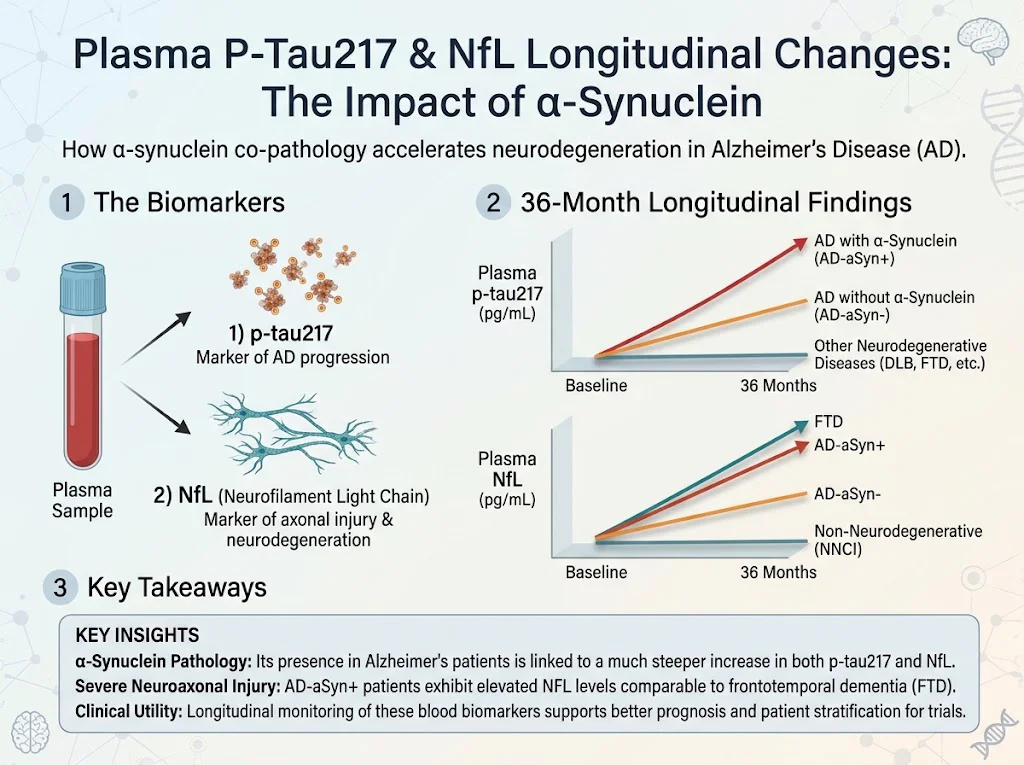
This study advances our understanding of the longitudinal behavior of plasma biomarkers p-tau217 and neurofilament light chain (NfL) across neurodegenerative diseases. Key highlights include: 1) Plasma p-tau217 elevations and increases over 36 months are most pronounced in Alzheimer disease (AD) patients with concomitant α-synuclein (aSyn) pathology. 2) NfL levels, indicative of neuroaxonal injury, are elevated and rise similarly in AD-aSyn+ and frontotemporal lobar dementia (FTD), reflecting greater neurodegeneration. 3) Biomarker trajectories vary significantly by underlying pathology, underscoring the potential for plasma-based stratification to refine prognosis and clinical trial enrichment in neurodegenerative disorders.
Study Background
Alzheimer disease (AD) is characterized pathologically by extracellular amyloid-β plaques and intracellular tau neurofibrillary tangles, with plasma phosphorylated tau at threonine 217 (p-tau217) emerging as a robust biomarker reflecting AD-specific tau pathology and disease progression. Additionally, plasma neurofilament light chain (NfL) serves as a nonspecific marker of axonal injury and neurodegeneration, being elevated in diverse neurodegenerative disorders.
Clinical phenotypes of neurodegeneration often feature mixed proteinopathies. α-Synuclein (aSyn) pathology, hallmark to Lewy body diseases, is frequently detected concomitantly in AD brains and considered a modulator of clinical progression and prognosis. Understanding how aSyn influences both specific (p-tau217) and nonspecific (NfL) plasma biomarkers longitudinally could enhance biomarker-driven diagnosis and management strategies.
Study Design
This prospective cohort study recruited 223 participants presenting with cognitive impairment from a single memory clinic in Barcelona, Spain, between 2019 and 2022. Subjects represented diverse diagnostic categories: AD without aSyn pathology (AD-aSyn-), AD with aSyn pathology (AD-aSyn+), dementia with Lewy bodies (DLB) with or without AD pathology, frontotemporal lobar dementia (FTD), and non-neurodegenerative cognitive impairment (NNCI).
At baseline, cerebrospinal fluid (CSF) biomarkers relevant to AD were measured using Lumipulse, and aSyn pathology was assessed by real-time quaking-induced conversion assay. Plasma p-tau217 and NfL levels were measured both at baseline and after 36 months, with linear mixed-effects models used to analyze longitudinal differences across groups.
Key Findings
Baseline plasma p-tau217 was highest among AD groups, both with and without aSyn pathology, whereas DLB groups showed intermediate levels, and FTD and NNCI displayed the lowest. Notably, AD-aSyn+ patients demonstrated the steepest longitudinal increase in p-tau217 over three years, with an average rise of 2.19 pg/mL (p < 0.001). AD-aSyn- and DLB-AD+ participants also showed increases though of lesser magnitude, while DLB-AD-, FTD, and NNCI groups remained stable.
Regarding plasma NfL, baseline and longitudinal levels were elevated most strikingly in AD-aSyn+ and FTD groups, both exhibiting significant increases over time (p < 0.001). AD-aSyn-, DLB-AD+, and DLB-AD- groups showed intermediate levels and moderate progression, with NNCI subjects remaining largely unchanged.
The data underscore a distinct subgroup within AD characterized by aSyn co-pathology, which is associated with accelerated p-tau217 and NfL increases, suggesting heightened tau pathology burden and neuroaxonal damage respectively. This subgroup also shares similar NfL profiles with FTD, indicative of more aggressive neurodegeneration.
Expert Commentary
The findings highlight that the co-occurrence of α-synuclein pathology within Alzheimer disease is more than a pathological curiosity—it actively modulates biomarker trajectories and possibly clinical outcomes. Plasma p-tau217, specific for AD pathology, shows differential longitudinal increases depending on aSyn status, aligning with a biological interaction between tau and α-synuclein proteinopathies.
Elevated NfL in AD-aSyn+ cases signals increased neuroaxonal injury, echoing patterns seen in FTD, another disease with rapid neurodegenerative progression. This supports the emerging concept that mixed proteinopathies contribute to clinical heterogeneity and faster decline in neurodegenerative diseases.
From a translational perspective, these insights advocate for biomarker stratification incorporating plasma p-tau217 and aSyn status to refine prognosis, personalize therapeutic approaches, and enhance clinical trial designs through targeted enrichment of pathologically defined subgroups.
Limitations include single-center recruitment and a relatively small sample size for some subgroups (e.g., AD-aSyn+ and DLB-AD+), which may affect generalizability. Future multi-center studies with larger, diverse cohorts and extended follow-up are warranted to confirm these observations and elucidate mechanisms linking α-synuclein and tau pathology.
Conclusion
This study convincingly demonstrates that plasma p-tau217 and NfL trajectories vary across neurodegenerative diseases and are modulated by α-synuclein co-pathology in Alzheimer disease. The accelerated biomarker changes in AD-aSyn+ patients suggest more aggressive disease biology, marked by enhanced tau phosphorylation and neuroaxonal compromise.
These findings emphasize the need for integrated biomarker assessment in clinical practice and research to identify high-risk subpopulations with mixed protein pathology. Such stratification could improve diagnostic accuracy, prognostic precision, and therapeutic targeting, ultimately advancing personalized medicine approaches in neurodegeneration.
Funding and ClinicalTrials.gov
The study was conducted at a specialized memory clinic in Barcelona with no specific funding details provided in the abstract. Further information on funding or trial registration was not disclosed.
References
- Esteller-Gauxax D, Pérez-Millan A, et al. Plasma P-Tau217 and NfL Longitudinal Changes Across Neurodegenerative Diseases: Impact of α-Synuclein in Alzheimer Disease. Neurology. 2026 Nov 2;107(10):e218685. PMID: 42970748.
- Zetterberg H. Blood-based biomarkers for Alzheimer’s disease—An update on recent advances. Molecular and Cellular Neuroscience. 2021;113:103615.
- Krämer BC, Beck J, et al. α-Synuclein pathology in Alzheimer’s disease: Longitudinal biomarker and clinical implications. Frontiers in Aging Neuroscience. 2023;15:1154126.
- Mattsson N, Zetterberg H, et al. Plasma neurofilament light predicts mortality and clinical progression in Alzheimer’s disease. Alzheimers Dement 2019;15(8): 1050–1056.
Specialty calculators
For clinical reference; use professional judgment.