Highlights
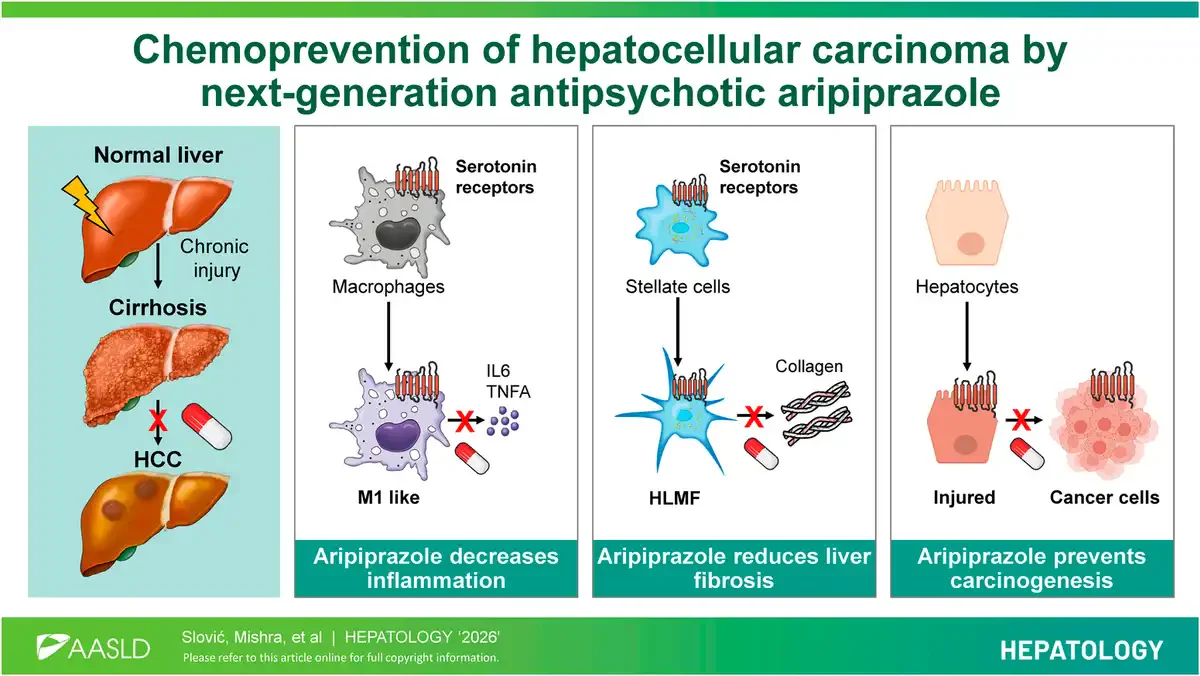
- Aripiprazole targets multiple liver cell types implicated in HCC pathogenesis including fibroblasts, macrophages, and epithelial tumor cells.
- In vivo rat models of metabolic dysfunction-associated steatohepatitis (MASH) demonstrate aripiprazole’s efficacy in preventing liver fibrosis progression and HCC development.
- Mechanistically, aripiprazole modulates fibrogenic and inflammatory pathways by altering fibroblast and macrophage phenotypes and inhibits cMET and ERK oncogenic signaling in tumor cells.
- Ex vivo patient-derived tumor spheroid studies reveal aripiprazole’s immune modulatory effects within the tumor microenvironment, reinforcing its translational potential.
Background
Hepatocellular carcinoma (HCC) stands as the predominant form of primary liver cancer, imposing a significant health burden globally with a sixth-ranked incidence and the third-highest cancer-related mortality worldwide. The rising incidence of HCC is fueled largely by chronic liver diseases primarily driven by viral hepatitis, alcohol abuse, and increasingly, metabolic dysfunction-associated steatohepatitis (MASH). Although treatment modalities have progressed to include surgical resection, locoregional therapies, and targeted systemic agents, therapeutic options for advanced or late-stage liver disease and HCC remain limited. Notably, the absence of effective preventive strategies for HCC development represents a critical unmet need in hepatology and oncology. Pharmacologic chemoprevention, the use of drugs to prevent cancer initiation or progression, is an evolving concept for liver cancer that may complement lifestyle interventions and antiviral therapies. Aripiprazole, a next-generation oral atypical antipsychotic widely prescribed for psychiatric disorders, was unexpectedly identified as a potential chemopreventive agent for HCC based on integrated target gene expression analyses and mechanistic studies. This review synthesizes current evidence underscoring the chemopreventive role of aripiprazole in HCC, spanning preclinical models to translational insights.Key Content
Chronological Development of Evidence
The identification of aripiprazole as a candidate for HCC chemoprevention emerged from transcriptomic analyses of liver tissues from patients with fibrotic liver diseases and HCC, highlighting drug target expression across liver compartments. Subsequent preclinical evaluation in relevant in vivo and in vitro models has progressively elucidated its biological effects and mechanisms.Cellular Targets and Expression in Liver Tissue
Clinical liver tissue analyses have demonstrated that aripiprazole target genes are prominently expressed in liver fibroblasts, macrophages, and epithelial cancer cells—cell populations central to fibrogenesis, inflammation, and tumorigenesis. This broad expression base suggests the drug’s potential to affect multiple pathways pertinent to HCC development.Preclinical Efficacy in Rat Models of MASH-Induced HCC
In a well-established rodent model where HCC is induced by a choline-deficient L-amino acid-defined high-fat diet mimicking human MASH pathophysiology, aripiprazole administration prevented progression of liver disease and suppressed HCC formation. Histologic and molecular analyses indicated that aripiprazole modulated pathways involved in fibrogenesis and inflammatory cascades, reducing extracellular matrix deposition and inflammatory cell infiltration.Mechanistic Insights: Fibroblast and Macrophage Modulation
Mechanistically, aripiprazole exerts antifibrogenic effects by altering hepatic stellate cells and fibroblast phenotypes, reducing fibrogenic mediator production and thereby mitigating fibrosis progression. Concurrently, it shapes macrophage polarization, promoting a phenotype less supportive of chronic inflammation and tumor promotion. These dual modulatory effects collectively diminish the fibrotic and inflammatory milieu that fosters HCC initiation.Tumor Cell-Intrinsic Effects and Signaling Pathway Inhibition
Studies employing cancer cell models revealed that aripiprazole impairs early tumorigenic events and proliferation. The drug inhibits oncogenic cMET receptor tyrosine kinase and ERK signaling pathways critical for hepatocarcinogenesis, and disrupts mitochondrial functions leading to reduced cancer cell viability. These findings delineate a direct anti-oncogenic role alongside the microenvironmental effects.Translational Studies in Patient-Derived Tumor Spheroids
Complementing in vivo and in vitro findings, treatment of patient-derived HCC tumor spheroids demonstrated that aripiprazole modulates immune cell responses within the tumor microenvironment. This underscores its potential to restore anti-tumor immunity and reinforces its applicability in human disease contexts.Expert Commentary
The collective evidence positions aripiprazole as a promising drug repurposing candidate for HCC chemoprevention, with multifaceted mechanisms encompassing antifibrotic, anti-inflammatory, and direct anti-tumor activities. The drug’s established safety profile in psychiatric use enhances its translational potential. However, the clinical applicability requires cautious interpretation. Most data stem from rodent models and ex vivo systems; thus, confirmation in human clinical trials is essential. Additionally, elucidation of optimal dosing, duration, and patient selection criteria will be required to maximize benefit and minimize off-target effects. Current hepatology guidelines do not yet include pharmacological chemoprevention for HCC, reflecting the paucity of interventional trial data. Aripiprazole’s novel mechanism targeting liver fibroblasts, macrophages, tumor cells, and immune modulation offers a unique multidimensional approach beyond classical antiviral or lifestyle interventions. Potential limitations include the need to monitor neuropsychiatric side effects given aripiprazole’s central nervous system activity, and the necessity to evaluate long-term outcomes beyond tumor incidence.Conclusion
Aripiprazole emerges as a clinically relevant candidate for hepatocellular carcinoma chemoprevention, supported by comprehensive mechanistic studies demonstrating its ability to modulate fibrosis, inflammation, tumor cell signaling, and immune responses. Future prospective clinical trials are warranted to validate efficacy and safety in at-risk populations with chronic liver disease. Implementation of aripiprazole could represent a paradigm shift toward pharmacologic strategies preventing HCC development, addressing a critical unmet need in liver oncology.References
- Slović N, Mishra S, Paul S, Oudot MA, Jühling F, Kanzaki H, Moehlin J, Charlot A, Denos M, Durand SC, Katz C, Gadenne C, Felli E, Ono A, Oka S, Higashi T, Nakagawa S, Akuta N, Goossens N, Chayama K, Lupberger J, Crouchet E, Hoshida Y, Baumert TF. Chemoprevention of hepatocellular carcinoma by next-generation antipsychotic aripiprazole. Hepatology (Baltimore, Md.). 2026 Mar 13;84(5):1352-1370. PMID: 41838879.
Specialty calculators
For clinical reference; use professional judgment.