Highlights
- Periconceptual progesterone administration is associated with a statistically significant reduction in gestational hypertension incidence but does not reduce preeclampsia risk.
- Population-based evidence, including a large Australian cohort of nulliparous women, supports modest effect sizes unlikely to shift clinical management substantially.
- Findings are consistent even in subpopulations undergoing assisted reproductive technology (ART), indicating a possible generalizable effect.
- Potential biological mechanisms include progesterone’s vascular and immunomodulatory actions during early placentation, though clinical benefit in hypertensive disorders remains uncertain.
Background
Hypertensive disorders of pregnancy (HDP), comprising gestational hypertension and preeclampsia, are prevalent pregnancy complications associated with significant maternal and perinatal morbidity and mortality globally. Gestational hypertension involves new-onset hypertension after 20 weeks’ gestation without proteinuria, whereas preeclampsia features hypertension accompanied by proteinuria and/or organ dysfunction. Despite advances in prenatal care, reliable strategies to prevent HDP remain limited. Progesterone, a critical hormone for pregnancy maintenance, exhibits vasoactive, immunomodulatory, and anti-inflammatory properties crucial during implantation and early placentation. Given its established role in preventing preterm birth in high-risk pregnancies, investigation into whether periconceptual progesterone administration reduces HDP has garnered interest. The timing of progesterone exposure—particularly the periconceptual period spanning six weeks preconception to the end of the first trimester—is critical in placental development and thus potentially impactful on HDP pathogenesis.Key Content
Population-Based Cohort Evidence
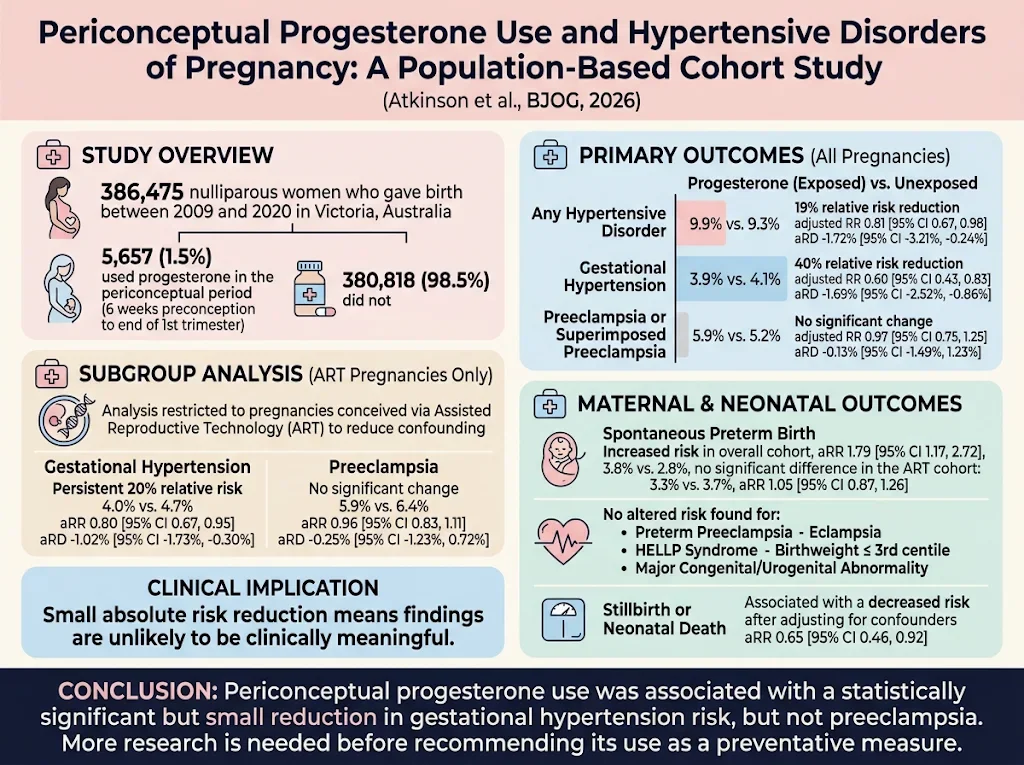
The landmark study by Atkinson et al. (2026) analyzed 386,475 nulliparous women delivering in Victoria, Australia, from 2009 to 2020, linking statewide birth, hospital, and prescription datasets. Of these, 1.5% used progesterone during the periconceptual window. Adjusted analyses utilizing inverse probability-weighted regression revealed a statistically significant reduction in overall new-onset hypertensive disorders (adjusted risk ratio [aRR] 0.81), primarily driven by a 40% relative risk reduction in gestational hypertension (aRR 0.60). No significant difference in preeclampsia risk was found (aRR 0.97). These associations held in sub-analyses restricting to pregnancies conceived via ART.Comparisons with Previous Trials and Meta-Analyses
Earlier randomized controlled trials (RCTs) and meta-analyses investigating progesterone for HDP prevention have yielded heterogeneous results. While progesterone is well-established for preterm birth prophylaxis, evidence for preeclampsia prevention remains inconclusive. A Cochrane review (2018) encompassing small RCTs found insufficient evidence supporting progesterone to prevent preeclampsia, with no robust data on gestational hypertension. Some trials suggested potential benefit in specific subgroups, but limitations include small sample sizes and variable intervention timing (often post first trimester).Biological and Mechanistic Insights
Progesterone modulates uterine vascular remodeling, reduces systemic vascular resistance, and downregulates inflammatory cytokines, plausibly attenuating early endothelial dysfunction implicated in HDP development. Periconceptual progesterone optimally targets trophoblast invasion and spiral artery transformation, critical in preventing placental ischemia—a central mechanism in preeclampsia. However, these mechanistic benefits may not fully translate into clinical reductions in preeclampsia incidence, possibly due to multifactorial etiology beyond progesterone-sensitive pathways.Clinical and Research Implications
While periconceptual progesterone use shows a modest association with decreased gestational hypertension risk, the absolute risk reduction (approximately 1.7%) is unlikely to lead to changes in clinical guidelines or routine practice. No evidence supports routine progesterone for preeclampsia prevention. Further rigorous RCTs focusing on timing, dosage, and patient selection, including women at high HDP risk, are warranted to clarify these associations. Moreover, elucidating the mechanistic pathways may enable targeted interventions.Expert Commentary
The large population-based cohort study by Atkinson et al. adds valuable real-world evidence addressing a critical window for progesterone’s potential impact on HDP. The use of sophisticated statistical adjustment bolsters confidence in the reported associations, though residual confounding remains possible. The lack of effect on preeclampsia is consistent with prior literature and biologic complexity of this syndrome. Guidelines such as those from the American College of Obstetricians and Gynecologists (ACOG) do not currently endorse progesterone for HDP prevention, reflecting these equivocal data. Clinicians should continue to counsel patients based on established indications for progesterone (e.g., short cervix, history of preterm birth) rather than HDP risk mitigation. These findings should stimulate further mechanistic studies and large-scale prospective trials rather than immediate practice changes.Conclusion
Current evidence, including the largest population-based cohort to date, suggests periconceptual progesterone use is modestly associated with reduced gestational hypertension risk but does not reduce preeclampsia incidence. While biologically plausible, the magnitude of effect is small and unlikely to warrant clinical implementation solely for HDP prevention. Future research should prioritize randomized trials targeting at-risk populations with detailed inquiry into timing and progesterone formulations to optimize translational impact.References
- Atkinson JA, Hiscock RJ, Forsythe A, et al. Periconceptual Progesterone Use and Hypertensive Disorders of Pregnancy: A Population-Based Cohort Study. BJOG. 2026 Nov 5. PMID: 42987862.
- Davies-Tuck ML, Keelan JA, Bianco-Miotto T. The Role of Progesterone in Pregnancy and Neonatal Outcomes. J Clin Med. 2020;9(5):1633. PMID: 32433749.
- American College of Obstetricians and Gynecologists. Hypertensive Disorders in Pregnancy. Practice Bulletin No. 222. Obstet Gynecol. 2020;135(6):e237-e260. PMID: 32424112.
- Askie LM, Duley L, Henderson-Smart DJ, Stewart LA. Antiplatelet agents for preventing pre-eclampsia and its complications. Cochrane Database Syst Rev. 2007;(2):CD004659. PMID: 17443540.
- Levine RJ, Maynard SE, Qian C, et al. Circulating angiogenic factors and the risk of preeclampsia. N Engl J Med. 2004;350(7):672-683. PMID: 14960714.
Specialty calculators
For clinical reference; use professional judgment.