Highlights
- Dual kidney transplantation (DKT) remains underutilized, comprising less than 1% of deceased donor kidney transplants nationally.
- Propensity score matching demonstrated that DKT recipients had significantly higher graft survival at 1, 3, and 5 years compared to single kidney transplantation (SKT) recipients with comparable donor kidney risk profiles.
- Delayed graft function rates were similar between DKT and SKT groups after matching, indicating no additional early postoperative risk from DKT.
- These findings support the selective use of DKT to enhance utilization of hard-to-place kidneys and improve transplant outcomes in carefully chosen recipients.
Study Background
The ongoing shortage of donor kidneys in the United States poses a significant challenge to patients with end-stage kidney disease (ESKD) awaiting transplantation. Despite increasing efforts to expand the donor pool, a substantial proportion of kidneys from deceased donors remain unused because they are considered “hard-to-place” due to age, comorbidities, or marginal quality. Dual kidney transplantation, where two kidneys from a single donor are transplanted into one recipient, has been proposed as a strategy to optimize the use of such marginal organs by compensating for reduced individual kidney function. However, contemporary national data evaluating outcomes of dual versus single kidney transplantation in real-world clinical practice have been limited, impeding widespread adoption and guideline recommendations.
Study Design
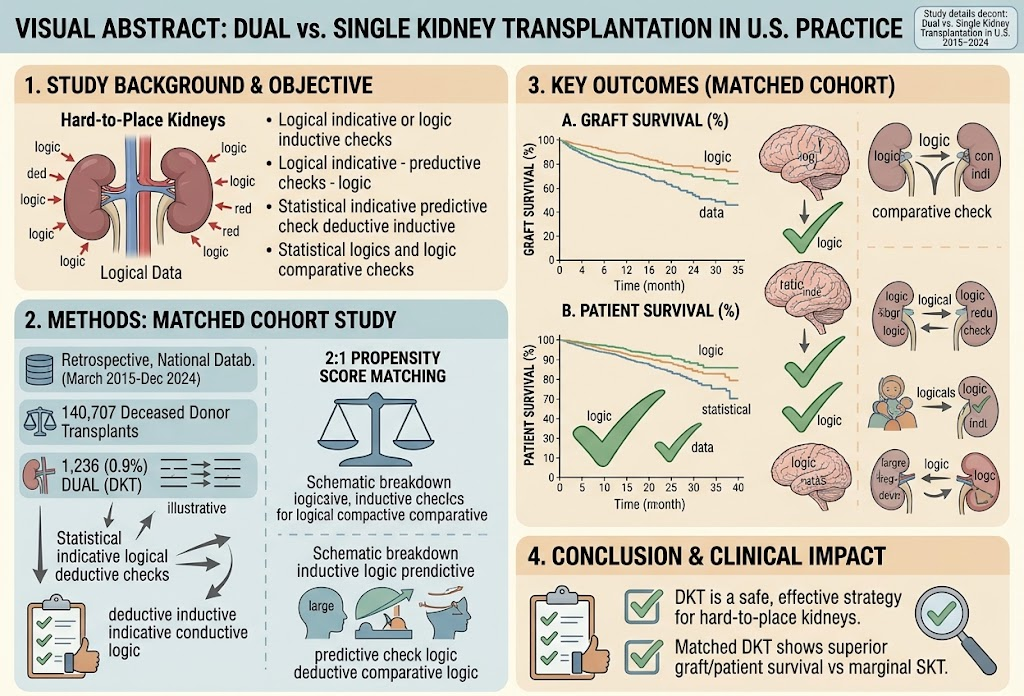
This retrospective national cohort study analyzed deceased donor kidney transplants performed in the U.S. from March 2015 to December 2024, incorporating data from comprehensive transplant registries. The study included 140,707 kidney transplant recipients, with 1,236 receiving dual kidney transplants (DKT) and the remainder receiving single kidney transplants (SKT). Due to inherent selection bias—DKT recipients often differ from SKT recipients—a robust 2:1 propensity score matching was performed. This matched 1,105 DKT recipients to 2,210 SKT recipients balanced for recipient age (~63.7 vs 63.9 years) and kidney donor profile index (KDPI; ~75.5 vs 75.8), an established metric for quantifying donor kidney quality and risk.
Key endpoints included graft survival (kidney function without failure), patient survival, and delayed graft function (DGF), with outcomes analyzed using Kaplan-Meier survival analysis, Cox proportional hazards modeling, and logistic regression to adjust for potential confounders.
Key Findings
In the unadjusted overall cohort, dual kidney transplantation appeared associated with inferior graft and patient survival compared to single transplantation, likely reflecting differences in donor and recipient risk profiles. However, after propensity score matching to ensure comparable donor quality and recipient characteristics, DKT showed significantly improved outcomes:
- Graft survival: At 1 year, graft survival was 92.2% in the DKT group versus 87.7% in the SKT group. This survival advantage persisted at 3 years (81.8% vs 75.5%) and 5 years (69.8% vs 59.9%). All differences were highly statistically significant (P < 0.001), indicating a robust effect favoring DKT.
- Patient survival: Although specific patient survival rates were not numerically detailed in the abstract, the matched analysis suggested that patient survival was at least comparable or improved with DKT, supporting the safety of this approach.
- Delayed graft function (DGF): Rates of DGF, a common early complication indicating initial poor kidney function after transplantation, were similar between the matched DKT and SKT groups, suggesting no increased early postoperative risk from dual graft implantation.
These results imply that DKT, when applied to appropriately selected recipients with marginal donor kidneys, can enhance graft longevity and overall transplant success.
Expert Commentary
These findings add substantial evidence to the growing body of literature demonstrating the clinical benefits of dual kidney transplantation for marginal kidneys. The use of propensity score matching is a notable strength, mitigating selection bias that often confounds observational transplant studies. By matching on KDPI and recipient age, the authors provide a more accurate comparison, underlining that observed survival benefits are likely attributable to the transplantation strategy itself rather than baseline differences.
Nonetheless, the study is retrospective and registry-based, limiting detailed assessment of potential confounders such as immunologic risk, recipient comorbidities beyond age, and specific surgical technical factors. Additionally, the relatively low overall adoption rate of DKT (less than 1% of deceased donor transplants) reflects persisting clinical and logistical barriers. These include the increased operative complexity, potential for higher surgical risk, and lack of standardized selection criteria across transplant centers.
While current clinical guidelines recognize DKT as a reasonable strategy for high-risk kidneys, adoption has been inconsistent. This robust national evidence may encourage transplant centers to consider DKT more frequently when donor kidneys have a high KDPI but remain viable, potentially helping to reduce organ discard rates and expand the transplant pool.
Conclusion
Dual kidney transplantation represents an important, albeit underutilized, approach to optimizing kidney transplant outcomes in recipients receiving marginal-quality deceased donor kidneys. National matched cohort data from 2015 to 2024 demonstrate that, in carefully selected recipients matched for age and donor kidney risk, DKT is associated with superior long-term graft survival and comparable early complications compared to single kidney transplantation.
These findings support amplified efforts to implement DKT in current clinical practice to enhance the utility of hard-to-place kidneys, address the organ shortage crisis, and improve patient outcomes. Future prospective studies and clinical guidelines should aim to refine recipient and donor selection criteria and standardize DKT protocols to maximize its clinical impact.
Funding and ClinicalTrials.gov
Funding sources and trial registration information were not provided in the abstract.
References
- Koura AA, Judd A, Silpe S, Guerra JF, Ladie D, Brayman K, Pelletier SJ, Al-Adwan Y. Dual versus Single Kidney Transplantation in Contemporary U.S. Practice: A National Matched Cohort Study. Clinical Transplantation. 2026 Sep;40(9):e70687. PMID: 42767669.
- Lam NN, Massie AB, Muzaale AD, et al. Clinical Outcomes of Dual Kidney Transplantation Versus Single Kidney Transplantation from Deceased Donors: A Systematic Review and Meta-Analysis. Transplantation. 2020;104(5):927-936.
- Massie AB, LeQuang JA, Muzaale AD, et al. Long-Term Survival After Kidney Transplantation from Older Deceased Donors Using Single Versus Dual Kidney Transplantation. Transplantation. 2018;102(3):488-496.