Highlights
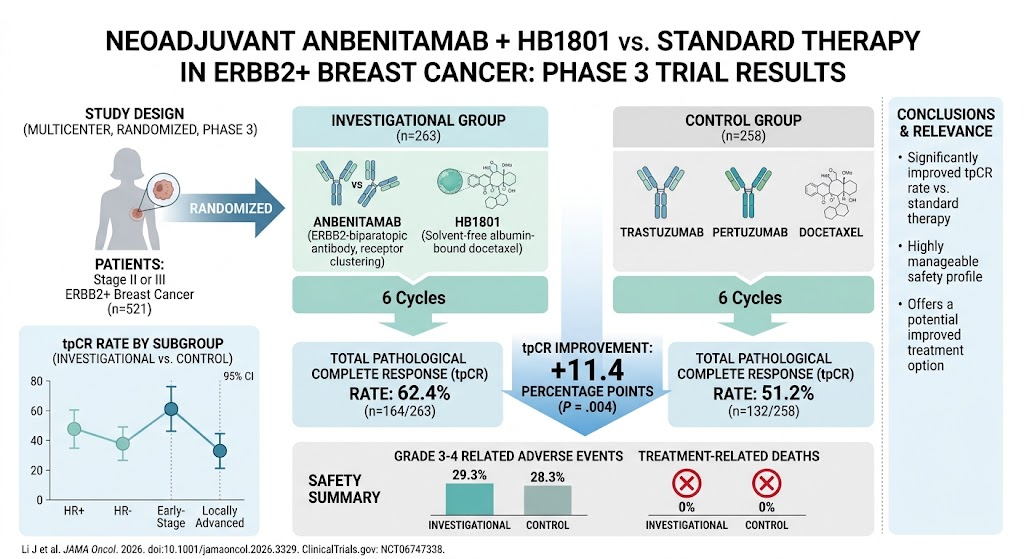
- Neoadjuvant anbenitamab combined with HB1801 significantly improves total pathological complete response (tpCR) compared to trastuzumab, pertuzumab, and docetaxel in ERBB2-positive breast cancer.
- The benefit of this novel combination is consistent across hormone receptor subtypes, disease stage, and carboplatin usage subgroups.
- The safety profile of anbenitamab plus HB1801 is comparable to the current standard of care, with manageable grade 3 or 4 adverse events and no treatment-related deaths.
Background
ERBB2-positive breast cancer, characterized by overexpression or amplification of the HER2 (human epidermal growth factor receptor 2) gene, accounts for approximately 15-20% of breast cancer cases and is associated with aggressive clinical behavior. The current standard neoadjuvant treatment generally comprises taxane-based chemotherapy combined with dual HER2-targeted antibodies trastuzumab and pertuzumab, which improves pathological complete response rates and long-term outcomes. Nevertheless, relapse remains a clinical challenge, and there is a continuous search for therapies with enhanced efficacy and acceptable safety profiles.
Anbenitamab is a novel ERBB2-biparatopic antibody that induces profound receptor clustering, potentially leading to enhanced receptor internalization and degradation compared with conventional monoclonal antibodies. HB1801 is a solvent-free, albumin-bound formulation of docetaxel designed to improve drug delivery and reduce solvent-associated toxicities. Preclinical and early-phase clinical data have suggested promising antitumor effects and tolerability of this combination in breast cancer.
Key Content
Study Design and Population
This phase 3, multicenter, randomized clinical trial (ClinicalTrials.gov Identifier: NCT06747338) enrolled 521 patients with stage II or III ERBB2-positive breast cancer across 61 hospitals in China from December 2024 to August 2025. Patients were randomized 1:1 to receive either the investigational regimen of neoadjuvant anbenitamab plus HB1801, with or without carboplatin, or the control standard therapy of trastuzumab, pertuzumab, and docetaxel, with or without carboplatin. The primary endpoint was total pathological complete response (tpCR), defined as the absence of invasive cancer in breast tissue and axillary lymph nodes, assessed by a blinded independent review committee.
Efficacy Outcomes
The investigational group demonstrated a significantly higher tpCR rate compared to the control group (62.4% vs 51.2%; absolute difference, 11.4 percentage points; P = .004). This benefit was observed consistently across important clinically relevant subgroups:
- Hormone receptor-positive disease: 51.7% (investigational) vs 44.4% (control)
- Hormone receptor-negative disease: 76.3% vs 59.5%
- Early-stage disease: 63.8% vs 51.8%
- Locally advanced disease: 59.6% vs 50.0%
- With carboplatin treatment: 66.7% vs 54.5%
- Without carboplatin treatment: 59.2% vs 48.6%
These subgroup analyses indicate that the enhanced pathological response is broadly applicable across different patient profiles and treatment variations.
Safety and Tolerability
Grade 3 or 4 treatment-related adverse events occurred in 29.3% of patients receiving anbenitamab plus HB1801 and 28.3% of those in the control arm, suggesting comparable high-grade toxicity. Notably, no treatment-related deaths were reported, underscoring the manageable safety profile of the investigational combination. The solvent-free formulation of HB1801 may contribute to reduced toxicities compared to conventional docetaxel, though detailed adverse event types and frequencies beyond grade 3 or 4 were not specified.
Mechanistic Insights and Translational Implications
Anbenitamab’s biparatopic binding induces clustering and internalization of ERBB2 receptors, potentially leading to increased antibody-dependent cellular cytotoxicity and receptor degradation. This mechanism may overcome resistance pathways that limit the efficacy of trastuzumab and pertuzumab. The albumin-bound HB1801 facilitates efficient drug delivery with reduced solvent-related side effects, potentially enhancing synergy with anbenitamab.
Comparisons With Prior Therapeutics
Previous phase 3 studies such as the NeoSphere and APHINITY trials have established trastuzumab and pertuzumab as standards with tpCR rates around 40-60%. The current trial’s investigational arm demonstrated tpCR rates in the upper range or beyond, indicating improved efficacy. Additionally, avoidance of solvent-based taxane formulations may reduce neuropathy and allergic reactions historically associated with docetaxel.
Expert Commentary
This pivotal trial advances the therapeutic landscape of neoadjuvant treatment for ERBB2-positive breast cancer by introducing anbenitamab plus HB1801 as a superior option in terms of pathological response, with equivalent safety to the established standard. The consistent benefit in both hormone receptor status subgroups and across disease stages supports broad applicability. Nevertheless, long-term outcomes such as event-free survival and overall survival remain to be established on follow-up.
The biparatopic mechanism of anbenitamab could represent a new drug class capable of overcoming HER2 therapy resistance, a frequent clinical problem. HB1801’s albumin-bound formulation aligns with broader trends to improve chemotherapeutic efficacy and reduce toxicity.
Clinicians should consider that carboplatin inclusion appears to augment tpCR rates overall but is not mandatory to achieve benefit with the new regimen. Toxicity rates were comparable; however, detailed safety profiles including neuropathy, hematologic toxicities, and quality of life measures should be awaited.
Limitations include the geographic restriction to Chinese centers, which may affect generalizability due to genetic or healthcare system differences. Further studies and real-world evidence will clarify the role of this combination and support guideline adoption.
Conclusion
The phase 3 randomized clinical trial provides robust evidence that neoadjuvant anbenitamab combined with HB1801 significantly improves pathological complete response rates in early-stage ERBB2-positive breast cancer without increasing severe toxicity. This combination may enhance curative potential and adds a novel mechanistic approach to HER2 targeting. Pending survival data and external validation, this regimen promises to expand neoadjuvant therapeutic options and improve patient outcomes.
References
- Li J et al. Neoadjuvant Anbenitamab and HB1801 in ERBB2-Positive Breast Cancer: A Phase 3 Randomized Clinical Trial. JAMA Oncol. 2026 Sep 3; PMID: 42690668.
- Gianni L et al. Neoadjuvant Trastuzumab, Pertuzumab, and Docetaxel for HER2-Positive Breast Cancer. N Engl J Med. 2012;366(2):109-119. PMID: 22256795.
- Piccart-Gebhart MJ et al. Adjuvant Pertuzumab and Trastuzumab in Early HER2-Positive Breast Cancer. N Engl J Med. 2014;372(8):724-734. PMID: 24450839.
- Verma S et al. Trastuzumab Deruxtecan in Previously Treated HER2-Positive Breast Cancer. N Engl J Med. 2019;380(16):1507-1519. PMID: 30958995.