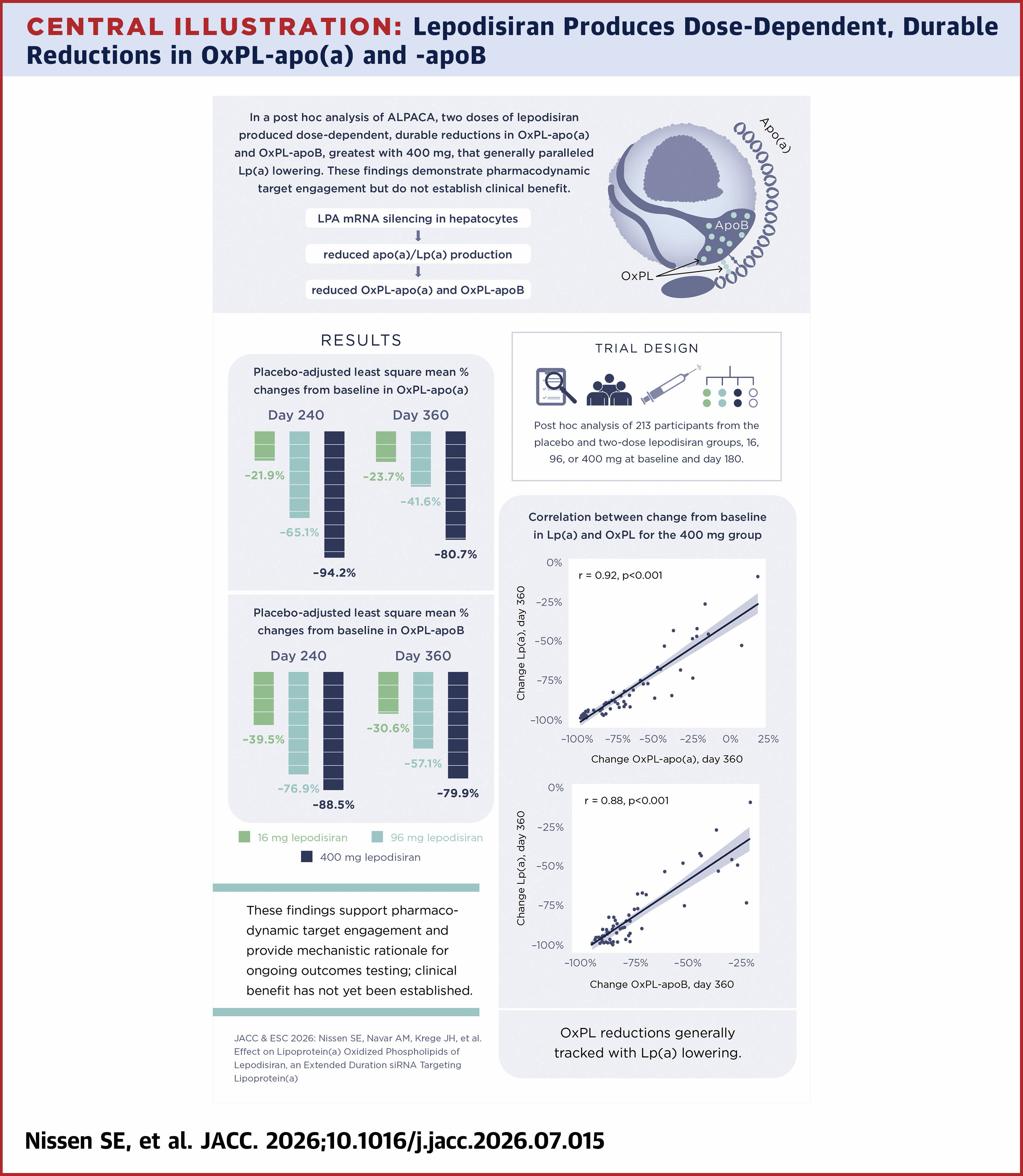
Highlight
- Lepodisiran significantly reduces oxidized phospholipids (OxPL) bound to apolipoprotein(a) and apolipoprotein B at multiple doses.
- Reduction in OxPL correlates closely with decreases in Lp(a) levels, suggesting proportional particle clearance.
- No observable correlation between high-sensitivity C-reactive protein (hsCRP) and OxPL changes was found.
- Findings reinforce biological plausibility for cardiovascular risk reduction trials with Lepodisiran but do not establish clinical benefit yet.
Study Background
Lipoprotein(a), or Lp(a), is a genetically determined lipoprotein widely recognized as a causal risk factor for atherosclerotic cardiovascular disease (ASCVD) and aortic valve stenosis. Elevated Lp(a) levels contribute to cardiovascular risk independently of traditional lipid parameters, primarily due to its unique structure featuring apolipoprotein(a) [apo(a)] linked to apolipoprotein B (apoB). Oxidized phospholipids (OxPL) bound to apo(a) and apoB are implicated in mediating the pro-inflammatory and pro-atherogenic properties of Lp(a).
Currently, non-specific lipid-lowering agents have limited efficacy in reducing Lp(a), leaving a significant unmet need for targeted therapies. Small interfering RNA (siRNA) therapies, such as Lepodisiran, have emerged to provide sustained Lp(a) lowering by selectively degrading apo(a) messenger RNA, thus reducing Lp(a) production in the liver.
Study Design
This was a randomized, placebo-controlled phase 2 trial conducted across 66 global centers enrolling 320 participants with elevated Lp(a) levels. Lepodisiran was administered subcutaneously at doses of 16 mg, 96 mg, or 400 mg at baseline and on day 180. A subset of 213 participants had oxidized phospholipid levels measured at baseline, day 240, and day 360, enabling post hoc analyses focused on OxPL bound to apo(a) and apoB.
Primary endpoints in this analysis included placebo-adjusted percent changes from baseline in OxPL-apo(a) and OxPL-apoB. Correlation assessments were performed to evaluate relationships among reductions in Lp(a), OxPL-apo(a), OxPL-apoB, and systemic inflammation biomarker high-sensitivity C-reactive protein (hsCRP).
Key Findings
At baseline, median OxPL-apo(a) and OxPL-apoB levels were 122.0 nmol/L and 27.7 nmol/L, respectively. Lepodisiran elicited dose-dependent, marked reductions in OxPL levels against placebo controls.
By day 240, placebo-adjusted reductions in OxPL-apo(a) were:
-16 mg: -21.9% (95% CI: -45.0% to 11.0%)
-96 mg: -65.1% (95% CI: -73.8% to -53.6%)
-400 mg: -94.2% (95% CI: -95.7% to -92.2%)
Similarly, reductions in OxPL-apoB at day 240 were:
-16 mg: -39.5% (95% CI: -51.2% to -25.0%)
-96 mg: -76.9% (95% CI: -80.6% to -72.5%)
-400 mg: -88.5% (95% CI: -90.4% to -86.3%)
At day 360, sustained reductions were noted though slightly attenuated compared with day 240:
OxPL-apo(a):
-16 mg: -23.7% (95% CI: -47.0% to 9.8%)
-96 mg: -41.6% (95% CI: -56.4% to -21.6%)
-400 mg: -80.7% (95% CI: -85.7% to -73.9%)
OxPL-apoB:
-16 mg: -30.6% (95% CI: -46.4% to -10.2%)
-96 mg: -57.1% (95% CI: -65.2% to -47.2%)
-400 mg: -79.9% (95% CI: -83.8% to -75.2%)
Importantly, percent changes in OxPL-apo(a) correlated more closely with percent changes in Lp(a) than OxPL-apoB, suggesting that reductions in OxPL largely track with Lp(a) particle number reductions. No significant correlation was found between changes in hsCRP and OxPL, indicating that systemic inflammation markers may not directly reflect OxPL dynamics in this setting.
Adverse events and safety outcomes were consistent with previous reports for extended-duration siRNA therapies, with no unexpected safety signals emerging during the analyzed timeframe.
Expert Commentary
This post hoc analysis supports the biological rationale that reducing Lp(a) via hepatic inhibition of apo(a) synthesis with Lepodisiran significantly lowers oxidized phospholipids bound to apo(a) and apoB, key contributors to Lp(a)-mediated vascular and valvular disease.
The strength of the correlation between OxPL-apo(a) and Lp(a) reductions underscores the importance of targeting the Lp(a) particle specifically rather than non-selective lipid reduction strategies. Although OxPL reduction is mechanistically plausible to decrease pro-atherogenic and pro-inflammatory pathways, the study does not yet demonstrate clinical benefit such as reduced cardiovascular events.
Limitations include the post hoc nature and relatively short follow-up for clinical outcomes. Measuring OxPL at later time points and evaluating clinical event rates in phase 3 trials will be crucial to validate these biomarker findings.
Future research should explore whether OxPL reductions translate into meaningful improvements in progression of atherosclerosis and aortic valve disease, alongside thorough cardiovascular outcome trials. The ongoing phase 3 cardiovascular outcomes trial for Lepodisiran (NCT05565742) is expected to shed light on these questions.
Conclusion
Lepodisiran, an extended-duration siRNA targeting apo(a), produces large and sustained reductions in oxidized phospholipids associated with Lp(a) particles. These findings align with its potent Lp(a)-lowering effects and reinforce the mechanistic basis for its cardiovascular risk modification potential. However, clinical benefit remains unproven and awaits confirmation by ongoing large-scale outcome trials.
Funding and Clinical Trials Registration
This trial was funded by the sponsor developing Lepodisiran. The clinical trial registration number is NCT05565742.
References
1. Nissen SE, Navar AM, Krege JH, et al. Effect on Lipoprotein(a) Oxidized Phospholipids of Lepodisiran, an Extended-Duration siRNA Targeting Lipoprotein(a). J Am Coll Cardiol. 2026 Aug 31; PMID: 42671367.
2. Tsimikas S. A Test in Context: Lipoprotein(a): Diagnosis, Prognosis, Controversies, and Emerging Therapies. J Am Coll Cardiol. 2017;69(6):692-711.
3. Gordts PL, et al. (2018). Lipoprotein(a) metabolism and atherogenesis: A comprehensive review. Front Cardiovasc Med.
4. Daniels LB, et al. Oxidized Phospholipids, Lipoprotein(a), and Cardiovascular Disease: Key Concepts in Clinical and Basic Research. J Lipid Res. 2020.