Highlight
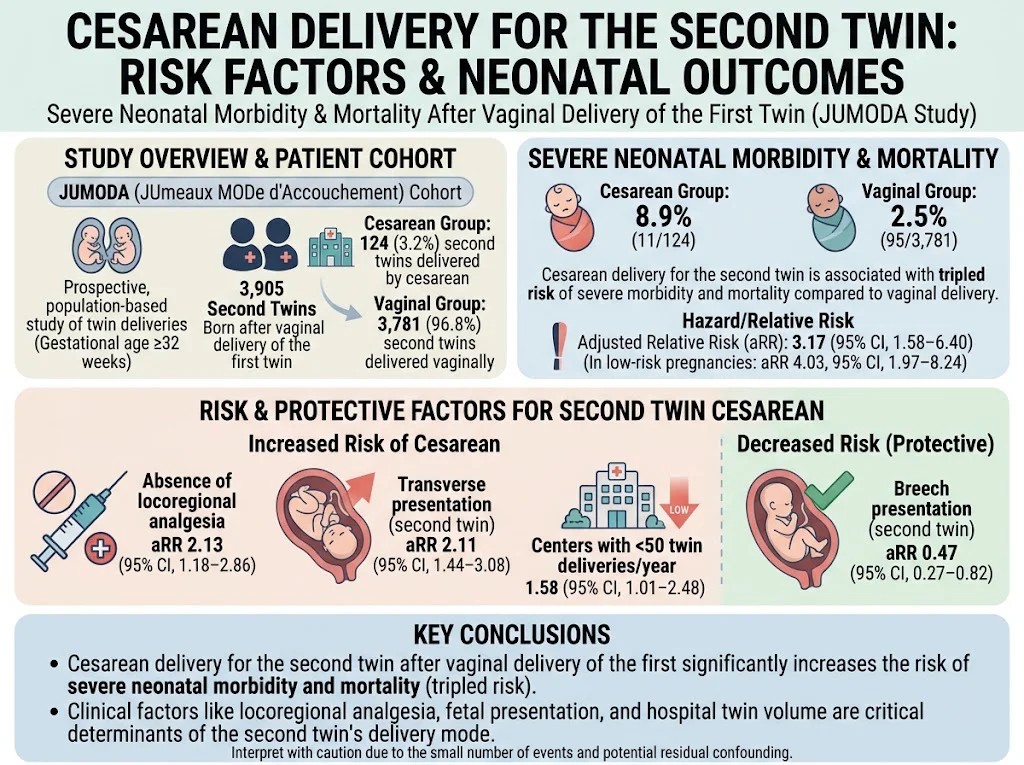
- Cesarean delivery for the second twin after vaginal delivery of the first twin is associated with a threefold increase in severe neonatal morbidity and mortality compared to vaginal delivery.
- Absence of locoregional analgesia, transverse presentation of the second twin, and delivery in centers with low twin delivery volumes increase the risk of cesarean delivery for the second twin.
- Breech presentation of the second twin appears protective against cesarean delivery.
- Findings were consistent even when analysis was limited to a low-risk population mirroring the Twin Birth Study criteria.
Study Background
Twin pregnancies are inherently complex, and delivery management for twins remains a challenging clinical scenario. When the first twin is delivered vaginally, decisions about how to deliver the second twin must balance safety and outcomes. Cesarean delivery for the second twin following vaginal birth of the first arises due to various intrapartum complications but its impact on neonatal outcomes compared to continued vaginal delivery requires clearer elucidation. The risk factors predisposing to cesarean delivery in this context are also not well defined. Understanding these associations is essential for optimizing twin delivery practices and reducing neonatal morbidity and mortality.Study Design
This article presents a secondary analysis of the JUMODA (JUmeaux MODe d’Accouchement) cohort, a French national prospective population-based study conducted from February 2014 to March 2015 across 176 maternity hospitals. The analysis included second twins delivered after vaginal delivery of the first twin at a gestational age of 32 weeks or more. The primary outcome assessed was severe neonatal morbidity and mortality. Researchers employed multivariate Poisson regression models to examine associations between cesarean delivery of the second twin and severe neonatal outcomes in the overall cohort. A sensitivity analysis focused on a subgroup reflecting the Twin Birth Study’s low-risk population profile was also conducted to validate findings. Additionally, candidate risk factors contributing to cesarean delivery for the second twin were evaluated.Key Findings
Of the 3,905 second twins analyzed, 124 (3.2%) were delivered by cesarean following vaginal delivery of the first twin, while 3,781 (96.8%) were delivered vaginally. Cesarean delivery of the second twin correlated with a significantly increased risk of severe neonatal morbidity and mortality compared to vaginal delivery (8.9% vs. 2.5%), with an adjusted relative risk (aRR) of 3.17 (95% CI, 1.58–6.40). The sensitivity analysis restricted to the low-risk population, defined as those meeting criteria from the Twin Birth Study, confirmed this association, showing a fourfold increase in risk (aRR 4.03, 95% CI 1.97–8.24) despite lower event counts. Risk factors significantly associated with second twin cesarean delivery included: – Absence of locoregional analgesia (aRR 2.13, 95% CI 1.18–2.86), which may reflect both patient and provider factors relating to labor management. – Transverse presentation of the second twin (aRR 2.11, 95% CI 1.44–3.08), a known mechanical impediment to safe vaginal delivery. – Delivery at centers performing fewer than 50 twin deliveries annually (aRR 1.58, 95% CI 1.01–2.48), suggesting that provider experience or institutional protocols may influence delivery mode decisions. Interestingly, breech presentation of the second twin was associated with a lower likelihood of cesarean section (aRR 0.47, 95% CI 0.27–0.82), which is counter to common perceptions and may reflect skilled vaginal breech delivery practices or selection bias.Expert Commentary
This robust population-based study underscores the complexity of delivery planning for twins, emphasizing that cesarean delivery of the second twin after vaginal birth of the first is not without significant neonatal risks. The findings reinforce the importance of careful intrapartum monitoring and decision making, considering that cesarean delivery under emergent conditions might carry higher neonatal morbidity, potentially due to delayed intervention or perinatal compromise. The increased risk associated with low-volume centers highlights the critical role of clinical experience and institutional preparedness in managing twin deliveries. The protective role of breech presentation against cesarean delivery invites further research into contemporary vaginal breech delivery techniques and selection criteria. Limitations notably include the relatively small number of adverse events and the potential for residual confounding despite multivariate adjustments. The observational design precludes definitive causal inference; however, the findings are pertinent for informing clinical guidelines and shared decision-making discussions with patients.Conclusion
Cesarean delivery for the second twin following vaginal delivery of the first twin substantially increases neonatal morbidity and mortality risks compared to vaginal delivery. Risk factors such as transverse lie, absence of analgesia, and delivery at low-volume centers should prompt heightened vigilance and potentially influence delivery planning. While vaginal delivery remains preferable for the second twin when safe and feasible, clinical teams must be prepared to promptly intervene when necessary to optimize neonatal outcomes. Further prospective research is warranted to delineate best practices and improve twin birth management protocols.Funding and ClinicalTrials.gov
The primary JUMODA cohort study received institutional support from French medical research bodies; however, specific funding details for this secondary analysis were not reported. This analysis did not specify a ClinicalTrials.gov registration number.References
1. Attali I, Goffinet F, Sentilhes L, Azria E, Schmitz T, JUMODA Study Group, GROG. Risk Factors and Associated Severe Neonatal Morbidity and Mortality at Cesarean Delivery for the Second Twin. Obstet Gynecol. 2026 Oct 27. PMID: 42945495. 2. Barrett JFR, Hannah ME, Hutton EK, et al. A randomized trial of planned cesarean or vaginal delivery for twin pregnancy. N Engl J Med. 2013;369(14):1295-1305. doi:10.1056/NEJMoa1302108. 3. Liu S, Liston RM, Joseph KS, Heaman M, Sauve R, Kramer MS. Maternal mortality and severe morbidity associated with low-risk planned cesarean delivery versus planned vaginal delivery at term. CMAJ. 2007 Mar 13;176(4):455-60. 4. Royal College of Obstetricians and Gynaecologists (RCOG). Twins and Higher Order Multiple Pregnancy. Green-top Guideline No. 51. 2016. 5. American College of Obstetricians and Gynecologists (ACOG). Twin Gestation: Obstetric Care Consensus No. 24. Obstet Gynecol. 2021;137(2):e75-e90.Specialty calculators
For clinical reference; use professional judgment.