Highlights
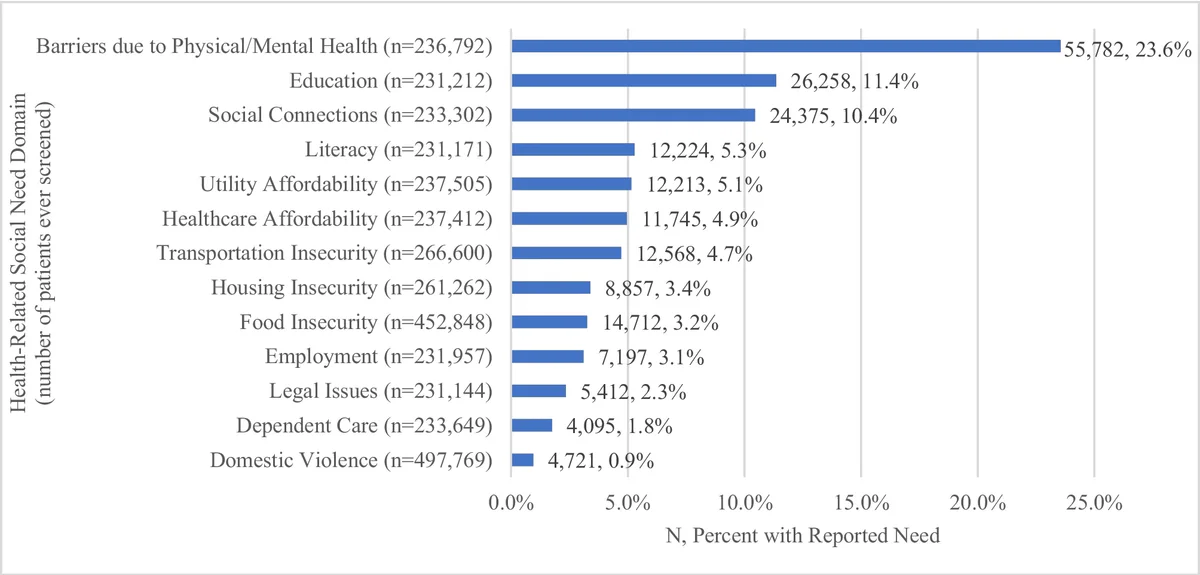
- Non-CMS domains such as barriers from physical/mental health and education show higher prevalence than several CMS-mandated social needs, emphasizing the need for expanded screening.
- Significant demographic disparities exist, with Black, Other race, younger and middle-aged adults, and certain insurance groups more likely to report multiple HRSN.
- Population-wide HRSN screening facilitates targeted interventions but demands consideration of domain selection and mechanisms underlying disparities.
- Future policy must integrate evidence-based domains mandating broader social determinants to better address patient needs and health outcomes.
Background
Health-related social needs (HRSN) — encompassing factors such as food insecurity, housing instability, and transportation barriers — have increasingly been recognized as critical determinants of health outcomes and healthcare utilization. In response, the Centers for Medicare and Medicaid Services (CMS) mandated between 2024-2026 that hospitals screen patients for five core HRSN domains: domestic violence, food insecurity, housing insecurity, transportation insecurity, and difficulty paying utilities. However, evidence suggests that patients in diverse populations may face additional social adversities that profoundly affect health, such as educational challenges, literacy, social isolation, and barriers stemming from physical or mental health conditions. Comprehensive understanding of these broader HRSN domains is essential for designing effective health system interventions, advancing health equity, and optimizing healthcare delivery. Large-scale, population-wide HRSN screening within integrated health systems offers an opportunity to characterize prevalence patterns, demographic correlates, and relative burden across mandated and additional domains.Key Content
Study Overview and Population
Lockhart et al. conducted a cross-sectional analysis encompassing 559,118 adult patients within a large Midwestern US healthcare system screened for HRSN from July 2021 to June 2023. Screening included the 5 CMS-mandated domains alongside 8 additional relevant social needs, thus totaling 13 domains. Demographic data encompassed sex assigned at birth, race, ethnicity, age groups, and health insurance status.Prevalence and Distribution of HRSN Domains
Remarkably, four non-CMS-mandated domains exhibited higher prevalence rates than any of the CMS-required categories: barriers related to physical or mental health (23.6%), educational needs (11.4%), social connections (10.4%), and literacy (5.3%). In contrast, while CMS-mandated domains such as food insecurity and domestic violence are well-recognized and targeted, their reported prevalence was comparatively lower within this population. This finding underscores the multifaceted nature of social determinants, indicating that the currently mandated domains may not fully capture the social complexity impacting patients’ health.Demographic Associations and Disparities in HRSN
The study revealed that Black patients and individuals reporting Other races had statistically higher odds of reporting all CMS-required HRSN. Age stratification indicated that younger adults (18-29 years) and middle-aged adults (50-64 years) had a higher likelihood of experiencing these needs. Insurance status also stratified risk, with Medicare/Medicare Supplement, Dual Medicaid plus Medicare, Self-pay, and Other insurance groups demonstrating increased odds of HRSN presence. For the additional eight HRSN domains, demographic correlations were variable, suggesting distinct sociocultural and systemic contexts influence these needs. For example, educational and literacy challenges may be concentrated in certain populations, influencing access and health literacy.Screening Methodologies and Analysis Approaches
The use of generalized estimating equation (GEE) models in the investigation accounted for correlated observations within demographic subgroups, enhancing robustness in associations. Population-wide screening with structured questions for 13 domains permitted a granular assessment of social needs at an unprecedented scale within a health system. However, limitations include potential reporting bias, variations in screening uptake, and socioeconomic confounding, all of which merit further analytic refinement.Comparisons to Prior Literature
Previous studies have highlighted the complexity and heterogeneity of HRSN across populations. For instance, Berkowitz et al. established the relationship between food insecurity and hospital readmissions, while Palakshappa et al. described the impact of transportation barriers on access to care. Yet, systematic integration of multiple domains including education, literacy, and social connectivity remains less studied. The current study differentiates itself by assessing broader social needs alongside CMS mandates in a large, demographically diverse patient cohort, providing new insights into the relative burden and demographic disparities.Expert Commentary
This study is pioneering in juxtaposing mandated CMS HRSN domains with an expanded scope of patient-reported social determinants within a large health system. The higher prevalence of non-mandated domains such as barriers due to physical or mental health and education suggests that policy-driven screening may currently underrepresent critical social needs influencing health outcomes. Mechanistically, these additional domains contribute to health through multiple pathways, including functional capacity limitations, health literacy deficits, and social isolation, each modulating healthcare engagement and disease trajectory. This multidimensionality argues for adaptive, personalized interventions in clinical practice. The findings also reinforce well-documented racial and socioeconomic disparities, emphasizing the need for culturally competent, equitable screening tools and tailored resource allocation. The variation among insurance types highlights systemic access inequities and potential gaps in social services integration. Nevertheless, the cross-sectional design limits causal inference, and the study setting within a single Midwestern system may constrain generalizability. Furthermore, implementation challenges such as resource constraints and provider training remain critical consideration points for health systems scaling HRSN screening.Conclusion
This comprehensive analysis reveals that patients experience a broad spectrum of health-related social needs extending beyond the five CMS-mandated domains. Incorporating additional domains such as barriers due to physical/mental health, educational needs, and social connections enriches understanding of patient vulnerabilities and can direct more nuanced interventions. Racial, age-based, and insurance-related disparities in HRSN prevalence accentuate the urgency for tailored screening and intervention strategies grounded in equity. Policy implications include reconsideration of mandated HRSN screening domains to reflect patient-reported realities, optimizing resource deployment, and enhancing health outcomes. Future longitudinal and interventional research is needed to elucidate the causal mechanisms driving HRSN disparities and to evaluate the impact of comprehensive screening on clinical outcomes and health equity.References
- Lockhart EA, Llamocca EN, Bossick AS, et al. Health-Related Social Needs in a Large Health System: Comparing Mandated to Eight Additional Domains. J Gen Intern Med. 2026 Nov 10. PMID: 43009706.
- Berkowitz SA, et al. Addressing food insecurity and health outcomes. Health Aff. 2022;41(10):151-159.
- Palakshappa D, et al. Transportation barriers and healthcare access. J Health Care Poor Underserved. 2021;32(2):559-571.
- Gottlieb LM, et al. Screening for social determinants of health in clinical care: Moving from the margins to the mainstream. Public Health Rep. 2020;135(1_suppl):111S-117S.
- Gottlieb LM, Adler NE, Wing H, et al. Integrating Social and Medical Care: Could It Worsen Disparities? JAMA. 2019;322(20):1967-1968.
Specialty calculators
For clinical reference; use professional judgment.