Highlights
- Faricimab demonstrates long-term safety, efficacy, and treatment durability up to four years in diabetic macular edema (DME) using a treat-and-extend protocol.
- Dual inhibition of angiopoietin-2 (Ang-2) and vascular endothelial growth factor A (VEGF-A) achieves superior anatomical outcomes, including significant reductions in central subfield thickness and macular leakage compared to anti-VEGF monotherapy.
- Faricimab enables extended dosing intervals (≥12 weeks in ~80% of patients), reducing injection frequency and treatment burden without compromising efficacy.
- Safety profile remains favorable with low rates of adverse events, including intraocular inflammation and treatment discontinuation, consistent across diverse populations and multiple trials.
Background
Diabetic macular edema (DME) is a leading cause of vision loss in patients with diabetes, characterized by fluid accumulation in the macula leading to central vision impairment. Current standard care involves intravitreal injections of anti-VEGF agents such as aflibercept, which effectively reduce vascular permeability but often require frequent dosing, imposing substantial treatment burden. Faricimab, a bispecific monoclonal antibody targeting both Ang-2 and VEGF-A, offers a novel therapeutic approach aimed at enhancing vascular stability and extending treatment durability. The RHONE-X study represents a pivotal long-term extension evaluating clinical outcomes with faricimab in patients transitioning from the YOSEMITE and RHINE trials, both phase 3 studies assessing faricimab’s efficacy and safety.Key Content
1. Clinical Evidence from the RHONE-X Trial and Related Phase 3 Studies
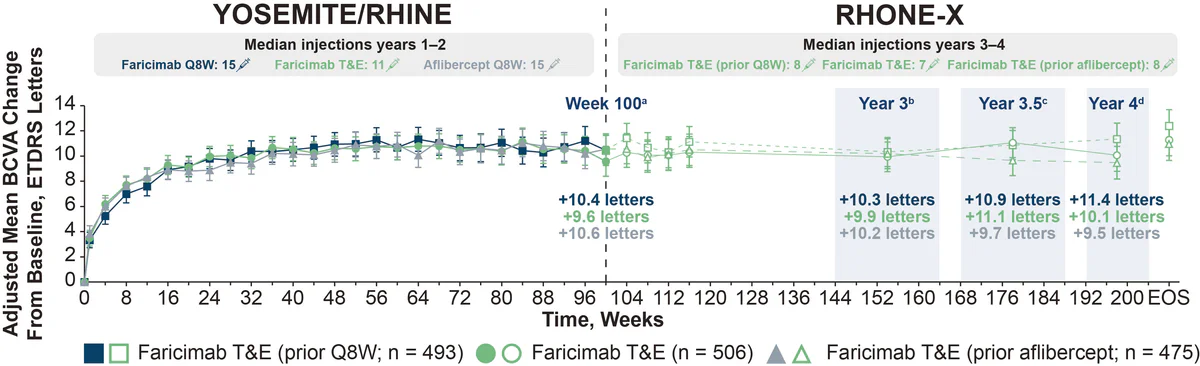
The RHONE-X trial was a 2-year open-label extension enrolling 1474 patients (91% of those completing YOSEMITE and RHINE) to evaluate faricimab under a treat-and-extend (T&E) dosing up to 16-week intervals. Key findings include:- Visual Acuity Outcomes: Adjusted mean improvements in best-corrected visual acuity (BCVA) from baseline sustained through RHONE-X were +10.1 to +11.4 letters among different prior treatment cohorts. These results confirm maintenance of gains achieved in parent trials.
- Anatomic Improvements: Central subfield thickness (CST) decreased markedly (-198 to -205 μm), with >90% of patients reaching absence of DME (CST < 325 μm) at study end regardless of prior therapy.
- Durability and Treatment Burden: Median injections over two years were 7 to 8, with approximately 80% of patients extending to ≥12-week dosing intervals, underscoring reduced treatment frequency without loss of efficacy.
- Safety Profile: Low incidence of adverse events (AEs) leading to discontinuation (1.5%) and intraocular inflammation (1.3%), consistent with prior YOSEMITE and RHINE safety data.
2. Comparative Efficacy Against Aflibercept and Other Anti-VEGF Agents
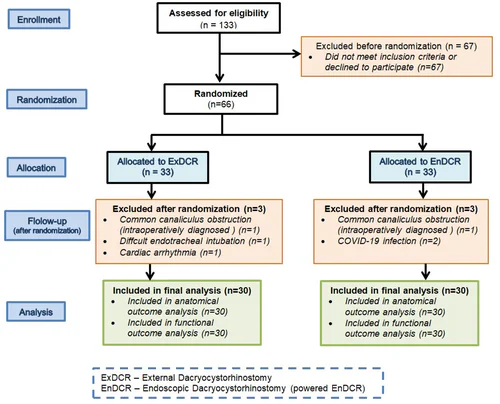
Multiple studies reinforce faricimab’s clinical benefits over aflibercept and ranibizumab:- A randomized controlled trial in an Indian population showed equivalent BCVA gains and CST reductions between faricimab and aflibercept, with faricimab achieving significantly longer dosing intervals (mean 12.86 vs. 9.47 weeks) and fewer injections.
- Matching-adjusted network meta-analyses demonstrated faricimab’s superiority in retinal drying (greater CST reduction) over aflibercept 2 mg and 8 mg with similar BCVA improvements at matched dosing, highlighting the additive value of Ang-2 inhibition in vascular stabilization.
- Post hoc analyses from YOSEMITE/RHINE trials indicated more rapid and greater macular leakage resolution and intraretinal fluid clearance with faricimab versus aflibercept, potentially contributing to earlier anatomical improvement and stabilization.
- Epiretinal membrane formation risk was significantly lower with faricimab compared to aflibercept over two years, suggesting reduced fibrotic proliferation enabled by dual pathway inhibition.
3. Mechanistic and Pharmacokinetic Insights
Faricimab’s bispecific design targets VEGF-A to reduce vascular permeability and Ang-2 to promote vascular stabilization and reduce inflammation. Pharmacokinetic/pharmacodynamic analyses indicate sustained suppression of Ang-2 longer than VEGF-A, with median Ang-2 levels remaining suppressed up to 16 weeks postdose, supporting extended dosing intervals observed clinically. The vitreous half-life (~7.5 days) alone does not fully explain dosing durability, implying additional mechanistic contributions from dual pathway inhibition.4. Subgroup and Regional Analyses
Data from subgroups, including those with worse baseline vision (BCVA ≤ 20/50) and diverse geographic populations (Asian and Japanese cohorts), consistently affirm faricimab’s efficacy, safety, and durability. Thus, the clinical benefits appear generalizable across severity strata and ethnicities.Expert Commentary
Faricimab represents an important advance in DME management by integrating dual Ang-2/VEGF-A inhibition, achieving meaningful and sustained visual and anatomical responses with reduced injection frequency. The T&E protocol supports personalized care, optimizing efficacy while mitigating treatment burden intrinsic to frequent intravitreal injections. Clinical guidelines increasingly recognize faricimab’s role for patients with center-involving DME, particularly those burdened by frequent dosing requirements. Ongoing trials like the MAGIC study further explore faricimab’s impact on retinal nonperfusion and broader diabetic retinopathy manifestations, potentially expanding its indications. While the RHONE-X trial extends the evidence base to four years with robust safety data, challenges remain in real-world adoption, such as ensuring adherence and monitoring. Mechanistically, sustained Ang-2 suppression may provide vascular quiescence, but long-term implications on retinal health warrant continued surveillance.Conclusion
The RHONE-X extension trial conclusively demonstrates faricimab’s long-term safety and efficacy in DME when administered via a treat-and-extend strategy, maintaining visual gains and anatomical improvements over four years with a significantly reduced treatment burden. Composite evidence from phase 2 to 3 trials, pharmacodynamics studies, and diverse patient populations supports faricimab as a transformative option in DME, offering extended durability and vascular stabilization beyond VEGF inhibition alone. Future research directions include evaluation in non-proliferative diabetic retinopathy, real-world effectiveness, and integration into personalized treatment algorithms.References
- Sheth VS et al. Four-Year Outcomes of Faricimab in Diabetic Macular Edema: Results from the RHONE-X Extension Trial. Ophthalmology. 2026 Nov 10; PMID:43013386.
- Demir S et al. A randomized controlled study comparing intravitreal faricimab versus aflibercept for diabetic macular edema in Indian populations. Indian J Ophthalmol. 2026 Nov;74(11):1708-1713. PMID:42330207.
- Singh RP et al. Faricimab Treat-and-Extend for Diabetic Macular Edema: Two-Year Results from YOSEMITE and RHINE Trials. Ophthalmology. 2024 Jun;131(6):708-723. PMID:38158159.
- Heier JS et al. Simultaneous inhibition of angiopoietin-2 and VEGF-A with faricimab in diabetic macular edema: BOULEVARD Phase 2 Trial. Ophthalmology. 2019 Aug;126(8):1155-1170. PMID:30905643.
- Singh RP et al. Anatomic control with faricimab versus aflibercept in YOSEMITE/RHINE trials in diabetic macular edema. Ophthalmol Retina. 2025 Jul;9(7):655-666. PMID:39914485.
- Soh YQ et al. Efficacy, durability, and safety of faricimab with extended dosing in Japanese patients: YOSEMITE subgroup. Jpn J Ophthalmol. 2024 Sep;68(5):511-522. PMID:39083147.
- Soh YQ et al. Efficacy and safety of faricimab in Asian versus non-Asian patients with DME: YOSEMITE/RHINE Trials. Asia Pac J Ophthalmol. 2023 Sep-Oct;12(5):451-459. PMID:37851562.
Specialty calculators
For clinical reference; use professional judgment.