Highlight
- Single-shade “chameleon effect” composite resins demonstrate comparable 36-month clinical performance to traditional multi-shade composites in restoring non-carious cervical lesions.
- Both biological, functional, and aesthetic parameters showed no significant differences between materials throughout the follow-up period.
- The simplified use of one-shade composites can reduce operative time and minimize operator-dependent variability without compromising restoration longevity.
Study Background
Non-carious cervical lesions (NCCLs) are a common clinical challenge characterized by the loss of tooth structure at the cemento–enamel junction, unrelated to decay. Their multifactorial etiology includes abrasion, erosion, and occlusal stress, often leading to dentin hypersensitivity and aesthetic concerns. Composite resins are the preferred restorative material for NCCLs due to their adhesive properties and favorable aesthetic outcomes.
Traditional multishade composite resins require careful shade matching and layering techniques to replicate natural tooth morphology, involving considerable chairside time and technique sensitivity. Recently, single-shade composite resins, exploiting a “chameleon effect” that adapts to surrounding tooth color, have been introduced to streamline restorative procedures. However, evidence on their long-term clinical performance compared to conventional multi-shade composites is limited, especially in NCCL applications.
Study Design
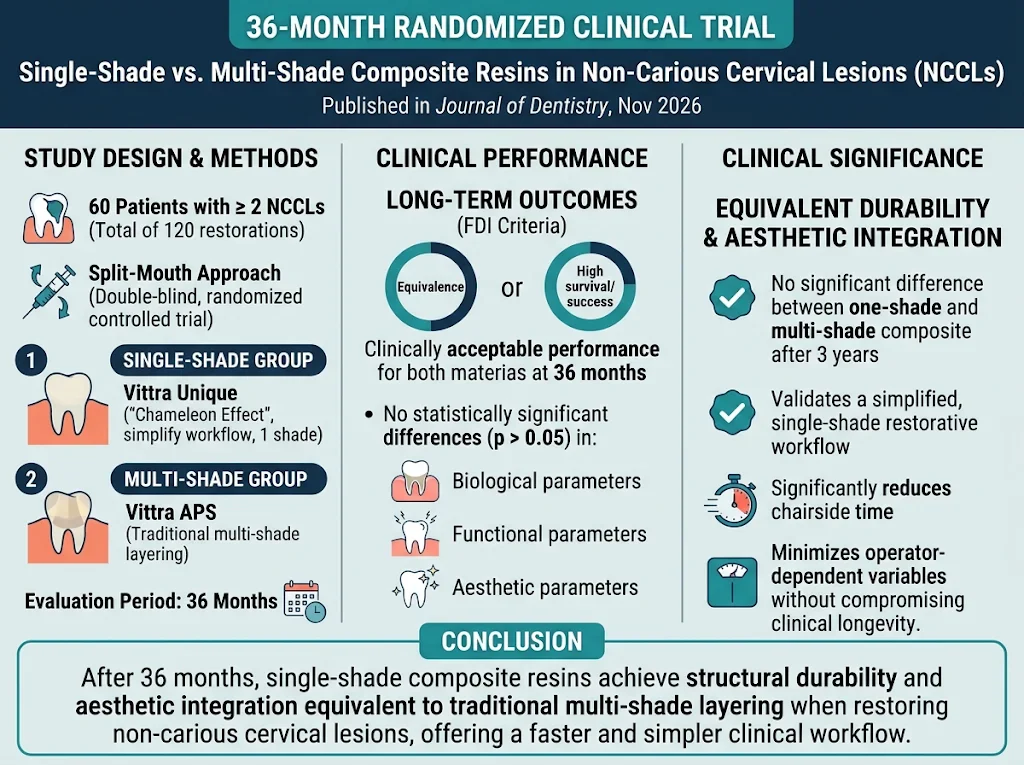
This investigation was a randomized, controlled, double-blind clinical trial with an equivalence design employing a split-mouth approach to minimize inter-individual variability. The study enrolled 60 patients each with at least two NCCLs, totaling 120 restorations.
Restorations were performed using two composite resins from the same manufacturer: Vittra Unique (single-shade, “chameleon effect”) and Vittra APS (multi-shade). This design allowed direct intraoral comparison under standardized conditions. Clinical performance was assessed longitudinally over 36 months based on the Fédération Dentaire Internationale (FDI) criteria, addressing biological (sensitivity, recurrence of caries, pulpal health), functional (fracture, retention), and aesthetic outcomes (color match, surface luster).
Statistical analyses included Kaplan–Meier survival curves with log-rank testing for restoration survival probabilities. Categorical clinical parameters were compared via chi-square tests with significance set at α = 0.05.
Key Findings
At baseline, the two groups showed no statistically significant differences across all evaluated parameters, confirming homogeneity prior to intervention.
Throughout the 36 months, both composite resins maintained clinically acceptable performance. Notably, the single-shade Vittra Unique demonstrated equivalent durability, retention rates, and aesthetic integration compared to the multi-shade Vittra APS.
There were no statistically significant differences between groups regarding biological compatibility — such as absence of secondary caries or postoperative sensitivity, functional integrity including fracture or marginal integrity, and aesthetic parameters including color stability and surface gloss.
Survival analysis indicated that the probability of restorations remaining intact without failure or need for intervention was comparable between materials over the full follow-up period.
Expert Commentary
The findings from de Miranda et al.’s trial reinforce emerging clinical evidence that single-shade composites can satisfactorily meet the demands of NCCL restorations. This equivalence in performance is attributed to the material’s adaptive optical properties, allowing it to blend with adjacent tooth structures despite a simplified shade system.
From a practical standpoint, the reduction in intraoperative steps afforded by single-shade composites may enhance efficiency, reduce procedure time, and lower technique sensitivity — advantages particularly relevant in busy clinical settings or less experienced operators.
However, it is important to consider that this study’s results are specific to NCCLs and the particular materials tested, and extrapolation to other restoration types or composite brands should be cautious. Future research could evaluate longer-term outcomes beyond three years, and performance in other clinical scenarios such as anterior esthetic restorations where color matching may be more critical.
Conclusion
This robust 36-month randomized clinical trial demonstrates that one-shade composite resin performs equivalently to a multi-shade composite in restoring non-carious cervical lesions with respect to biological, functional, and aesthetic criteria. The clinical success of single-shade composites supports their integration into routine practice for NCCLs, offering a simplified workflow without compromising restoration longevity or appearance.
These findings have implications for clinical decision-making aimed at balancing esthetic outcomes with operational efficiency, patient comfort, and cost-effectiveness in restorative dentistry.
Funding and ClinicalTrials.gov Registration
No specific funding disclosures were reported in the source article. The trial registration number was not provided.
References
- de Miranda AO, Lima J, Pierdona RL, Favoreto MW, Pupo YM, Reis A, Loguercio AD, Matos TP. Clinical performance evaluation of single-shade versus multi-shade composite resins in non-carious cervical lesions: a 36-month randomized clinical trial. J Dent. 2026 Jul 21;174:106922. PMID: 42480895.
- Van Dijken JWV, Pallesen U. Posterior Resin Composite Restorations in High- and Low-Caries-Risk Individuals: Results after 11 Years. J Dent. 2017;56:53-58.
- Ferracane JL. Resin composite—State of the art. Dent Mater. 2011 Jan;27(1):29-38.
- Fda Criteria for composite evaluation in clinical studies: Hickel R, et al. Clinical evaluation of dental restorative materials—recommendations for criteria, methods, and clinical procedures. Clin Oral Investig. 2010;14(4):349-359.
Specialty calculators
For clinical reference; use professional judgment.