Highlight
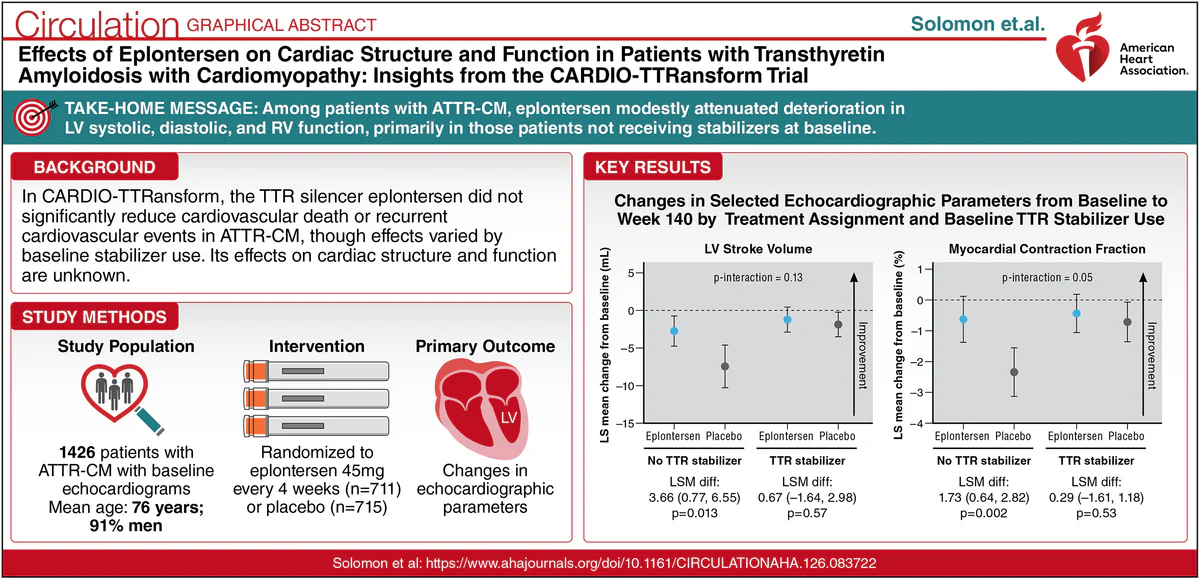
The CARDIO-TTRansform trial investigated eplontersen, a transthyretin (TTR) silencer, in patients with TTR amyloidosis with cardiomyopathy. Although the drug did not significantly reduce cardiovascular death or recurrent cardiovascular events overall, it attenuated key echocardiographic markers of cardiac dysfunction over 140 weeks, particularly in patients not on baseline TTR stabilizer therapy.
Baseline measures of left ventricular systolic and diastolic function as well as right ventricular function predicted mortality and major cardiovascular events. Eplontersen slowed worsening of LV wall thickness, stroke volume, myocardial contraction fraction, and diastolic function indices, highlighting potential cardioprotective effects.
Study Background
Transthyretin amyloidosis (ATTR) is a progressive infiltrative cardiomyopathy characterized by misfolded transthyretin protein deposits within myocardial tissue, leading to cardiomyocyte dysfunction, restrictive physiology, and heart failure. ATTR can manifest as wild-type or hereditary forms, with wild-type being more common in elderly men. Cardiac involvement portends significant morbidity and mortality.
Current therapies include TTR stabilizers such as tafamidis, which prevent tetramer dissociation. Recently, TTR silencers that inhibit TTR production are being studied as a complementary or alternative approach, potentially mitigating amyloid deposition and cardiac remodeling more directly.
Despite clinical advances, the effects of TTR silencers like eplontersen on cardiac structure and function in ATTR cardiomyopathy remain incompletely characterized, necessitating the CARDIO-TTRansform trial.
Study Design
CARDIO-TTRansform was a multicenter, randomized, placebo-controlled trial including 1,432 patients diagnosed with TTR amyloidosis with cardiomyopathy. Participants were randomized to subcutaneous eplontersen 45 mg every 4 weeks or placebo.
Echocardiograms were performed at baseline and at weeks 61, 97, and 140 to evaluate cardiac structure and function over time. Patients with and without baseline TTR stabilizer therapy were analyzed to explore potential interactions with treatment effect.
The primary endpoint comprised a composite of cardiovascular death and recurrent cardiovascular events, while secondary analyses evaluated echocardiographic parameters and their association with clinical outcomes.
Key Findings
Of 1,426 patients with baseline echocardiograms, the cohort had a mean age of 76 years, predominantly male (91%), with 85% wild-type ATTR and 57% receiving TTR stabilizers at baseline.
Baseline Predictors: Several echocardiographic markers of left ventricular systolic function — including LV ejection fraction, global longitudinal strain, stroke volume, and myocardial contraction fraction — as well as diastolic function parameters (E wave deceleration time, septal e’, average E/e’) and right ventricular function/hemodynamics independently predicted all-cause mortality and primary endpoint events, underscoring their prognostic value in ATTR-CM.
Treatment Effects at Week 140: Among patients with available follow-up echocardiograms (554 on eplontersen and 506 on placebo), eplontersen attenuated the increase in LV wall thickness (LSM difference -0.24 mm, 95% CI -0.48 to -0.01), and slowed declines in LV stroke volume (LSM difference 1.88 mL, 95% CI 0.07-3.69) and myocardial contraction fraction (LSM difference 0.88%, 95% CI 0.25-1.57).
The drug also mitigated worsening of diastolic dysfunction as reflected by average E/e’ (LSM difference -0.71, 95% CI -1.36 to -0.07) and improved right ventricular outflow tract velocity-time integral (LSM difference 0.42, 95% CI 0.00-0.85) relative to placebo.
These favorable echocardiographic changes were primarily seen in patients not receiving TTR stabilizers at baseline. No significant benefits were observed in those on stabilizer therapy, suggesting a possible ceiling effect or overlapping mechanisms.
Clinical Outcomes: Despite these structural and functional improvements, the primary composite endpoint of cardiovascular death and recurrent events was not significantly reduced overall by eplontersen, highlighting a disconnect between echocardiographic surrogate markers and hard clinical outcomes within the timeframe studied.
Expert Commentary
The CARDIO-TTRansform trial offers critical insights into the cardiac effects of TTR silencing in amyloid cardiomyopathy. The attenuation of disease progression in echocardiographic parameters indicates that eplontersen may positively influence myocardial remodeling and function, complementing known effects of TTR stabilizers.
The selective efficacy in patients not on baseline stabilizers may suggest that TTR silencers could be particularly beneficial as first-line therapy or in patients intolerant to stabilizers. Alternatively, combination approaches warrant further exploration.
However, the modest magnitude of changes and lack of significant impact on major clinical events raise questions about the clinical relevance of echocardiographic improvements alone. The trial duration or patient characteristics might have limited the ability to detect differences in hard endpoints.
Future research should investigate longer-term outcomes, potential combined therapy strategies, and whether early initiation of silencers could translate into mortality or hospitalization benefits.
Conclusion
Eplontersen demonstrated modest but statistically significant benefits in preserving left ventricular and right ventricular structure and function in patients with transthyretin amyloid cardiomyopathy, mainly among those not receiving concomitant TTR stabilizers. This supports the hypothesis that TTR silencing may slow cardiac deterioration in ATTR-CM.
While these echocardiographic improvements are promising, they have yet to translate clearly into reductions in cardiovascular death or recurrent events. Thus, eplontersen represents a potentially valuable therapeutic option within an evolving treatment landscape, emphasizing a personalized approach based on prior stabilizer use.
Ongoing and future studies are needed to confirm long-term clinical benefits and to define optimal patient selection and combination therapies for maximal cardiac protection in ATTR amyloidosis.
Funding and Registration
The CARDIO-TTRansform trial is registered on ClinicalTrials.gov (NCT04136171) and EudraCT (2019-002835-27). Details regarding funding sources were not provided in the abstract. The study was conducted and reported by a consortium of international experts in amyloidosis and cardiology.
References
- Jering KS, Skali H, Claggett B, et al. Effects of Eplontersen on Cardiac Structure and Function in Patients With Transthyretin Amyloidosis With Cardiomyopathy: Insights from the CARDIO-TTRansform Trial. Circulation. 2026 Nov 9. PMID: 43002247.
- Maurer MS, Hanna M, Grogan M, et al. Tafamidis Treatment for Patients With Transthyretin Amyloid Cardiomyopathy. N Engl J Med. 2018;379:1007-1016. <li}Gillmore JD, Damy T, Fontana M, et al. A New Imaging Paradigm to Differentiate Transthyretin from Light Chain Cardiac Amyloidosis: A Multimodality Approach. JACC Cardiovasc Imaging. 2020;13(11):247-260.
Specialty calculators
For clinical reference; use professional judgment.