Highlight
– Discharge to inpatient rehabilitation facilities (IRFs) after stroke is associated with better functional outcomes and higher quality-adjusted life years (QALYs) compared to skilled nursing facilities (SNFs).
– IRFs demonstrated lower overall 90-day healthcare costs despite higher upfront therapy intensity, yielding an average cost saving of $6,257 per patient from a US health care payer perspective.
– Functional recovery measures such as mobility and self-care improvements were significantly greater in patients discharged to IRFs.
– Results remained robust across multiple sensitivity analyses, supporting equitable access to intensive postacute rehabilitation.
Study Background
Stroke is a leading cause of long-term disability in the United States, with substantial clinical and economic impacts. Postacute rehabilitation is critical for functional recovery and quality of life improvement among stroke survivors. Two common institutional rehabilitation pathways include inpatient rehabilitation facilities (IRFs) and skilled nursing facilities (SNFs). IRFs deliver higher-intensity therapy, often leading to better outcomes but are perceived as more costly compared to SNFs, which provide less intensive rehabilitation.
The economic burden of stroke rehabilitation is substantial, and optimizing care pathways is a priority for US healthcare payers to maximize clinical benefits within constrained resources. Despite evidence of superior outcomes with IRFs, reimbursement policies and access barriers often lead to wide variability in utilization and patient placement decisions. There remains a need for robust cost-effectiveness analyses comparing IRFs and SNFs in order to inform policy and clinical decision-making.
Study Design
The study by Hayes et al. employed a decision analytic model simulating 90-day outcomes among adult stroke survivors (≥18 years) discharged to either IRFs or SNFs after ischemic or hemorrhagic stroke requiring institutional postacute care.
The model incorporated mortality, disability (using modified Rankin Scale categories 0-2 versus 3-6), probability of community discharge, and hospital readmissions as key outcomes. Costs were analyzed from the US health care payer perspective and included rehabilitation stay costs, subsequent long-term care, home health services, and readmission expenses. All costs were calculated in 2024 US dollars.
Utility values reflective of quality of life for four distinct health states were applied to estimate 90-day quality-adjusted life years (QALYs). Secondary analyses integrated functional recovery measures using the Activity Measure for Postacute Care (AM-PAC) and Functional Independence Measure (FIM) domains. The robustness of results was tested through one-way and probabilistic sensitivity analyses, including 10,000 Monte Carlo simulations.
Key Findings
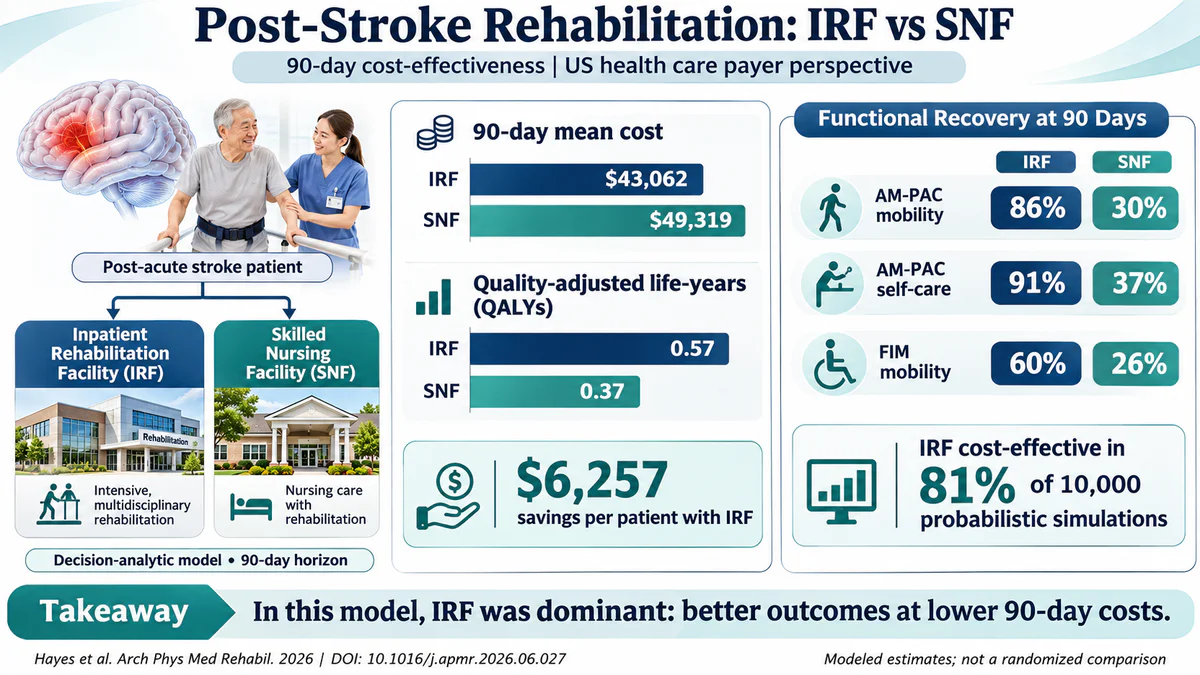
In the base case, discharge to an IRF was the dominant strategy over SNF discharge. IRF patients accrued higher effectiveness with mean 90-day QALYs of 0.57 compared to 0.37 for SNF patients. Despite the higher initial intensity of rehabilitation in IRFs, total mean 90-day costs were lower ($43,062 for IRF vs $49,319 for SNF), resulting in net savings of $6,257 per patient.
Functional analyses reinforced these findings. The probability of clinically meaningful functional improvements in mobility and self-care (measured by AM-PAC) were substantially higher in IRF recipients: 86% vs 30% for mobility and 91% vs 37% for self-care. Similarly, improvements in FIM mobility scores were doubled (60% vs 26%) in the IRF group.
The superiority of IRFs persisted across wide parameter ranges in one-way sensitivity tests and in 81% of probabilistic simulations, indicating strong confidence in cost-effectiveness across varying assumptions. These results suggest that the higher upfront costs of IRF care are offset by better recovery profiles, reduced long-term care needs, and fewer readmissions.
Expert Commentary
This study provides robust economic and clinical evidence favoring IRF discharge for stroke survivors requiring institutional postacute care. The integration of functional outcome measures beyond traditional mortality and disability scales adds valuable insight into patient-centered recovery trajectories.
Limitations include the 90-day horizon, which may underestimate longer-term cost offsets and functional benefits. The decision model relies on aggregated data and assumptions that may not capture all regional or population-level heterogeneity. Additionally, patient selection factors influencing the appropriateness of IRF vs SNF placement may confound results despite modeling adjustments.
Nonetheless, the findings align with clinical guidelines advocating intensive rehabilitation to optimize stroke recovery. From a health policy perspective, these data support efforts to expand equitable access to IRFs and reconsider reimbursement structures that may inadvertently favor less effective lower-intensity settings.
Conclusion
Among stroke survivors requiring institutional rehabilitation, discharge to inpatient rehabilitation facilities is associated with significantly better functional outcomes, greater quality-adjusted life years, and lower 90-day healthcare costs compared to discharge to skilled nursing facilities. This cost-effectiveness analysis from a US payer perspective substantiates the value of intensive rehabilitation and provides actionable evidence to guide clinical and policy decisions. Efforts to improve access to IRFs may enhance stroke recovery and reduce overall healthcare expenditures.
Funding and ClinicalTrials.gov
The original study was published in the Archives of Physical Medicine and Rehabilitation in 2026 (PMID: 42402263). No specific funding sources or clinical trial registrations were reported in the abstract.
References
- Hayes H, Yoo M, Nelson R. Cost-Effectiveness of Postacute Stroke Rehabilitation From a US Health Care Payer Perspective: Inpatient Rehabilitation Facilities Versus Skilled Nursing Facilities. Arch Phys Med Rehabil. 2026 Jul;107(11):3205-3211. PMID: 42402263.
- Duncan PW, Zorowitz R, Bates B, et al. Management of Adult Stroke Rehabilitation Care: A clinical practice guideline. Stroke. 2005 Sep;36(9):e100-43.
- Winstein CJ, Stein J, Arena R, et al. Guidelines for Adult Stroke Rehabilitation and Recovery: A Guideline for Healthcare Professionals from the American Heart Association/American Stroke Association. Stroke. 2016 Jun;47(6):e98-e169.
- Fisher K, Robinson-Smith G, Corazon S. Comparing outcomes from acute stroke rehabilitation in inpatient rehabilitation facilities and skilled nursing facilities. Rehabil Nurs. 2009 Nov-Dec;34(6):238-45.
- Centers for Medicare & Medicaid Services. IRF and SNF comparative data and analysis. 2023. Available at: https://www.cms.gov/
Specialty calculators
For clinical reference; use professional judgment.