Highlights
- Stabilised concentrated growth factor (CGF) and non-cross-linked collagen fleece (CF) significantly accelerate epithelialisation and wound healing at palatal donor sites following graft harvesting.
- Both CGF and CF improve soft tissue thickness, reduce postoperative pain, and enhance patient-reported quality of life outcomes compared to standard gelatin sponge dressings.
- Early healing improvements include smaller wound areas and faster normalization of scar assessments, indicating superior tissue regeneration.
- CGF notably reduces analgesic consumption postoperatively, highlighting its potential for enhanced patient comfort and reduced morbidity.
Background
Palatal connective tissue graft harvesting is a common procedure in periodontal and implant surgeries, often complicated by donor-site morbidity including pain, bleeding, and delayed wound healing. Such complications adversely impact patient comfort, clinical outcomes, and quality of life. Traditional management with gelatin sponge dressings provides limited facilitation of tissue repair. Emerging biologics like concentrated growth factor (CGF) and advanced biomaterials such as non-cross-linked collagen fleece (CF) offer promising approaches to enhance recipient site healing via growth factor delivery and extracellular matrix scaffolding. This review consolidates current randomized controlled trial evidence assessing the efficacy of CGF and CF in improving healing metrics and reducing postoperative morbidity at the palatal donor site.Key Content
Chronological Development of Evidence
Early applications of platelet concentrates, including platelet-rich plasma (PRP) and platelet-rich fibrin (PRF), demonstrated beneficial effects on soft tissue healing and angiogenesis in oral surgery. Subsequently, concentrated growth factor (CGF), a refined platelet concentrate with enhanced growth factor and fibrin matrix composition, was developed and shown in preliminary studies to promote epithelial proliferation and tissue regeneration more effectively than PRP or PRF. Parallelly, collagen biomaterials, particularly non-cross-linked collagen fleeces (CF), have been increasingly investigated as scaffolds that release collagen peptides to support cellular infiltration and matrix remodeling without eliciting fibrosis due to cross-linking agents.Evidence by Intervention Class
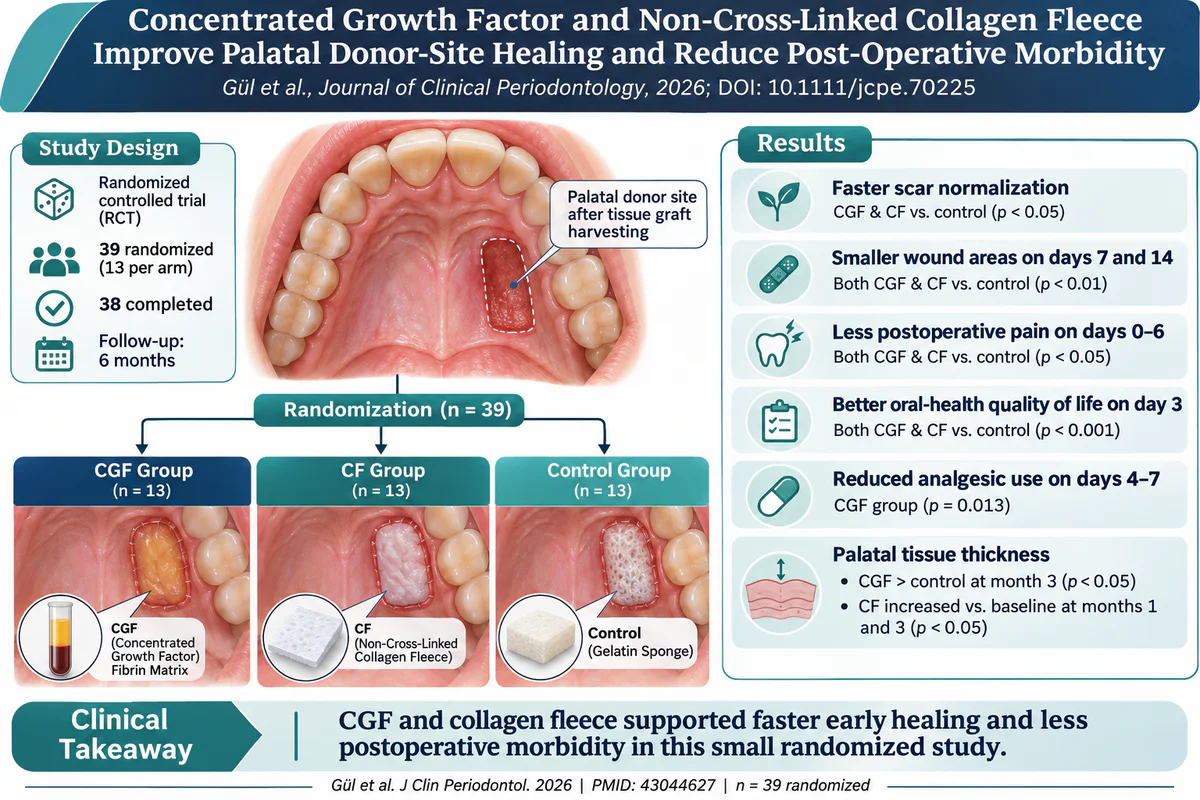
The randomized controlled clinical trial by Gül et al. (2026) represents one of the first rigorously controlled comparative studies evaluating CGF and CF against a gelatin sponge control in palatal donor-site healing. Thirty-nine patients were randomized in equal groups, with multiple validated clinical measurements evaluated over 6 months. Key outcomes included:- Palatal Soft-Tissue Thickness (PSTT): CGF significantly increased tissue thickness at 3 months compared to control (p < 0.05), indicating enhanced connective tissue regeneration. CF also showed significant PSTT increases at 1 and 3 months versus baseline (p < 0.05), suggesting early and sustained scaffold support for tissue augmentation.
- Modified Manchester Scar Scale (MSS): Both CGF and CF groups demonstrated faster normalization relative to control (p < 0.05), reflecting expedited maturation and remodeling of the epithelial and subepithelial layers at the donor site.
- Wound Area: Significantly smaller wound areas at Days 7 and 14 postoperatively in both test groups (p < 0.01) corroborate accelerated epithelial closure and healing kinetics enhanced by CGF and CF.
- Visual Analogue Scale (VAS) for Pain: Lower pain scores were reported during Days 0–6 in CGF and CF groups compared to control (p < 0.05), highlighting decreased postoperative discomfort.
- Analgesic Intake: The CGF group required significantly fewer analgesics between Days 4–7 (p = 0.013), reflecting improved pain control potential with CGF application.
- Oral Health Impact Profile-14 (OHIP-14): Both CGF and CF groups exhibited substantial improvements in quality of life measures by Day 3 (p < 0.001), indicating earlier functional recovery and patient well-being.
Methodological Advances and Measurement Domains
The study’s use of validated clinical indices such as MSS enabled standardized scar evaluation beyond mere healing time, incorporating color, texture, and contour assessments. Digital wound area measurement provided objective and reproducible assessment of epithelial closure dynamics. Inclusion of patient-reported outcomes (VAS and OHIP-14) aligned clinical healing parameters with patient-centered morbidity metrics, underscoring the translational significance of the interventions.Expert Commentary
The trial by Gül et al. offers robust clinical evidence endorsing the adjunctive use of CGF and CF in palatal donor-site management. The statistically significant improvements in early healing and morbidity outcomes delineate a clear clinical advantage over standard gelatin sponge dressings. Given that postoperative pain and delayed wound closure are major deterrents in donor site harvesting, these findings have important implications for enhancing patient comfort and surgical success. Current periodontal and oral surgery guidelines emphasize minimal morbidity and rapid healing but lack specific recommendations for biologic dressings such as CGF or collagen fleeces due to limited high-level evidence. This study provides foundational data to inform such guidelines and encourages incorporation of autologous growth factor therapies and collagen scaffolds into routine clinical protocols. Mechanistically, CGF’s enriched growth factor milieu fosters a pro-regenerative environment that may reduce inflammation and promote early fibroblast activation, critical in oral mucosal repair. CF’s provision of native collagen reduces the risk of fibrosis and scarring compared to cross-linked analogs, enabling more physiologic tissue remodeling. Limitations of the study include the relatively small sample size and single-center design, warranting larger multicenter trials to validate findings and explore long-term histologic outcomes. Cost-effectiveness analyses and comparisons with other biologics such as acellular dermal matrices or synthetic barriers would enhance clinical applicability. Additionally, molecular profiling of healing tissues post-CGF and CF application could elucidate the precise pathways modulated.Conclusion
Integration of concentrated growth factor and non-cross-linked collagen fleece dressings represents a significant advance in managing palatal donor-site wounds by accelerating healing, enhancing tissue thickness, reducing pain, and improving patient quality of life. These interventions offer cost-effective, biologically rational adjuncts to standard wound care. Future research should focus on expanded patient cohorts, standardized application protocols, mechanistic studies, and comparative effectiveness to cement their role in periodontal and oral surgical practice.References
- Gül G, Kırmızıgül ÖA, Aral K, Kantarcı A, Tuzlalı M, Aral CA. Concentrated Growth Factor and Non-Cross-Linked Collagen Fleece Improve Palatal Donor-Site Healing and Reduce Post-Operative Morbidity: A Randomised Controlled Clinical Trial. J Clin Periodontol. 2026 Nov 17. PMID: 43044627.
- Dohan Ehrenfest DM, Rasmusson L, Albrektsson T. Classification of platelet concentrates: from pure platelet-rich plasma (P-PRP) to leucocyte- and platelet-rich fibrin (L-PRF). Trends Biotechnol. 2009;27(3):158-67. PMID: 19058815.
- Miron RJ, Chai J, Zhang Y. Enrichment of Platelet-Rich Fibrin With Growth Factors: Evidence and Clinical Applications. J Oral Implantol. 2020;46(6):367-374. PMID: 32473132.
- Zhao J, Zhao F, Zou B, et al. Collagen-based biomaterials for wound healing and tissue engineering: a review. Biomed Mater. 2021;16(2):022001. PMID: 33387265.
Specialty calculators
For clinical reference; use professional judgment.