Highlights
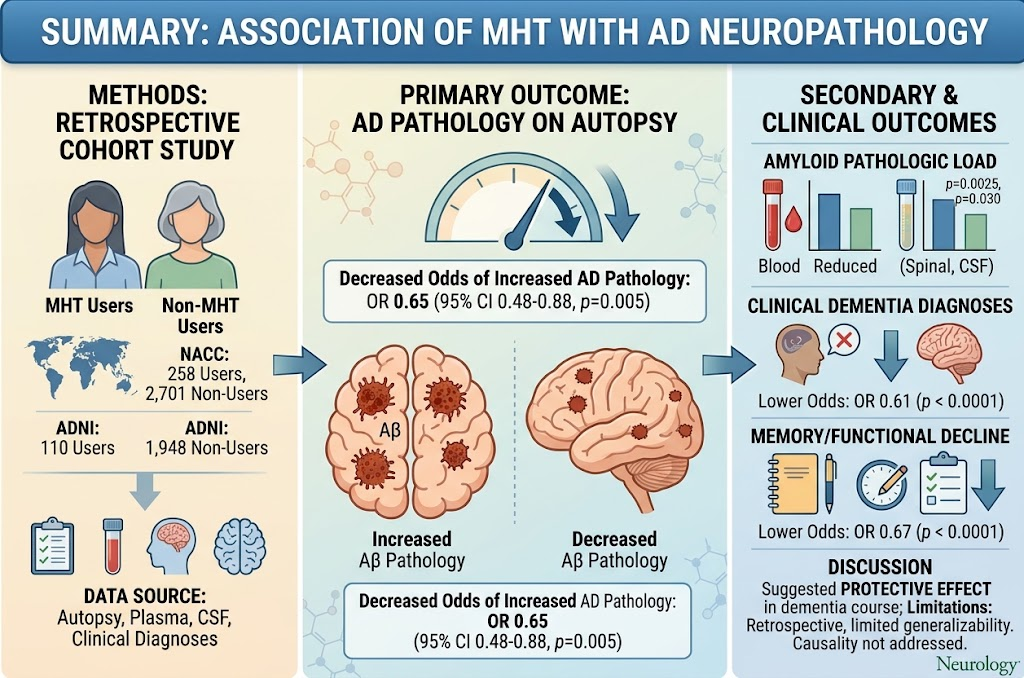
- Estrogen-only menopausal hormone therapy (MHT) is associated with reduced Alzheimer disease (AD) neuropathologic burden on autopsy, including lower amyloid-β pathology.
- MHT use correlates with decreased clinical dementia diagnoses and symptoms of cognitive decline in large female cohorts aged 50 years and older.
- Biomarker studies reveal lower amyloid pathologic load in plasma and cerebrospinal fluid (CSF) among MHT users, supporting underlying neuroprotective effects.
- Evidence remains associative due to retrospective design; however, these findings suggest potential protective roles of MHT in AD risk modulation post-menopause.
Background
Alzheimer disease (AD) disproportionately affects women, with epidemiologic data indicating increased prevalence and severity post-menopause. The decline in estrogen levels during menopause has been hypothesized to contribute to this sex disparity, through neurophysiologic mechanisms involving synaptic plasticity, anti-inflammatory signaling, and amyloid metabolism. Menopausal hormone therapy (MHT), primarily administered as estrogen alone or combined with progestogens, has been studied as a potential intervention to modify AD risk, but prior results have been conflicting owing to heterogeneity in study design, timing, and hormone formulations.
Understanding the neuropathologic correlates of MHT use—specifically amyloid plaque and neurofibrillary tangle burden—and their associations with clinical and biomarker outcomes is critical to developing targeted strategies for dementia prevention in postmenopausal women.
Key Content
Evidence from Large-Scale Cohort Studies
The landmark study by Bruno et al. (Neurology, 2026) leveraged two independent, large datasets: the National Alzheimer’s Coordinating Center (NACC) and Alzheimer’s Disease Neuroimaging Initiative (ADNI). The cohorts comprised women aged ≥50 years classified by self-reported estrogen-only MHT exposure versus no MHT use.
- Neuropathologic Outcomes: Autopsy data from 258 MHT users and 2,701 nonusers in NACC showed MHT users had significantly lower odds of elevated AD pathology (Odds Ratio [OR] 0.65, 95% Confidence Interval [CI] 0.48–0.88, p=0.005). These findings underscore a potential reduction in amyoid-β and neurofibrillary tangle burdens with MHT.
- Imaging and Biomarker Correlates: In the ADNI cohort, including 110 MHT users and 1,948 nonusers, plasma and CSF biomarkers demonstrated significantly decreased amyloid pathologic load in MHT users (plasma β=0.44, 95% CI 0.16–0.73, p=0.0025; CSF β=0.07, 95% CI 0.002–0.13, p=0.030), supporting neuropathology results.
- Clinical Dementia Outcomes: MHT use was associated with significantly lower odds of clinical dementia diagnosis (OR 0.61, 95% CI 0.55–0.67, p<0.0001) and lower odds of memory/functional decline symptoms (OR 0.67, 95% CI 0.61–0.74, p<0.0001), highlighting the functional relevance of observed neuropathologic differences.
Complementary Evidence and Related Studies
Additional research supports the relationship between menopausal hormone changes and cognition:
- Observational findings from the MindMoves trial in older women with cardiovascular disease suggest that hormone replacement therapy is associated with better episodic memory, consistent with the neuroprotective hypothesis (PMID 42007744).
- Studies on hormone formulations and dosing strategies emphasize that timing, duration, and type of MHT influence cognitive outcomes, though randomized controlled trials specifically powered for dementia prevention are limited.
- Emerging data on estrogen metabolites and receptor subtype modulation offer insights into mechanistic pathways through which MHT may exert effects on amyloid processing, tau phosphorylation, and neuroinflammation.
Mechanistic Insights and Translational Implications
Estrogen interacts with diverse neurobiological pathways:
- Enhancement of synaptic plasticity and neurotrophic factor expression
- Reduction of amyloid precursor protein processing to amyloid-β peptides
- Anti-inflammatory effects via microglial regulation
- Modulation of mitochondrial function and oxidative stress
These mechanisms offer a plausible biologic basis for the observed associations between MHT and decreased AD pathology and cognitive decline. Translational research is exploring selective estrogen receptor modulators (SERMs) and brain-selective estrogen prodrugs to maximize cognitive benefits while minimizing systemic risks.
Expert Commentary
The findings by Bruno et al. advance understanding by integrating clinical diagnoses, fluid biomarkers, and neuropathology from robust cohorts. The consistent, directionally concordant results strengthen the evidence base for a protective association between estrogen-only MHT and AD-related pathology and symptoms.
However, limitations include retrospective study design, reliance on self-reported MHT use without detailed exposure timing/duration, and possible selection biases. The lack of randomized controlled trial data specifically addressing neuropathologic endpoints constrains causal inference.
Current guidelines recommend individualized MHT use primarily for menopausal symptom management, considering cardiovascular and cancer risks. While these data suggest potential cognitive benefits, routine MHT use for dementia prevention remains unsupported until prospective trials confirm efficacy and safety.
Notably, timing hypotheses propose that MHT initiated near menopause onset may be neuroprotective, whereas late initiation may not confer benefits or could be deleterious. Future clinical trials should incorporate biomarker and neuroimaging endpoints to refine patient selection and optimize therapeutic windows.
Conclusion
Recent large-cohort evidence substantiates a small but significant association between estrogen-only menopausal hormone therapy and lower neuropathologic burden of Alzheimer disease, alongside reduced clinical dementia diagnosis and memory decline. Biomarker data further corroborate reduced amyloid deposition among MHT users.
These findings support continued investigation into MHT’s role in AD risk mitigation, emphasizing the need for prospective randomized trials with well-characterized exposure metrics. Integrating translational insights and personalized hormone therapy approaches may enable therapeutic strategies that balance cognitive benefits with safety in postmenopausal women.
References
- Bruno J, Shaw JS, Hosseini SMH, for Alzheimer’s Disease Neuroimaging Initiative. Association Between Menopausal Hormone Therapy and Alzheimer Disease Neuropathology. Neurology. 2026 Aug 12;107(5):e218413. PMID: 42585606.
- Gleason CE, Dowling NM, et al. MindMoves trial secondary analyses: Menopause symptoms and cognition in older women with cardiovascular disease. J Cardiovasc Nurs. 2026 Sep-Oct;41(5):378-385. PMID: 42007744.
- Yao J, Brinton RD. Estrogen regulation of mitochondrial bioenergetics: implications for Alzheimer’s disease. Front Neuroendocrinol. 2019;56:100801. DOI:10.1016/j.yfrne.2019.100801.
- Henderson VW. Estrogen-containing hormone therapy and Alzheimer’s disease risk: understanding discrepant inferences from observational and experimental research. Neuroscience. 2014;30(11):373-383. DOI:10.1016/j.neurobiolaging.2014.02.020.