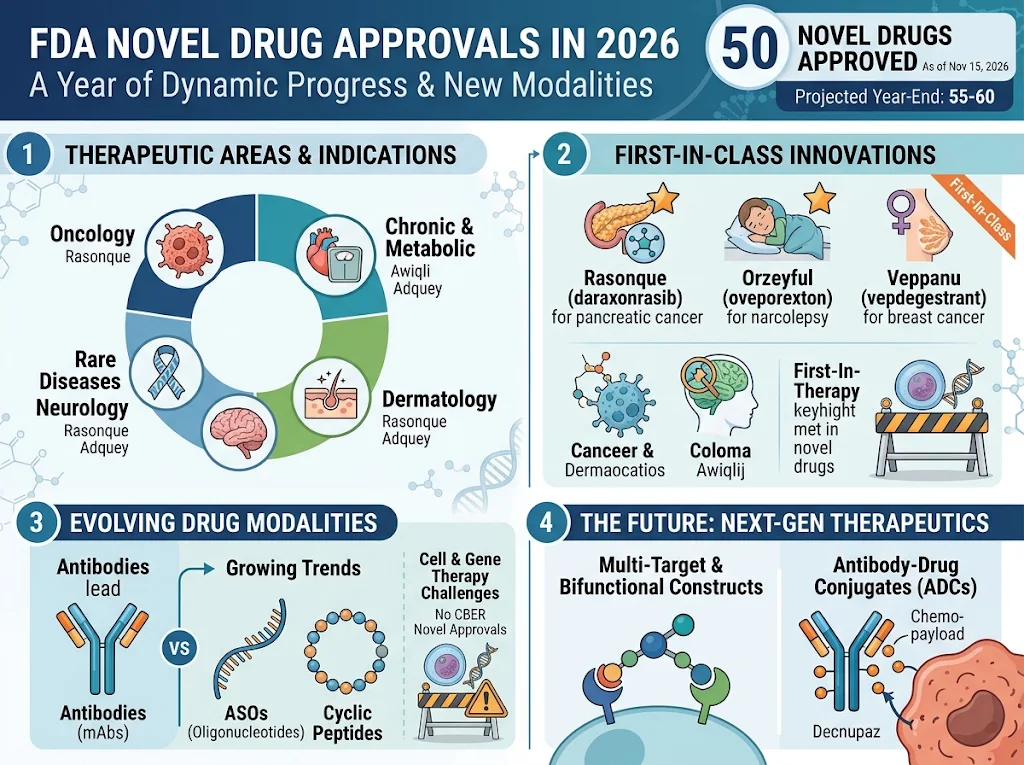
As of November 15, 2026, the U.S. Food and Drug Administration (FDA) Center for Drug Evaluation and Research (CDER) has approved 50 novel drugs (as detailed on the Novel Drug Approvals for 2026 page). Maintaining this steady regulatory momentum through the final weeks of the year, total novel approvals for 2026 are projected to reach 55 to 60, reflecting a robust and consistent pace of pharmaceutical innovation compared to historical averages.
1. Breakdown by Therapeutic Area and Indication
The 2026 approvals span a wide spectrum of clinical needs, with oncology, chronic metabolic/cardiovascular conditions, rare genetic disorders, and neurology leading the landscape:
- Oncology & Hematology: Remains a cornerstone of FDA approvals, covering both solid tumors and hematologic malignancies. Key approvals include Rasonque (daraxonrasib) for metastatic pancreatic cancer; Etcamah (camizestrant), Revtorpyk (gedatolisib), and Veppanu (vepdegestrant) for advanced breast cancer; Jideytro (zidesamtinib) for ROS1-positive non-small cell lung cancer; Lyrfigtu (lirafugratinib) for cholangiocarcinoma; Lifyorli (relacorilant) for ovarian cancer; Pimjetmi (pimicotinib) for tenosynovial giant cell tumors; Zenbexus (iberdomide) for multiple myeloma; Beqalzi (sonrotoclax) for mantle cell lymphoma; and Decnupaz (pivekimab sunirine-pvzy) for blastic plasmacytoid dendritic cell neoplasm.
- Chronic, Metabolic & Cardiovascular Diseases: High-prevalence chronic conditions saw major additions, particularly in weight management, diabetes, and cardiovascular risk reduction. Highlights include oral GLP-1 therapy Foundayo (orforglipron) for obesity; once-weekly insulins Awiqli (insulin icodec-abae) and Onswik (insulin efsitora alfa-gobe) for type 2 diabetes; Lipfendra (enlicitide decanoate) for lowering LDL cholesterol; Baxfendy (baxdrostat) for hypertension; and Sunharbo (asundexian) for secondary stroke prevention.
- Rare & Genetic Diseases: Orphan drug innovation remained strong, featuring Zycubo (copper histidinate) for Menkes disease, Loargys (pegzilarginase-nbln) for Arginase 1 Deficiency, Yuviwel (navepegritide) for achondroplasia, Avlayah (tividenofusp alfa-eknm) for Hunter syndrome, Zanvastro (zilganersen) for Alexander disease, Isembyld (apitegromab-mstn) for spinal muscular atrophy, Emcitate (tiratricol) for MCT8 deficiency, and two therapies—Pasatru (garetosmab-grts) and Atebrioz (zilurgisertib)—for fibrodysplasia ossificans progressiva (FOP).
- Neurology & Psychiatry: Notable approvals include Bysanti (milsaperidone) for schizophrenia and bipolar I disorder, Simtriyo (centanafadine) for ADHD, Orzeyful (oveporexton) for narcolepsy type 1, Juvmo (tavapadon) for Parkinson’s disease, and Klygefa (gefurulimab-gaks) for generalized myasthenia gravis.
- Dermatology & Autoimmune Disorders: Approvals targeting inflammatory and skin conditions include Adquey (difamilast) for atopic dermatitis, Icotyde (icotrokinra) for plaque psoriasis, and Lisraya (brepocitinib) for dermatomyositis.
- Infectious Diseases & Other Specialties: Key anti-infectives include Idvynso (doravirine/islatravir) for HIV-1, Hepcludex (bulevirtide-gmod) for chronic hepatitis D, Hibsago (bepirovirsen) for chronic hepatitis B, Xocova (ensitrelvir) for COVID-19 post-exposure prophylaxis, Hovilpri (pritelivir) for resistant herpes simplex virus, and Zaynich (cefepime/zidebactam) alongside Utebzi (tebipenem pivoxil) for complicated urinary tract infections. Diagnostic radiopharmaceuticals Tauklarify (florquinitau F 18) and Pixclara (floretyrosine F 18), as well as ophthalmic drugs Lytenava (bevacizumab-vikg) and Lumvoa (veligrotug-vvze), round out the list.
2. Notable First-in-Class Approvals
A significant portion of the 2026 cohort introduces novel mechanisms of action, offering first-in-class options for previously undruggable or poorly managed targets:
- Rasonque (daraxonrasib): A pioneering multi-selective RAS(ON) inhibitor targeting metastatic pancreatic cancer, breaking long-standing barriers in RAS-driven oncology.
- Orzeyful (oveporexton): The first selective orexin 2 receptor (OX2R) agonist approved to directly address the underlying hypocretin/orexin deficiency in narcolepsy type 1.
- Sunharbo (asundexian): A first-in-class oral Factor XIa inhibitor designed to prevent recurrent ischemic stroke without significantly increasing major bleeding risks.
- Veppanu (vepdegestrant): A breakthrough PROTAC (proteolysis-targeting chimera) estrogen receptor degrader for ESR1-mutated breast cancer, validating targeted protein degradation in solid tumors.
- Isembyld (apitegromab-mstn): The first muscle-directed therapy (selectively inhibiting latent myostatin activation) approved to improve motor function in spinal muscular atrophy alongside SMN-targeted treatments.
- Baxfendy (baxdrostat): A highly selective aldosterone synthase inhibitor offering a new mechanism for resistant hypertension.
- Zycubo (copper histidinate): The first FDA-approved treatment specifically indicated for pediatric patients with Menkes disease.
3. Drug Modalities: Rise of Oligonucleotides and Cyclic Peptides vs. Cell & Gene Therapy Bottlenecks
The molecular composition of 2026 approvals underscores a clear diversification beyond traditional small molecules and monoclonal antibodies:
- Antibodies Remain Foundational: Monoclonal antibodies and engineered biologics continue to anchor the pipeline across oncology, immunology, and rare diseases (e.g., Klygefa, Pasatru, Isembyld, Lumvoa, Lytenava).
- Growth in Oligonucleotides (ASOs) and Peptides: Nucleic acid and peptide therapeutics demonstrated strong clinical translation in 2026. Antisense oligonucleotides (ASOs) achieved key milestones with Zanvastro (zilganersen) for Alexander disease and Hibsago (bepirovirsen) for chronic hepatitis B. Concurrently, innovative peptide architectures gained traction, highlighted by Lipfendra (enlicitide decanoate)—an oral macrocyclic peptide PCSK9 inhibitor—as well as Icotyde (icotrokinra, an oral targeted peptide inhibiting IL-23R), Mimrylo (rusfertide, a hepcidin mimetic peptide), and Yuviwel (navepegritide, a prodrug CNP peptide).
- Absence of New Cell and Gene Therapies in CDER Approvals: Notably, no novel cell or gene therapies appear among CDER’s 50 novel approvals in 2026 (note: cell and gene therapies are regulated under CBER, though overall industry output in 2026 also reflected slower novel commercial launches in these categories). This underscores the persistent developmental, manufacturing (CMC), durability, and reimbursement hurdles facing in vivo gene therapies and complex engineered cell therapies, contrasting sharply with the scalable manufacturing and predictable pharmacokinetics of ASOs and peptides.
4. Emerging R&D Trends: Multi-Target Constructs and ADCs
Within biologics and peptide engineering, two structural trends stand out as primary drivers for the next wave of pharmaceutical R&D:
- Next-Generation Antibody-Drug Conjugates (ADCs): ADCs continue to evolve toward rarer hematologic and solid tumor targets with improved linker-payload stability. In 2026, Decnupaz (pivekimab sunirine-pvzy), a CD123-targeting ADC carrying a novel indolinobenzodiazepine pseudodimer (IGN) payload, secured approval for blastic plasmacytoid dendritic cell neoplasm (BPDCN), exemplifying the push into precision cytotoxic delivery.
- Multi-Target and Bifunctional Design: Drug developers are increasingly moving away from single-pathway blockade toward multi-specific molecules and rational co-formulations that overcome resistance and improve convenience. Examples from 2026 include Zaynich (combining cefepime with the dual-action β-lactamase inhibitor/PBP2 binder zidebactam), Avlayah (tividenofusp alfa-eknm, a fusion protein utilizing a transferrin receptor-binding module to ferry iduronate-2-sulfatase across the blood-brain barrier), and Klygefa (gefurulimab-gaks, a dual-binding nanobody targeting both C5 and albumin for extended half-life). Together, multi-target engineering and targeted conjugates represent the core frontier of next-generation therapeutic design.
Reference
https://www.fda.gov/drugs/novel-drug-approvals-fda/novel-drug-approvals-2026
Specialty calculators
For clinical reference; use professional judgment.