Highlight
- Biatrial maze ablation yields superior freedom from atrial tachyarrhythmias at 12 months compared to left atrial maze in patients undergoing rheumatic mitral valve surgery with persistent or long-standing persistent atrial fibrillation.
- Biatrial maze ablation does not increase the risk of permanent pacemaker implantation, meeting noninferiority criteria relative to left atrial ablation.
- The trial utilized rigorous procedural standardization with surgeon certification and centralized video adjudication to ensure high-quality and reproducible ablation techniques.
- These findings provide critical evidence to guide surgical lesion set selection during concomitant surgical ablation in cardiac valve procedures.
Study Background
Atrial fibrillation (AF) is a common arrhythmic complication in patients undergoing cardiac surgery, particularly in the context of rheumatic mitral valve disease, which remains a significant global health burden. Persistent and long-standing persistent AF increase morbidity through stroke risk, heart failure, and impaired quality of life. Surgical ablation concomitant to cardiac valve surgery is recommended by guidelines to restore sinus rhythm and improve clinical outcomes. However, the optimal lesion set remains debated, specifically the comparative efficacy and safety of biatrial versus left atrial (LA) maze ablation techniques. The Cox-Maze IV procedure represents a biatrial method involving lesions in both atria to interrupt arrhythmogenic circuits, whereas the LA maze targets the left atrium alone, potentially reducing procedural complexity but possibly at the expense of efficacy.
Study Design
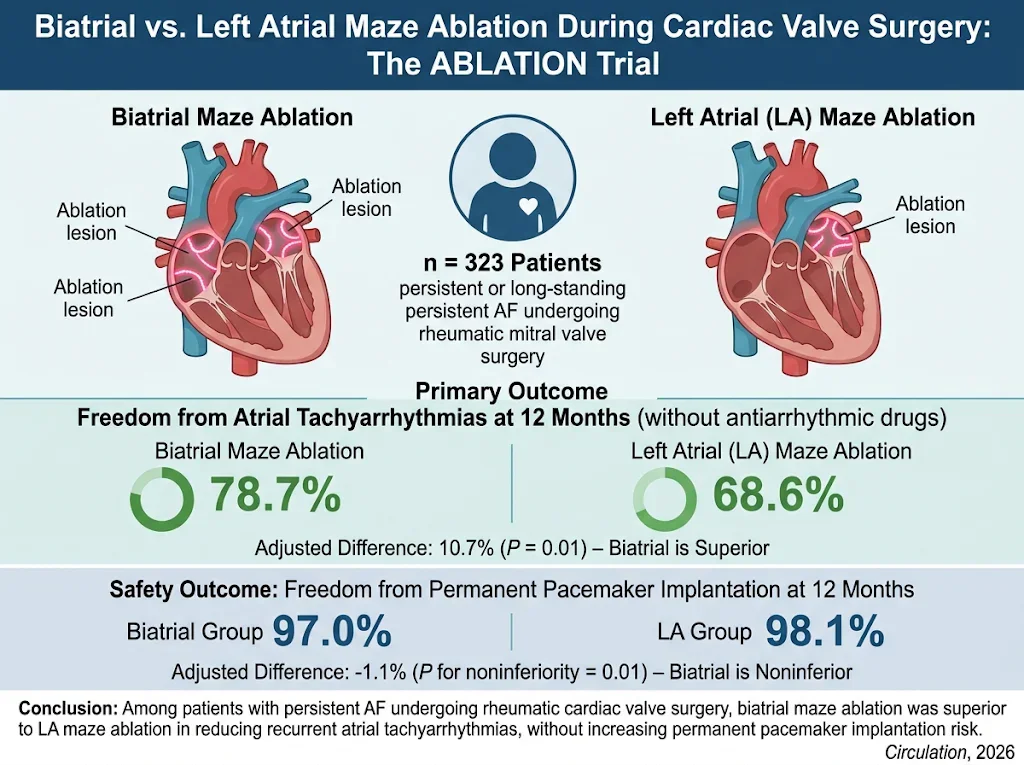
The ABLATION trial was a multicenter, randomized, single-blind investigation enrolling 323 patients with persistent or long-standing persistent AF undergoing rheumatic mitral valve surgery, with or without other cardiac procedures. Participants were randomized 1:1 to receive either biatrial maze ablation via a complete Cox-Maze IV lesion set or exclusively left atrial maze ablation. Surgeons underwent extensive pretrial training and were certified to standardize the ablation techniques. All ablation procedures were videorecorded and centrally reviewed to ensure procedural consistency and fidelity. The primary endpoint was freedom from atrial tachyarrhythmias lasting longer than 30 seconds without antiarrhythmic drugs at 12 months post-surgery. The key secondary endpoint assessed safety through freedom from permanent pacemaker implantation, with a predefined noninferiority margin of -5% between groups.
Key Findings
The intention-to-treat cohort included 323 patients (mean age 56.5 years; 72.1% female; mean left atrial diameter 51.9 mm). At 12 months, freedom from atrial tachyarrhythmias was achieved in 78.7% (129/164) of the biatrial group, compared to 68.6% (109/159) in the LA group. The adjusted difference of 10.7% (1-sided lower 95% CI, 3%) was statistically significant (P=0.01), confirming superiority of biatrial ablation. Importantly, this arrhythmia control was attained without a significant increase in permanent pacemaker implantation: 97.0% of the biatrial group versus 98.1% of the LA group remained free from permanent pacing (adjusted difference -1.1% [1-sided lower 95% CI, -3.9%]; Pnoninferiority=0.01), thus meeting the noninferiority criterion. These data suggest that more extensive ablation does not translate into higher conduction system complications in this population. The trial’s rigorous methodology, including procedural standardization and blinded outcome assessment, strengthens the validity of these findings.
Expert Commentary
The ABLATION trial provides compelling direct evidence supporting the use of biatrial maze ablation during rheumatic mitral valve surgery in patients with persistent or long-standing persistent AF. Previous studies largely extrapolated from heterogeneous populations or used surrogate outcomes. This trial delineates a patient-centered endpoint — freedom from clinically relevant arrhythmia without antiarrhythmic drugs — and simultaneously addresses safety concerns regarding pacemaker dependency. The noninferiority in pacemaker implantation rates mitigates prior concerns that biatrial lesions might increase conduction disturbances. The results align with mechanistic understanding that atrial fibrillation substrates often involve both atria, especially in persistent forms and rheumatic pathology, making biatrial ablation more comprehensive. An important strength is the careful surgical training and videographic quality control, which reduces variability and increases reproducibility in clinical practice. However, the study cohort mainly involved rheumatic valve disease and younger patients (mean age ~56 years), possibly limiting generalizability to degenerative valve disease or older populations. Longer-term arrhythmia and clinical outcome data beyond 12 months would be informative to consolidate these findings. Moreover, operational factors such as increased procedure duration and surgeon expertise required for biatrial ablation merit consideration in routine practice.
Conclusion
In summary, the ABLATION trial establishes that biatrial maze ablation produces superior rhythm control compared to left atrial ablation alone in patients undergoing rheumatic mitral valve surgery with persistent AF, without a concomitant increase in the risk of permanent pacemaker implantation. These findings provide a high-quality evidence base to guide lesion set decision-making in concomitant surgical ablation during cardiac valve surgery. Incorporating biatrial approaches may optimize patient outcomes by more effectively targeting arrhythmogenic substrates while maintaining safety. Future research should explore long-term clinical endpoints including stroke, heart failure, and survival, as well as applicability in broader cardiac surgery populations.
Funding and Clinical Trial Registration
The study was sponsored and formally registered under ClinicalTrials.gov Identifier: NCT05021601.
References
- Li Z, Yu C, Li H, et al. Biatrial Versus Left Atrial Maze Ablation During Cardiac Valve Surgery for Persistent Atrial Fibrillation: The ABLATION Trial. Circulation. 2026 Nov 16;154(20):2001-2010. PMID: 43038430.
- January CT, Wann LS, Alpert JS, et al. 2014 AHA/ACC/HRS Guideline for the Management of Patients With Atrial Fibrillation. J Am Coll Cardiol. 2014;64(21):e1-e76.
- Calkins H, Hindricks G, Cappato R, et al. 2017 HRS/EHRA/ECAS/APHRS/SOLAECE expert consensus statement on catheter and surgical ablation of atrial fibrillation. Heart Rhythm. 2017 Oct;14(10):e275-e444.
Specialty calculators
For clinical reference; use professional judgment.