Highlight
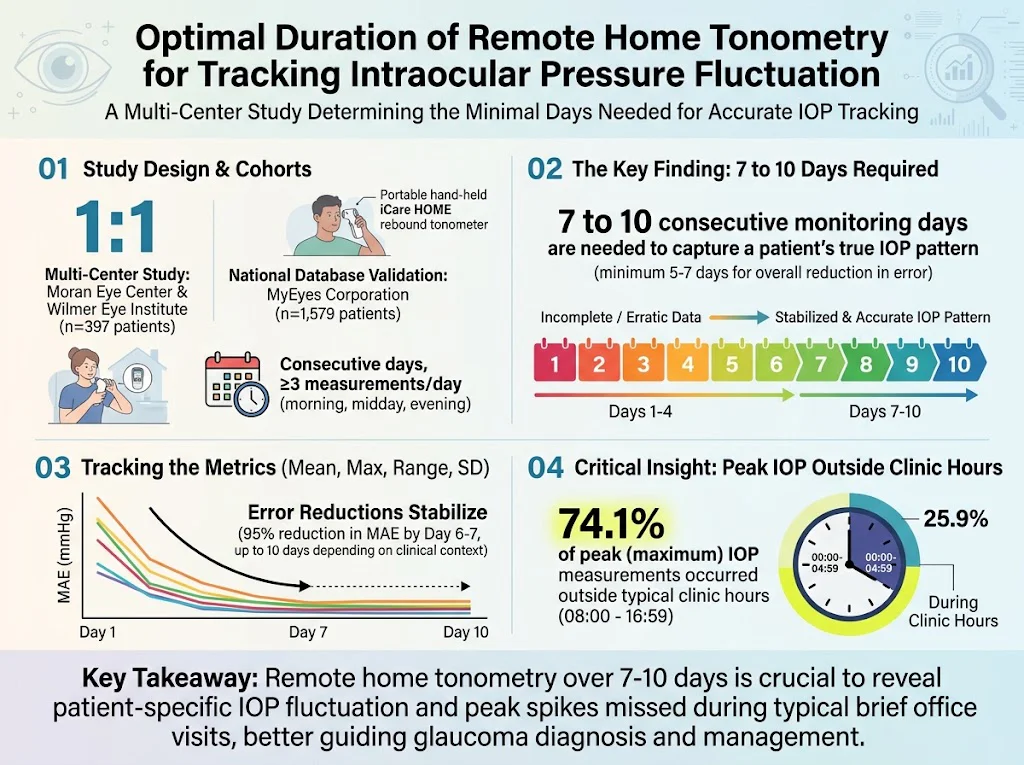
Remote home tonometry provides an advanced method to track intraocular pressure (IOP) fluctuations continuously outside of clinic hours, revealing critical IOP peaks missed in standard visits. Approximately 7 to 10 days of consecutive daily monitoring with multiple measurements per day optimally balance accuracy with patient burden. Different glaucoma types and treatment status affect optimal monitoring duration, highlighting the need for personalized monitoring strategies.
Study Background
Glaucoma is a leading cause of irreversible blindness worldwide, closely linked to elevated and fluctuating intraocular pressure (IOP). Accurate characterization of IOP fluctuation is critical for diagnosis, treatment planning, and monitoring glaucoma progression. Traditional clinic-based tonometry offers limited temporal sampling, often missing peak IOP events, which typically occur outside office hours. Remote home tonometry devices like the iCare HOME and HOME2 enable patients to measure IOP multiple times daily over extended periods in real-world settings. However, the optimal duration of remote IOP monitoring that balances comprehensive fluctuation characterization and patient adherence remains undefined.
Study Design
This research conducted a secondary modeling analysis using retrospective data from two large cohorts: 397 patients from the Moran Eye Center and Wilmer Eye Institute and 1,579 patients from a MyEyes CorporationTM database. All participants used the iCare HOME/HOME2 tonometer, recording three or more IOP measurements daily over several consecutive days. The primary aim was to determine the minimal number of consecutive monitoring days required to achieve robust and clinically meaningful estimates of IOP fluctuation metrics, including mean, maximum, range, and standard deviation (SD).
The investigators employed bootstrapped progressive day-censorship analyses combined with exponential decay modeling. Ground truth was established using all measurements available within each eye-specific monitoring period. Sensitivity analyses evaluated the influence of glaucoma diagnosis subtype (primary open-angle glaucoma, secondary open-angle glaucoma, primary angle-closure glaucoma, glaucoma suspects), intervention status (selective laser trabeculoplasty, Hydrus microstent implantation), and reduced measurement frequency (3 measurements/day) on recommended monitoring duration.
Key Findings
Across both datasets, approximately 6 to 7 consecutive monitoring days were sufficient to achieve 95% of the maximal model-based reduction in error for daily mean, maximum, range, and standard deviation of IOP, indicating this duration adequately reflects true IOP fluctuation patterns.
However, the optimal duration varied by glaucoma subtype:
- Primary open-angle glaucoma (POAG): Required the longest monitoring periods, averaging 9.1 to 10.0 days to ensure reliable estimates.
- Glaucoma suspects: Needed shorter durations, approximately 5.5 to 6.7 days.
- Secondary open-angle glaucoma: Required 6.4 to 8.0 days.
- Primary angle-closure glaucoma: Needed 7.8 to 8.3 days.
Treatment interventions did not substantially alter monitoring needs: durations remained consistent before and after selective laser trabeculoplasty (8.4-9.0 days) and Hydrus microstent implantation (6.0-6.8 days).
Importantly, when IOP measurements were restricted to only three recordings per day, the required monitoring duration extended to approximately 10 days in the Moran/Wilmer cohort and longer in the MyEyes cohort, underscoring the importance of frequency of measurement for accuracy.
Another notable finding was that 74.1% of peak IOP readings occurred outside traditional clinic hours, highlighting the limitation of office-based tonometry and the added value of remote home assessments.
Expert Commentary
The study by Jensen et al. is pivotal in defining evidence-based parameters for remote home tonometry utilization, providing practical guidance for clinicians. Their rigorous modeling approach and validation with a large, diverse dataset strengthen the reliability of results. The finding that peak IOP frequently occurs outside clinic hours aligns with existing literature questioning the sufficiency of snapshot measurements in managing glaucoma. The longer monitoring duration needed for POAG likely reflects its more complex IOP variability pattern.
Limitations include the retrospective nature of data and potential selection bias towards patients compliant with home monitoring. Additionally, device measurement variability and patient technique could influence metric accuracy. Prospective studies are needed to validate these findings in broader clinical populations and to explore the impact of remote monitoring-guided treatment adjustments on glaucoma progression and visual outcomes.
Conclusion
Remote home tonometry emerges as a valuable clinical tool that surpasses conventional in-clinic measurements by capturing comprehensive diurnal and nocturnal IOP fluctuations. The current evidence supports that a monitoring period of seven to ten consecutive days, with multiple daily IOP measurements, is optimal to accurately characterize a patient’s true IOP profile. Tailoring monitoring duration based on glaucoma subtype and measurement frequency can further refine individualized patient care. Incorporating extended remote tonometry into routine glaucoma management protocols may enhance early detection of risk from IOP spikes and improve therapeutic outcomes.
Funding and ClinicalTrials.gov
The publication does not specify external funding sources or clinical trial registration. Further inquiry with authors or sponsoring institutions is suggested to clarify funding and ethical oversight.
References
- Jensen MS, Renschler AW, Johnson C, et al. Defining the optimal duration of remote home tonometry for accurate characterization of intraocular pressure fluctuation. Ophthalmology. 2026 Nov 2; [PMID:42971438].
- Asrani S, Zeimer R, Wilensky J, et al. Large diurnal fluctuations in intraocular pressure are an independent risk factor in patients with glaucoma. J Glaucoma. 2000;9(2):134-142.
- De Moraes CG, Juthani VJ, Liebmann JM, et al. Continuous 24-hour monitoring of intraocular pressure patterns in glaucoma and ocular hypertension: a systematic review. J Glaucoma. 2017;26(5):452-460.
- Mansouri K, Shaarawy T. Continuous 24-hour monitoring of intraocular pressure patterns in glaucoma management: current approaches and future directions. J Curr Opin Ophthalmol. 2015;26(2):134-140.
Specialty calculators
For clinical reference; use professional judgment.