Highlight
This article uncovers a unique dual T helper 17/type 2 (Th17/Th2) transcriptomic endotype in psoriasis among Taiwanese patients, distinctly marked by robust IL-36 cytokine axis activation and downregulation of skin barrier genes. These findings underscore intrinsic molecular heterogeneity and suggest ethnicity-specific immunopathogenic mechanisms that may guide personalized therapeutic strategies.
Study Background
Psoriasis is a chronic, immune-mediated inflammatory skin disorder affecting millions worldwide, characterized by erythematous, scaly plaques driven largely by dysregulated T helper (Th) cell responses. While the interleukin (IL)-23/Th17 axis has been established as central in psoriasis pathogenesis, heterogeneous clinical presentations and therapeutic responses across diverse populations suggest additional underlying immunological complexities. Molecular heterogeneity influenced by ethnicity remains insufficiently defined, particularly in East Asian cohorts such as Taiwanese patients, where psoriasis prevalence and manifestations may differ from Western populations. Identifying transcriptomic endotypes can enhance understanding of disease mechanisms and foster personalized treatment.
Study Design
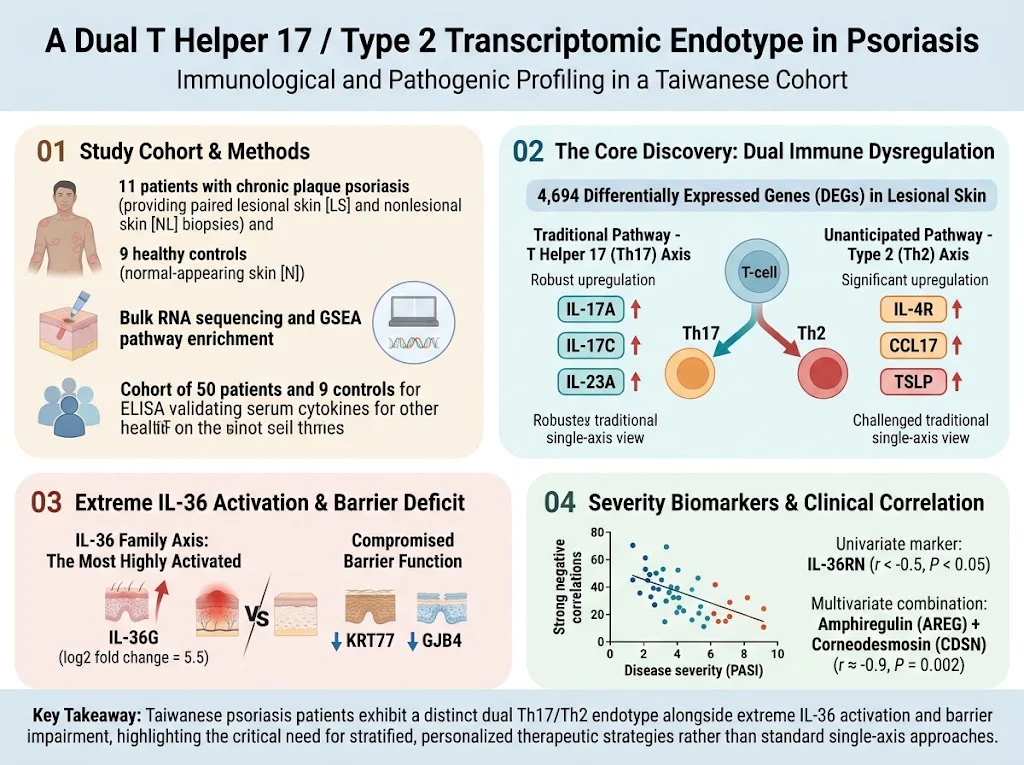
This study analyzed skin biopsies from 11 Taiwanese patients with chronic plaque psoriasis and 9 healthy controls. Both lesional and nonlesional skin samples were collected and subjected to bulk RNA sequencing to delineate differential gene expression profiles. Complementary analyses included Gene Set Enrichment Analysis (GSEA) to identify enriched immunological pathways, correlations with clinical severity measured by the Psoriasis Area and Severity Index (PASI), and validation of serum cytokine levels from a larger cohort of 50 psoriasis patients and 9 controls by enzyme-linked immunosorbent assay (ELISA). The study focused on transcriptomic profiling without mechanistic experiments and acknowledged the limited sample size and ethnicity-specific focus as limitations.
Key Findings
Comparative transcriptomic analysis identified 4694 differentially expressed genes (DEGs) between lesional and normal-appearing skin. Confirming canonical pathways, IL-17A, IL-17C, and IL-23A were significantly upregulated, affirming robust Th17 activation intrinsic to psoriasis pathogenesis. Unexpectedly, a pronounced Th2-type immune signature emerged, evidenced by increased expression of IL-4 receptor (IL-4R), chemokine CCL17, and thymic stromal lymphopoietin (TSLP). This dual Th17/Th2 immune dysregulation diverges from the classical Th17-dominated profile predominant in Western cohorts.
Further, IL-36 cytokines, particularly IL-36G, demonstrated extreme activation, with a log2 fold change of 5.5, representing the most dramatically altered cytokine axis. IL-36 plays a pivotal role in amplifying skin inflammation and may serve as a critical pathogenic driver in Taiwanese psoriasis. Genes crucial to skin barrier integrity, such as keratin 77 (KRT77) and gap junction protein beta 4 (GJB4), were markedly downregulated, indicating compromised epidermal function in lesional skin.
Correlation analyses revealed strong relationships between molecular markers and clinical severity. IL-36RN (IL-36 receptor antagonist) and the combined expression of amphiregulin (AREG) and corneodesmosin (CDSN) inversely correlated with PASI scores (r approximately -0.9, P = .002), suggesting these molecules as potential biomarkers for disease severity and progression monitoring.
Expert Commentary
This investigation challenges the prevailing single-axis Th17 paradigm by unveiling a dual Th17/Th2 endotype in psoriasis among Taiwanese patients. The co-activation of Th2 pathways, traditionally associated with atopic dermatitis, highlights complex immune crosstalk and potential ethnic variations in immunopathology. Additionally, prominent IL-36 axis activation may account for aggressive local inflammation and offers a plausible mechanistic link to observed skin barrier disruption.
Considering these findings, current therapeutic strategies primarily targeting the IL-23/Th17 axis may require adaptation or combination with agents modulating Th2 responses and IL-36 signaling to achieve optimal disease control in this population. However, the study’s small sample size and absence of functional validation of identified pathways limit generalizability and causal inference. Further research involving larger, multiethnic cohorts and mechanistic studies is warranted to confirm these transcriptomic signatures and translate them into clinical interventions.
Conclusion
This study provides compelling transcriptomic evidence that psoriasis in Taiwanese patients is characterized by a distinct dual Th17/Th2 immune endotype accompanied by extreme activation of IL-36 cytokines and significant downregulation of barrier function genes. These results emphasize molecular heterogeneity across ethnicities and identify molecular candidates for personalized treatment stratification. Incorporating such molecular insights into clinical practice could lead to improved, ethnicity-tailored therapeutic strategies and biomarker-guided patient management in psoriasis.
Funding and ClinicalTrials.gov
The original study did not specify funding sources or clinical trial registration numbers.
References
Chen CH, Lee MS, Chang WY, Cho YT, Lu YT, Huang WL, Chu CY, Tsai TF, Krueger JG, Chan TC. Uncovering a dual T helper 17/type 2 transcriptomic endotype in psoriasis. J Am Acad Dermatol. 2026 Jul;95(5):1335-1343. PMID: 42392458.
Lowes MA, Suarez-Farinas M, Krueger JG. Immunology of psoriasis. Annu Rev Immunol. 2014;32:227-55. doi:10.1146/annurev-immunol-032713-120225.
Johnston A, Fritz Y, Dawes SM, Diaconu D, Al-Attar PM, Guzman AM, Ding J, Gudjonsson JE. Keratinocyte overexpression of IL-36γ amplifies skin inflammation in psoriasis. J Invest Dermatol. 2017;137(8): 1774–1783.
Specialty calculators
For clinical reference; use professional judgment.