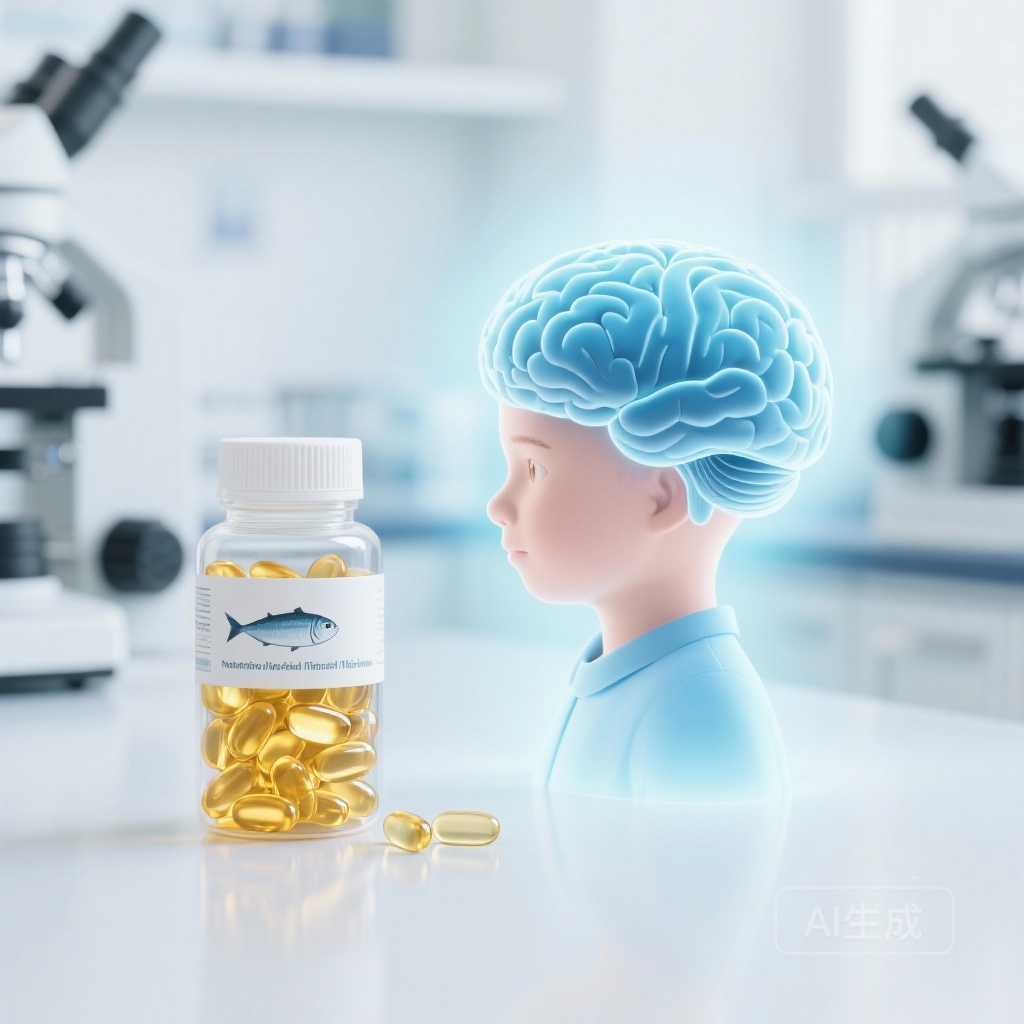
Highlights
Key Finding
Adjunctive omega-3 supplementation (1.5 g/day, 2:1 EPA:DHA ratio) showed no statistically significant benefit over placebo in reducing depressive symptoms in children and adolescents with moderate-to-severe Major Depressive Disorder (MDD).
Clinical Outcome
At 36 weeks, remission occurred in 31.9% of the omega-3 group compared to 41.1% of the placebo group, illustrating that the supplement did not enhance the efficacy of standardized psychotherapy.
Safety Profile
While 76 serious adverse events (including suicide attempts) were recorded across both groups, none were found to be causally related to the omega-3 intervention.
Adherence Confirmation
Significant increases in the omega-3 index in the treatment arm confirmed high participant adherence, ruling out lack of intake as a reason for the null results.
Background: The Quest for Evidence-Based Nutritional Psychiatry
Major Depressive Disorder (MDD) in children and adolescents is a significant global health burden, associated with impaired social development, academic failure, and increased risk of suicide. Current first-line treatments typically involve a combination of cognitive-behavioral therapy (CBT) and, when necessary, selective serotonin reuptake inhibitors (SSRIs). However, many patients show only partial responses to these interventions, leading both clinicians and parents to seek adjunctive therapies.Omega-3 polyunsaturated fatty acids (PUFAs), specifically eicosapentaenoic acid (EPA) and docosahexaenoic acid (DHA), have long been hypothesized to possess antidepressant properties due to their anti-inflammatory effects and their role in maintaining neuronal membrane fluidity and neurotransmitter signaling. While meta-analyses in adult populations have suggested modest benefits, particularly with EPA-rich formulations, pediatric evidence has remained sparse and inconsistent. The promotion of these supplements without robust clinical evidence remains a concern, as it may lead families to delay or substitute proven psychiatric care with unverified nutritional interventions.
Study Design: The Omega-3 pMDD Randomized Clinical Trial
The study was a multicenter, double-blind, placebo-controlled randomized clinical trial conducted across five child and adolescent psychiatry centers in Switzerland. Between April 2017 and March 2022, 257 youths aged 11 to 19 years with moderate-to-severe MDD were enrolled. The participants were randomized into two groups: the treatment arm received 1.5 g/d of omega-3 fatty acids (comprising 1 g of EPA and 0.5 g of DHA, a 2:1 ratio), while the control arm received a medium-chain triglyceride placebo.A critical component of the study design was that all participants received standardized psychotherapy. Additionally, the use of antidepressants was permitted following national guidelines, ensuring that the trial reflected real-world clinical practice for severe pediatric depression. The primary outcome was the trajectory of Children’s Depression Rating Scale-Revised (CDRS-R) scores over 36 weeks. To ensure statistical rigor, the researchers employed a joint mixed-effects and time-to-event model, which accounted for potential dropouts or the initiation of off-trial antidepressant therapies.
Key Findings: No Significant Benefit Over Placebo
The results of the trial, analyzed from July 2022 to January 2023, revealed that omega-3 supplementation did not provide a therapeutic advantage over placebo. At the baseline, the mean CDRS-R score was 58.5, indicating significant depressive burden. Both groups experienced a marked reduction in symptoms over the 36-week period, but the rate of improvement was nearly identical.At 12 weeks, the mean CDRS-R scores were 45.93 for the omega-3 group and 46.08 for the placebo group. By 36 weeks, these scores dropped further to 36.50 and 36.83, respectively. The adjusted mean difference was a negligible 0.77 points (95% CI, -1.39 to 2.93; P = .49). Secondary outcomes mirrored the primary findings. Response rates (defined as a 30% or greater reduction in CDRS-R) at 12 weeks were 31.2% for omega-3 recipients and 39.1% for placebo recipients. Remission rates at 36 weeks also favored the placebo numerically, though not significantly (31.9% vs. 41.1%).Measures of self-rated depression, quality of life, and suicidality all improved over time in both cohorts, but no between-group differences were observed. Notably, the omega-3 index (the percentage of EPA plus DHA in red blood cell membranes) rose significantly in the treatment arm (by a mean of 4.88% at 36 weeks), confirming that the participants were indeed taking the supplements as prescribed.

Safety and Tolerability
Safety was a paramount concern given the vulnerability of the study population. A total of 76 serious adverse events (SAEs) occurred in 97 participants. These events included 28 suicide attempts, which reflects the high-risk nature of moderate-to-severe pediatric MDD. However, the distribution of SAEs was relatively balanced (31 in the placebo arm and 45 in the omega-3 arm), and none were judged by the investigators to be causally related to the study medication. There were no deaths or permanent disabilities reported during the trial.
Expert Commentary: Interpreting the Null Results
The failure of omega-3s to outperform placebo in this trial raises several important questions for clinical practice and future research. One consideration is the placebo effect, which is notably high in pediatric depression trials. In this study, the concurrent administration of high-quality psychotherapy likely contributed to the significant improvement seen in both groups, potentially masking any subtle benefits the omega-3s might have provided.Furthermore, some researchers argue that the ratio of EPA to DHA is crucial. While this study used a 2:1 EPA:DHA ratio, some adult studies suggest that even higher concentrations of EPA (greater than 60% of the total omega-3 content) are necessary for antidepressant effects. The biological plausibility of omega-3s remains strong, but the translational evidence in youths is increasingly suggesting that for the general population of depressed adolescents, standard nutritional supplementation is not a primary solution.There is also the possibility that omega-3s may only benefit a specific subgroup of patients—those with high baseline inflammatory markers or those with a pre-existing omega-3 deficiency. Future research should perhaps pivot toward biomarker-guided approaches rather than broad supplementation for all patients with MDD.
Conclusion: Clinical Practice Gaps and Recommendations
The findings of the Omega-3 pMDD Study Group provide clear evidence that adjunctive omega-3 administration at 1.5 g/d does not improve outcomes for youths with moderate-to-severe MDD when added to standard care. Clinicians should be cautious about recommending these supplements as a primary or adjunctive treatment strategy, as they do not appear to offer the therapeutic efficacy promised by earlier, smaller studies.The study emphasizes the importance of adhering to evidence-based treatments, such as psychotherapy and appropriate pharmacotherapy, rather than relying on unproven nutritional supplements. While the safety of omega-3s is high, the lack of efficacy suggests that resources and patient focus should remain on established clinical interventions. Future research may explore higher-dose EPA formulations or the use of omega-3s in specific inflammatory phenotypes of depression, but for now, the data does not support their routine use in pediatric MDD.
Funding and Trial Registration
This study was supported by the Swiss National Science Foundation (grant 32003B_160206) and other Swiss research foundations. The trial is registered at ClinicalTrials.gov (NCT03167307).
References
1. Berger G, Häberling I, Emery S, et al. ω-3 Fatty Acids in Pediatric Major Depressive Disorder: A Randomized Clinical Trial. JAMA Netw Open. 2026;9(1):e2548703. doi:10.1001/jamanetworkopen.2025.48703 IF: 9.7 Q1 .2. Bloch MH, Hannestad J. Omega-3 fatty acids for the treatment of depression: systematic review and meta-analysis. Mol Psychiatry. 2012;17(12):1272-1282.
3. Rice SM, Purcell R, McGorry PD. Adolescent MDD: A review of current and emerging treatment options. Curr Treat Options Psychiatry. 2019;6(3):234-246.