A new subgroup analysis from the Phase 3 FoCus trial (NCT03403205) marks a major turning point in managing neurologic Wilson disease. While traditional chelators (penicillamine, trientine) and zinc salts effectively reduce systemic copper, they rarely reverse established brain damage—and trigger paradoxical neurologic worsening in 14% to 26% of patients upon initiation.
Presented at the AAN and EAN 2026 annual meetings, data on ALXN1840 (tiomolibdate choline) demonstrate that targeted copper modulation can both prevent early deterioration and drive measurable neurologic improvement.
Mechanism of Action: Why ALXN1840 Differs from Chelators
Unlike conventional chelators that mobilize copper for renal excretion—often causing transient copper redistribution and free-copper “flushes” into the central nervous system—ALXN1840 acts as a first-in-class albumin tripartite complex (ATC) activator.
- Inert Sequestration: It binds with albumin and copper in the plasma to form a stable, redox-inactive tripartite complex.
- Triple Therapeutic Effect: It rapidly mobilizes tissue-bound copper, neutralizes copper-induced oxidative stress, and blocks copper transport across the blood-brain barrier.
- Fecal Elimination: Copper is cleared via the biliary/fecal route rather than the kidneys, minimizing neurotoxic spikes.
Key FoCus Trial Results: Neurologic Subgroup Analysis
The randomized, rater-blinded FoCus trial enrolled 214 Wilson disease patients (aged 12 and older) randomized 2:1 to ALXN1840 or standard of care (SoC). The pre-specified neurologic subgroup included patients with baseline neurologic symptoms confirmed via the Unified Wilson Disease Rating Scale Part III (UWDRS Part III; ALXN1840 n = 77 vs. SoC n = 35):
| Endpoint (Week 48) | ALXN1840 | Standard of Care (SoC) | Clinical Takeaway |
| Clinically Meaningful Worsening | 9% | 25% | 16% absolute risk reduction (p = 0.038) |
| CGI-Severity (CGI-S) Improvement | 61% | 17% | Significant clinician-rated global benefit (p = 0.008) |
| CGI-Improvement (CGI-I) Rate | 47% | 19% | Broad functional & neuropsychiatric gains (p = 0.003) |
| UWDRS Part III Improvement Rate | 45% | 32% | Favorable numeric trend (exploratory) |
Additional Efficacy Highlights:
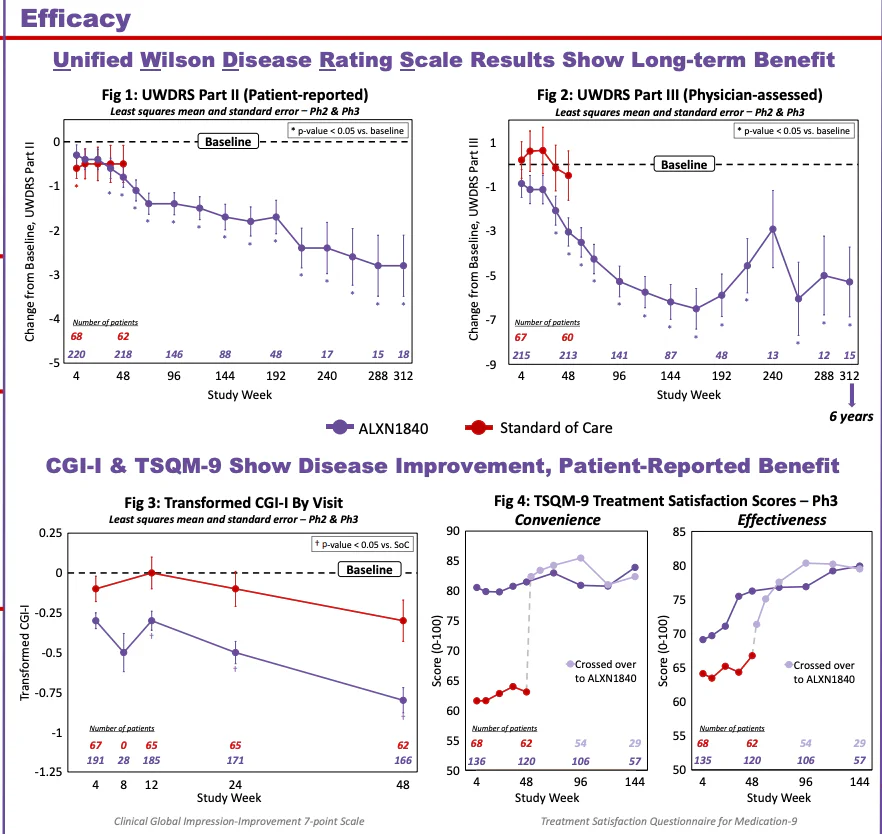
- Sustained Functional Gains: Longitudinal data presented at EAN 2026 (n = 207) showed statistically significant, continuous improvement in UWDRS Part III scores over time with ALXN1840 (p = 0.006), whereas SoC merely stabilized symptoms (p = 0.435).
- 3-Year Durability: Neurologic benefits continued to build and remained durable for approximately 3 years in extension follow-up, consistent across both treatment-naive and treatment-experienced patients.
- Superior Copper Mobilization: Measured by 48-week non-ceruloplasmin-bound copper (NCC) AUC, ALXN1840 achieved ~3.2-fold greater copper mobilization than SoC (p < 0.0001), even in patients previously treated for over a decade.
Safety Profile & Regulatory Milestones
- Favorable Tolerability: Across a pooled safety database of 266 patients (645 patient-years; median exposure 2.58 years, up to >8 years), drug-related serious adverse events (SAEs) occurred in 4.9% of patients, with neurologic SAEs below 1% and zero treatment-related deaths.
- Convenient Dosing: Administered orally once daily (starting at 15 mg every other day and titrating up to 60 mg/day), avoiding the strict meal-spacing requirements of chelators and zinc.
- FDA Rolling NDA: Following FDA Fast Track, Orphan Drug, and Rare Pediatric Disease designations (June 2026), Monopar Therapeutics initiated a rolling NDA submission in July 2026. If approved, ALXN1840 will be the first novel mechanism approved for Wilson disease in decades.
Clinical Perspective & Study Limitations
While these findings support positioning ALXN1840 as a potential first-line option for patients presenting with neurologic involvement, several caveats remain:
- Subgroup Power: The neurologic analysis was pre-specified rather than a primary endpoint, leaving the 45% vs. 32% UWDRS improvement rate underpowered for formal superiority.
- Heterogeneous Comparator: The SoC arm pooled penicillamine, trientine, and zinc regimens, preventing head-to-head comparisons against individual agents.
- Open-Label Extension Bias: The 3-year durability data stem from an open-label phase without a parallel control group.
- Scale Variability: Despite blinded raters, symptom fluctuation in Wilson disease introduces inherent measurement noise in UWDRS Part III scoring.
References
- Monopar Therapeutics Inc. Monopar Presents Phase 3 Data Showing Greater Neurologic Benefit with ALXN1840 vs SoC in Wilson Disease Patients with Neurologic Symptoms at AAN 2026. GlobeNewswire, April 19, 2026.
- Monopar Therapeutics Inc. Monopar Therapeutics Receives FDA Rare Pediatric Disease Designation for ALXN1840 for the Treatment of Wilson Disease. June 30, 2026.
- Monopar Therapeutics Inc. Monopar Therapeutics Presents Positive ALXN1840 Phase 3 Findings at EAN 2026. cGxP.wire, June 29, 2026.
- Meglio M. Monopar Begins Rolling NDA Submission for ALXN1840 in Wilson Disease. NeurologyLive, July 23, 2026.
- Hedera P. Novel Copper-Binding Agent Shows Benefit in Wilson Disease. Medscape Medical News, April 21, 2026.
- Current treatment and unmet needs in neurologic Wilson‘s disease. VJNeurology, August 6, 2026.
- Mohr I, et al. Neurological worsening in Wilson disease – clinical classification and outcome. Journal of Hepatology, 2023.
Specialty calculators
For clinical reference; use professional judgment.