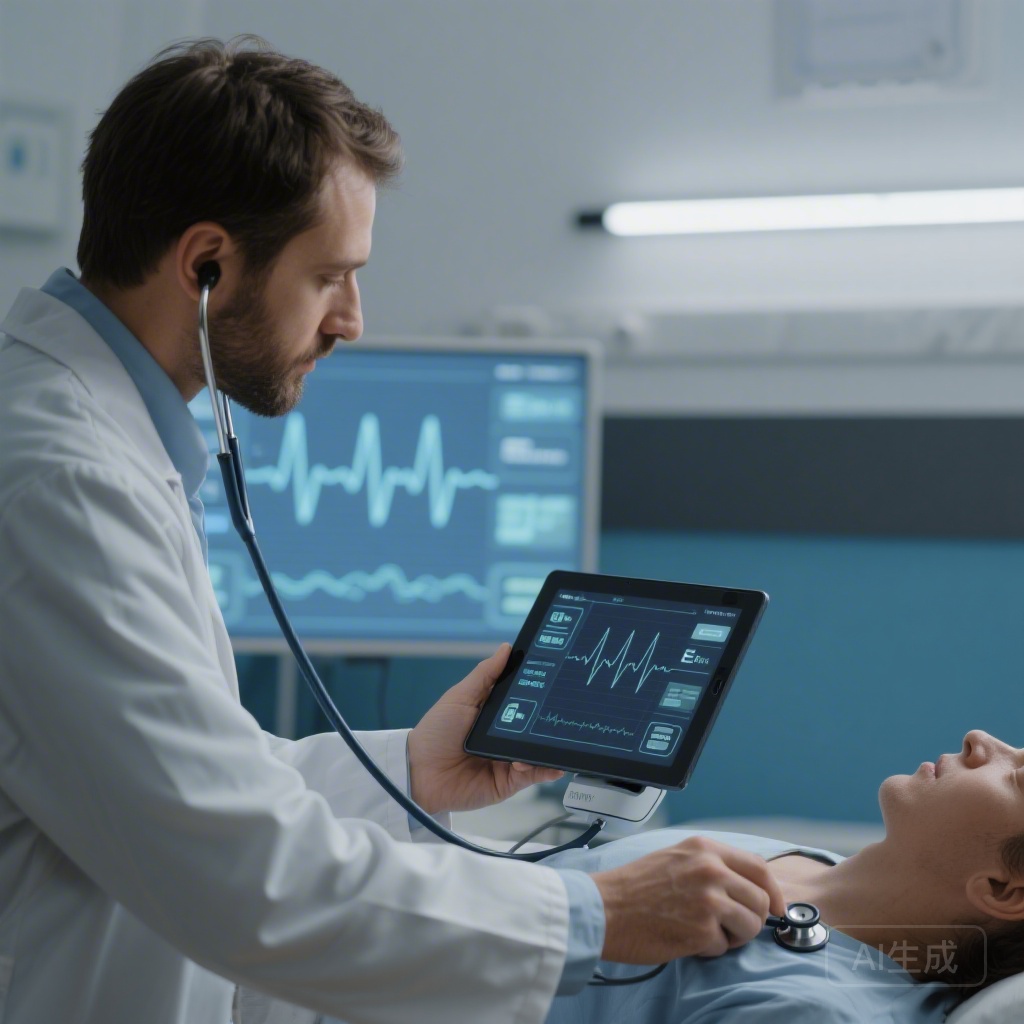
Highlights
The TRICORDER trial, a large-scale cluster-randomised study in the UK, found that implementing AI-enabled stethoscopes in routine primary care did not significantly increase the incidence of newly coded heart failure diagnoses compared to standard care (IRR 0.94; 95% CI 0.86-1.02).
While the AI stethoscope algorithms have proven diagnostic accuracy for heart failure, atrial fibrillation, and valvular heart disease, the population-level impact was limited by real-world implementation challenges and clinician uptake rates.
The study highlights a critical gap between technological performance and clinical utility, emphasizing that the success of digital health tools depends as much on workflow integration as it does on algorithmic sensitivity.
Background: The Burden of Undiagnosed Cardiovascular Disease
Cardiovascular disease (CVD) remains the leading cause of mortality and morbidity globally. Within the spectrum of CVD, heart failure (HF), atrial fibrillation (AF), and valvular heart disease (VHD) represent significant public health challenges. Early detection is paramount; however, these conditions often remain asymptomatic or present with non-specific symptoms in their early stages, leading to missed opportunities for evidence-based interventions that could prevent hospitalisation and death.
The traditional stethoscope, while iconic, has limited sensitivity for detecting subtle signs of early heart failure or complex valvular pathology, particularly in the hands of non-specialists. Artificial intelligence-enabled stethoscopes, which combine digital phonocardiography (PCG) with single-lead electrocardiography (ECG), have emerged as a promising solution. These devices use deep-learning algorithms to identify structural and functional cardiac abnormalities at the point of care. Despite their high performance in controlled settings, their effectiveness in shifting the needle on diagnosis rates within a busy primary care environment remained unproven until the TRICORDER trial.
Study Design and Methodology
The TRICORDER trial was a pragmatic, cluster-randomised controlled implementation trial conducted across primary care practices in the United Kingdom. This design was chosen to reflect the complexities of the National Health Service (NHS) and to evaluate how innovation performs when integrated into existing clinical workflows.
Population and Randomisation
Between October 2023 and May 2024, 205 primary care practices were randomised. The intervention arm consisted of 96 practices (representing 701,933 registered patients), while the control arm included 109 practices (representing 851,242 registered patients). In the intervention group, clinicians received training on the AI-enabled stethoscope and were encouraged to use it during routine cardiac examinations. The control group continued with routine care using traditional methods.
The Intervention: AI Stethoscope Technology
The AI stethoscope used in the trial recorded 15 seconds of simultaneous single-lead ECG and PCG signals. These data were processed by three regulatory-approved AI algorithms designed to provide binary predictions for:
1. Reduced left ventricular ejection fraction (LVEF ≤40%).
2. Atrial fibrillation.
3. Valvular heart disease.
Clinicians received immediate feedback on the device or a paired application, allowing for immediate clinical decision support during the patient encounter.
Endpoints
The primary endpoint was the incidence of any newly coded diagnosis of heart failure (all subtypes) per 1000 patient-years, sourced from the NHS Secure Data Environment. A coprimary endpoint examined the place of diagnosis (community-based vs. hospital-based). Secondary endpoints focused on detection rates for AF and VHD, the diagnostic performance characteristics of the AI tool, and a qualitative assessment of implementation barriers and enablers reported by clinicians.
Key Findings: Does AI Translate to Improved Detection?
The results of the TRICORDER trial provide a sobering look at the challenges of translating high-tech tools into public health outcomes. In the intention-to-treat (ITT) analysis, the implementation of the AI stethoscope did not lead to a statistically significant increase in heart failure detection. The incidence rate ratio (IRR) was 0.94 (95% CI 0.86-1.02), suggesting no difference between the intervention and control groups.
Detection by Setting
There was no significant difference in where these diagnoses were made. The hope that AI stethoscopes would shift diagnoses from acute hospital admissions (late-stage) to community-based clinics (early-stage) was not realized (p>0.05). This suggests that simply providing the tool did not fundamentally alter the pathway for patients who were already symptomatic or at risk.
Utilization and Diagnostic Association
A deeper look at the data revealed that 12,725 examinations were performed using the AI stethoscope by 972 clinical users. Interestingly, when the device was actually used, its predictions were independently associated with significantly higher detection rates of heart failure, AF, and VHD. This creates a paradox: the tool works when used, but its introduction into the system did not change the overall population diagnosis rate. This discrepancy points toward a “dose-response” issue in implementation—the volume of AI-assisted examinations may have been too low relative to the total population to impact the primary endpoint.
Expert Commentary: Bridging the Gap Between Performance and Practice
The TRICORDER trial is a landmark study not because it showed a massive benefit, but because it accurately mapped the “valley of death” between a validated algorithm and a successful clinical outcome. Medical literature is replete with studies showing AI can outperform clinicians in reading images or signals; however, TRICORDER shows that “performance” does not equal “implementation.”
Implementation Barriers
Clinician-reported data identified several barriers that likely hindered the trial’s success. Time constraints in primary care are severe; adding a 15-second recording plus the time to interpret and act on the result can be a significant hurdle in a 10-minute consultation. Furthermore, there may have been ambiguity regarding which patients should be screened. Without a mandated screening protocol, clinicians may have only used the device on patients they already suspected had cardiac issues, thereby failing to capture the “silent” cases the technology is theoretically best at finding.
Strengths and Limitations
The study’s strengths include its massive scale and its pragmatic, real-world design using NHS data. It avoided the “ivory tower” bias of highly controlled diagnostic accuracy studies. However, the lack of masking (unavoidable in this design) and the relatively short 12-month follow-up period may have limited the ability to see long-term shifts in diagnostic coding. Additionally, the trial did not mandate a specific screening frequency, leaving utilization to clinician discretion.
Conclusion: The Path Forward for Digital Health
The TRICORDER trial serves as a vital case study for the future of AI in medicine. It demonstrates that having an accurate tool is only the first step. For AI-enabled stethoscopes to improve public health, they must be accompanied by robust implementation strategies that address clinician workflow, clear guidelines on patient selection, and perhaps a move toward proactive screening rather than passive implementation. While the primary endpoint was not met, the association between device use and disease detection suggests that the technology remains a potent asset if the barriers to its use can be dismantled. Future research should focus on optimizing the “human-AI” interface to ensure these powerful diagnostic insights reach the patients who need them most.
Funding and Clinical Trial Information
The TRICORDER trial was funded by the National Institute for Health and Care Research (NIHR), the British Heart Foundation, and the Imperial Health Charity. The trial is registered with the UK National Health Service Secure Data Environment protocols.
References
1. Kelshiker MA, et al. Triple cardiovascular disease detection with an artificial intelligence-enabled stethoscope (TRICORDER) in the UK: a cluster-randomised controlled implementation trial. Lancet. 2026;407(10529):704-715.
2. Bächtiger P, et al. Artificial intelligence for the detection of heart failure: a systematic review of diagnostic accuracy. European Heart Journal – Digital Health. 2023.
3. Lloyd-Jones DM, et al. American Heart Association: 2023 Heart Disease and Stroke Statistics Update. Circulation. 2023.