Highlights
- The MSU-TELEMED trial found that a telemedicine-based care model for Mobile Stroke Units (MSUs) is superior to the traditional onboard neurologist model based on a composite outcome of safety, speed, and resource efficiency.
- Telemedicine achieved a win-odds ratio of 3.5 (95% CI, 2.4-5.1), driven primarily by a 67-percentage-point increase in the neurologist’s time spent in direct patient care.
- While telemedicine resulted in a median 4-minute delay in scene-to-treatment-decision time (19 minutes vs. 13 minutes), safety profiles and adverse event rates remained comparable between both models.
Background: The Evolution of Prehospital Stroke Care
In the management of acute ischemic stroke, the paradigm “time is brain” remains the cornerstone of clinical practice. Mobile Stroke Units (MSUs)—specialized ambulances equipped with a CT scanner, point-of-care laboratory, and thrombolytic agents—have revolutionized this field by bringing the hospital to the patient. By initiating treatment in the prehospital setting, MSUs significantly reduce the time to thrombolysis and improve long-term functional outcomes.
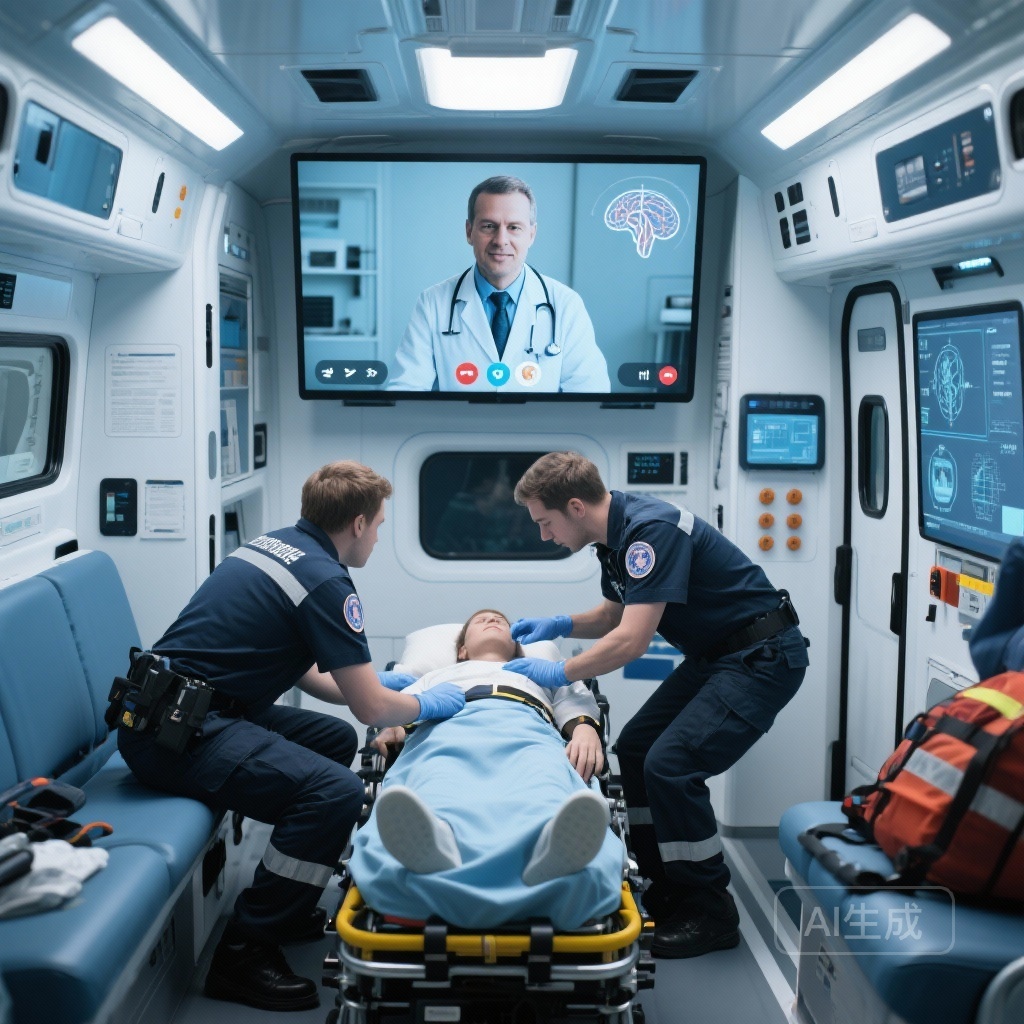
However, the traditional MSU model requires an onboard neurologist, which presents significant logistical and financial hurdles. Neurologists are a scarce resource, and having a specialist physically present on a vehicle that may spend a large portion of its shift in transit or waiting for calls is often viewed as an inefficient use of highly trained personnel. Telemedicine has emerged as a potential solution, allowing a single neurologist to cover multiple MSUs or hospital duties simultaneously. Until now, however, the two models had not been directly compared in a randomized controlled trial to determine if the digital interface compromises care quality or speed.
Study Design: The MSU-TELEMED Trial
The MSU-TELEMED trial was a randomized, open-label, blinded-endpoint study designed to rigorously compare these two models of care. The researchers prospectively randomized MSU care by day to either an onboard neurologist or a telemedicine neurologist model for patients presenting with suspected stroke.
The trial enrolled 275 participants, with 135 assigned to the telemedicine group and 140 to the onboard neurologist group. To capture the multi-faceted nature of healthcare delivery, the investigators utilized a hierarchical composite primary outcome using a win-odds approach. This approach prioritized three key factors in descending order:
- Safety: Incidence of serious adverse events.
- Speed: Scene-to-treatment-decision time.
- Efficiency: Percentage of the total case time the neurologist spent in direct care (higher values representing better resource utilization).
By comparing every participant in one group against every participant in the other, the researchers could calculate a “win/tie/loss” distribution for the telemedicine model compared to the onboard model.
Key Findings: A Win for Resource Optimization
The primary analysis revealed a clear advantage for the telemedicine model. The win/tie/loss distribution favored telemedicine (76%/4%/20%), resulting in an adjusted win-odds of 3.5 (95% CI, 2.4-5.1). This statistical significance underscores that, when considering the totality of safety, speed, and resource use, the telemedicine model provides a more optimal framework for MSU operations.
The Efficiency Gap
The most dramatic difference between the two cohorts was found in resource utilization. In the telemedicine group, the median percentage of the neurologist’s time directly involved in patient care was 100%. Conversely, in the onboard group, this figure plummeted to 33%. The adjusted difference of 63 percentage points (95% CI, 53-74) highlights the inherent inefficiency of the onboard model, where neurologists spend two-thirds of their time on the unit not engaged in direct clinical decision-making.
The Time-Decision Trade-off
While telemedicine won on efficiency, it did introduce a slight delay in decision-making. The median scene-to-treatment-decision time was 19 minutes in the telemedicine group compared to 13 minutes in the onboard group. This 4-minute adjusted difference (95% CI, 1.9-5.9) likely reflects the time required to establish a stable digital connection, perform a remote neurological examination, and review imaging via a cloud-based server. Clinicians must weigh whether this 4-minute delay is clinically significant in the context of the broader time savings offered by the MSU itself compared to standard hospital transport.
Safety and Secondary Endpoints
Safety is a paramount concern when transitioning to remote care. The trial found that safety events were nearly identical between the two groups: 13% in the telemedicine group and 12% in the onboard group (risk ratio 0.9; 95% CI, 0.5-1.8). There were no significant differences in the rates of intracranial hemorrhage or other major complications, suggesting that the remote neurological exam is a safe and reliable substitute for the physical presence of a physician during the acute phase of stroke triage.
Expert Commentary: Balancing Efficiency and Speed
The results of the MSU-TELEMED trial provide a compelling argument for the decentralization of stroke expertise. From a health policy and systems perspective, the ability to achieve a win-odds ratio of 3.5 is substantial. It suggests that the “opportunity cost” of keeping a neurologist on a single vehicle is high, particularly when that specialist could be serving a larger population via telemedicine.
However, some experts may point to the 4-minute delay as a point of contention. In hyper-acute stroke care, every minute counts. Yet, many MSUs currently operate in regions where the alternative—standard ambulance transport to a hospital—could result in delays of 30 to 60 minutes or more. In this light, the 4-minute “telemedicine tax” is a minor trade-off for a model that is significantly more scalable and sustainable.
Furthermore, as 5G connectivity and mobile imaging technology continue to improve, the latency and connection times that contributed to that 4-minute delay are expected to decrease. The trial essentially proves that telemedicine is not just a “backup” option, but perhaps the superior structural model for modern prehospital neurology.
Conclusion: Shaping the Future of Prehospital Neurology
The MSU-TELEMED trial concludes that an MSU telemedicine model is superior to an onboard neurologist model when evaluated through a composite lens of safety, speed, and resource utilization. While the onboard model remains the “gold standard” for pure speed, the telemedicine model offers a path toward broader implementation of MSUs by making them more economically and operationally viable.
For healthcare systems looking to expand their stroke rescue networks, these findings suggest that investing in robust telecommunication infrastructure and remote-access imaging software may be more beneficial—and more sustainable—than attempting to staff every mobile unit with a physically present neurologist.
Funding and clinicaltrials.gov
This study was funded by the Sylvia and Charles Viertel Charitable Foundation and the Medical Research Future Fund “Golden Hour.” ClinicalTrials.gov number: NCT05991310.
References
Yogendrakumar V, Balabanski AH, Johns H, et al. A Randomized Trial of Telemedicine Models of Care on a Mobile Stroke Unit. NEJM Evid. 2025 Dec 22:EVIDoa2500217. doi: 10.1056/EVIDoa2500217. PMID: 41429047.