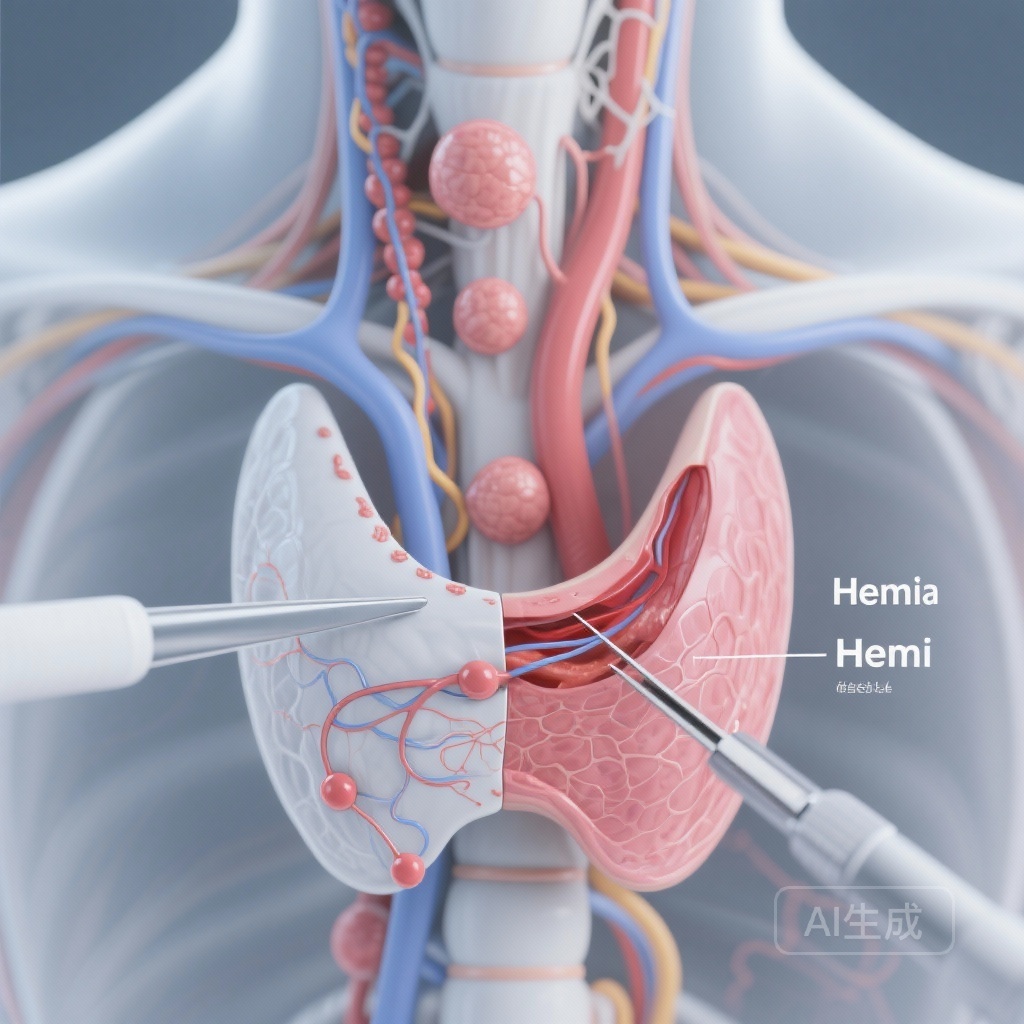
Highlights
- A systematic review and meta-analysis of 2,462 patients found no significant difference in recurrence-free survival (RFS) between total thyroidectomy (TT) and lobectomy (LT) for intermediate-risk papillary thyroid carcinoma (PTC) with unilateral lateral lymph node metastasis (LLNM).
- The presence of unilateral LLNM (N1b) alone may not necessitate total thyroidectomy, challenging traditional interpretations of the 2015 American Thyroid Association (ATA) guidelines.
- Subgroup analyses revealed that the addition of radioactive iodine (RAI) therapy following total thyroidectomy did not provide a statistically significant survival advantage over lobectomy alone in this specific patient population.
- Lobectomy may offer a preferable alternative for patients seeking to optimize quality of life by reducing the risk of surgical complications such as permanent hypoparathyroidism and recurrent laryngeal nerve injury.
Introduction: The Shifting Paradigm in Thyroid Oncology
The management of papillary thyroid carcinoma (PTC) has undergone a significant transformation over the last decade, moving away from a universal “one-size-fits-all” surgical approach toward a more nuanced, risk-stratified strategy. Historically, total thyroidectomy (TT) was the gold standard for most patients with PTC, particularly those presenting with any degree of lymph node metastasis. The rationale was simple: complete removal of thyroid tissue facilitates the use of radioactive iodine (RAI) for both adjuvant therapy and surveillance via thyroglobulin monitoring.
However, the 2015 American Thyroid Association (ATA) guidelines introduced a more conservative framework, suggesting that lobectomy (LT) could be sufficient for low-risk tumors. Despite this shift, patients with lateral lymph node metastasis (LLNM), categorized as intermediate risk (N1b), are still frequently steered toward TT and adjuvant RAI. The clinical superiority of this more aggressive approach remains a subject of intense debate among endocrine surgeons and oncologists, as the evidence supporting TT over LT in the context of unilateral LLNM has been sparse and inconsistent.
The Clinical Challenge of Lateral Lymph Node Metastasis
Lateral lymph node metastasis is a well-recognized prognostic factor in PTC, associated with a higher risk of regional recurrence compared to central node metastasis (N1a) or node-negative disease. Because of this, N1b status has traditionally been viewed as a mandate for total thyroidectomy. The logic dictates that if the cancer has spread to the lateral neck compartments, the risk of multifocality within the thyroid gland and the potential for occult contralateral disease are high enough to justify total resection.
Yet, the morbidity associated with TT—specifically permanent hypocalcemia due to parathyroid injury and bilateral recurrent laryngeal nerve palsy—can profoundly impact a patient’s quality of life. If LT can provide equivalent oncological control for unilateral N1b disease, many patients might be spared the lifelong requirement for thyroid hormone replacement and the risks of surgical complications. A recent meta-analysis by Li et al., published in the International Journal of Surgery, sought to provide clarity on this critical clinical trade-off.
Study Methodology: A Systematic Evaluation
The researchers conducted a PRISMA/AMSTAR-compliant systematic review and meta-analysis, registered with PROSPERO (CRD42023410775). Their goal was to evaluate recurrence-free survival (RFS) in patients with intermediate-risk PTC and unilateral LLNM who underwent either TT or LT. The investigators performed an exhaustive search of PubMed, Web of Science, and the Cochrane Library covering the period from 2004 to 2024.
The inclusion criteria were stringent, focusing on studies that directly compared TT and LT in the N1b population and provided sufficient data for hazard ratio (HR) calculation. Two independent investigators extracted data, and the quality of the included studies was assessed using the Newcastle-Ottawa Scale (NOS), ensuring that only high-quality evidence informed the final analysis. The primary endpoint was RFS, with pooled hazard ratios calculated using a random-effects or fixed-effects model based on the degree of heterogeneity (I2 statistics).
Core Results: No Survival Penalty for De-escalated Surgery
From an initial pool of 609 references, 8 studies met the final criteria, encompassing a total of 2,462 patients. Within this cohort, 53.3% (1313/2462) underwent total thyroidectomy, while 46.7% (1149/2462) underwent lobectomy. The analysis yielded several landmark findings:
Overall Recurrence-Free Survival
The primary analysis demonstrated that there was no statistically significant difference in RFS between the TT and LT groups. The pooled hazard ratio (HR) was 1.08 (95% CI 0.83-1.40, P = 0.56). This finding suggests that for patients with unilateral LLNM, the extent of the thyroidectomy (total vs. partial) does not inherently dictate the risk of cancer recurrence, provided that the lateral neck disease is appropriately addressed.
Subgroup Analysis: The RAI Question
One of the most compelling aspects of the study was the subgroup analysis investigating the role of radioactive iodine (RAI). Traditionally, TT is performed to enable RAI. However, the data showed:
- Comparing LT alone to TT + RAI: No significant difference in RFS (HR = 0.66, 95% CI 0.40-1.08, P = 0.10).
- Comparing TT alone to TT + RAI: No significant difference in RFS (HR = 0.87, 95% CI 0.42-1.81, P = 0.37).
- Comparing LT to TT alone: No significant difference in RFS (HR = 1.16, 95% CI 0.63-2.12, P = 0.64).
These results challenge the long-held belief that adjuvant RAI is a necessary component of treatment for all N1b patients. It appears that the oncological benefit of RAI in the intermediate-risk, unilateral LLNM setting may be marginal at best.
Clinical Discussion: Morbidity vs. Oncological Control
The findings of this meta-analysis have profound implications for surgical decision-making. If the oncological outcomes are comparable, the focus shifts to surgical morbidity and patient preference. Total thyroidectomy carries a significantly higher risk of transient and permanent hypoparathyroidism compared to lobectomy. In the LT group, the preserved contralateral thyroid lobe often maintains sufficient parathyroid function and, in many cases, enough thyroid hormone production to avoid or minimize the need for exogenous levothyroxine.
Furthermore, the risk of bilateral recurrent laryngeal nerve injury, though rare, is entirely eliminated with a lobectomy. For patients whose profession depends on voice integrity or those who are particularly concerned about the metabolic consequences of a total thyroidectomy, LT represents a high-value surgical option. However, clinicians must remain vigilant. The study specifically addressed unilateral LLNM. In cases of bilateral nodal involvement, large primary tumors (>4 cm), or gross extrathyroidal extension (T4), total thyroidectomy remains the indicated procedure.
Expert Commentary and Limitations
While this meta-analysis provides strong evidence for the safety of lobectomy in N1b disease, experts caution that patient selection remains paramount. The studies included were retrospective in nature, which introduces the possibility of selection bias—surgeons may have naturally chosen LT for patients with smaller nodal burdens or less aggressive features. Additionally, the definition of “recurrence” can vary across studies, ranging from biochemical recurrence to structural disease identified on imaging.
Another consideration is the method of surveillance. Monitoring thyroglobulin levels is straightforward after TT, but in the LT setting, the remaining lobe produces thyroglobulin, making it a less sensitive marker for recurrence. Surveillance in LT patients relies more heavily on serial ultrasonography, which requires high-quality radiological expertise. Despite these limitations, the lack of a survival difference in a cohort of nearly 2,500 patients is a powerful signal that the medical community should reconsider the “absolute indication” of TT for N1b disease.
Conclusion: Implications for Surgical Practice
The meta-analysis by Li et al. marks a pivotal point in the discussion surrounding intermediate-risk PTC management. For patients presenting with isolated, unilateral lateral lymph node metastasis without other high-risk features, lobectomy appears to be an oncologically safe and effective alternative to total thyroidectomy. The presence of N1b disease should no longer be viewed as an automatic requirement for total resection and radioactive iodine.
Moving forward, the choice between TT and LT should be a shared decision-making process, weighing the comparable oncological safety against the different morbidity profiles and surveillance requirements of each procedure. Future prospective randomized trials are needed to definitively confirm these findings, but for now, the evidence supports a more conservative surgical path for a significant portion of the PTC population.
References
- Li X, Gui Z, Xu C, Xiang J, Ming J, Huang T, Jiang M, Zhang H, Wang Z. Comparison of total thyroidectomy and lobectomy for intermediate-risk papillary thyroid carcinoma with lateral lymph node metastasis: a systematic review and meta-analysis. Int J Surg. 2025 Sep 1;111(9):6343-6350. doi: 10.1097/JS9.0000000000002673.
- Haugen BR, Alexander EK, Bible KC, et al. 2015 American Thyroid Association Management Guidelines for Adult Patients with Thyroid Nodules and Differentiated Thyroid Cancer. Thyroid. 2016;26(1):1-133. doi:10.1089/thy.2015.0020.
- Randolph GW, et al. The prognostic significance of nodal metastasis in papillary thyroid carcinoma. Curr Opin Oncol. 2014;26(1):1-7.