The Evolution of Prehospital Stroke Care
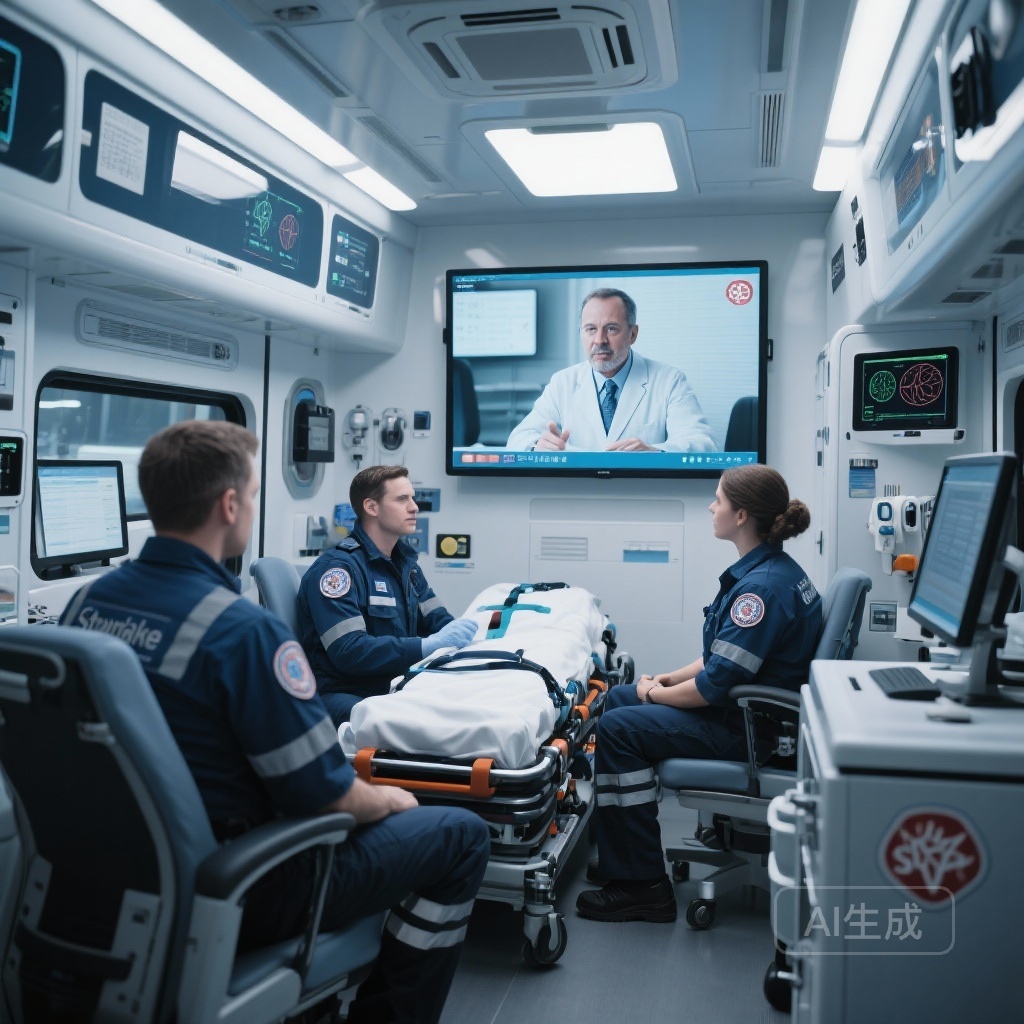
For decades, the mantra in stroke neurology has been ‘time is brain.’ The introduction of Mobile Stroke Units (MSUs)—specialized ambulances equipped with a computed tomography (CT) scanner, point-of-care laboratory testing, and a specialized team—has revolutionized the ‘Golden Hour’ of stroke care. By bringing the diagnostic and therapeutic capabilities of an emergency department directly to the patient’s doorstep, MSUs have significantly reduced the time to thrombolysis and improved functional outcomes. However, a critical logistical challenge remains: the staffing of these units. Historically, many MSU programs have relied on having a neurologist physically present on the vehicle. While this ensures immediate expertise, it is a resource-intensive model that consumes a specialist’s entire shift for a relatively small number of cases. Telemedicine has emerged as a potential alternative, yet until now, the two models had not been compared in a head-to-head randomized trial. The MSU-TELEMED trial, recently published in NEJM Evidence, provides the first high-level evidence to guide this choice.
The MSU-TELEMED Trial: Study Design and Methodology
MSU-TELEMED was a randomized, open-label, blinded-endpoint trial designed to determine whether a telemedicine-based care model could match or exceed the performance of the traditional onboard neurologist model. The study prospectively randomized MSU care by day to either an onboard neurologist or a telemedicine neurologist. This design allowed the researchers to account for the inherent variability in stroke presentations and geographic challenges.
The trial included 275 participants presenting with suspected stroke. In the telemedicine group (n=135), the neurologist provided consultation via a high-definition video link from a remote hub, while in the onboard group (n=140), the neurologist was physically present in the MSU. The primary outcome was a hierarchical composite outcome using a ‘win-odds’ approach. This sophisticated statistical method prioritized outcomes in the following order: (1) safety, (2) scene-to-treatment-decision time, and (3) the percentage of the neurologist’s total case time spent in direct patient care. The ‘win-odds’ approach is particularly useful in health services research as it allows for the simultaneous evaluation of clinical efficacy, safety, and operational efficiency.
Key Findings: Efficiency Meets Efficacy
The results of the MSU-TELEMED trial favored the telemedicine model significantly. The primary outcome distribution of win/tie/loss favored telemedicine (76%/4%/20%), resulting in an adjusted win odds of 3.5 (95% CI, 2.4-5.1). This indicates that the telemedicine model was substantially more likely to provide a ‘win’ across the composite metrics than the onboard model.
Safety and Clinical Equivalence
Safety was the first priority in the hierarchical outcome. The trial found that safety events were nearly identical between the two groups. Specifically, 13% of the telemedicine group and 12% of the onboard group experienced safety events (risk ratio 0.9; 95% CI, 0.5-1.8). This finding is crucial as it reassures clinicians that the absence of a physically present neurologist does not increase the risk of procedural errors or adverse events during acute stroke management in the field.
The Time-Efficiency Paradox
In terms of speed, the onboard neurologist model held a slight advantage. The median scene-to-treatment-decision time was 13 minutes for onboard care compared to 19 minutes for telemedicine care. The adjusted difference in median time was 4 minutes (95% CI, 1.9-5.9). While every minute counts in stroke care, this 6-minute median difference must be weighed against the broader operational benefits. Many experts argue that a 4-to-6-minute delay, while statistically significant, may not be clinically prohibitive if it facilitates a more sustainable service model.
Resource Utilization: The Deciding Factor
The most dramatic difference between the two models was found in neurologist resource utilization. In the telemedicine group, the median percentage of the neurologist’s time directly involved in patient care was 100%. In contrast, the onboard neurologist spent only 33% of their time in direct care, with the remainder spent in transit or standby. This adjusted difference of 63 percentage points (95% CI, 53-74) highlights the profound inefficiency of the onboard model. In a telemedicine framework, a single neurologist can cover multiple MSUs or continue their hospital-based duties while remaining ‘on-call’ for prehospital emergencies.
Expert Commentary: Navigating the Trade-offs
The MSU-TELEMED trial presents a classic healthcare trade-off: a minor loss in procedural speed for a major gain in system efficiency. From a health policy perspective, the telemedicine model is the clear winner. In many regions, there is a chronic shortage of vascular neurologists. Requiring a specialist to sit in an ambulance for an 8-hour shift to see perhaps two or three patients is often an unsustainable use of human capital. By using telemedicine, health systems can scale their MSU programs more effectively, potentially deploying more units across a wider geographic area with the same number of specialists.
However, the 4-minute delay in the telemedicine group warrants further investigation. This delay often stems from the time required to establish a stable connection, perform a remote neurological exam, and review imaging via a cloud-based server. As 5G technology and mobile connectivity continue to improve, it is likely that this time gap will narrow even further. Furthermore, the use of AI-assisted imaging and automated notification systems may streamline the telemedicine workflow, bridging the gap between remote and physical presence.
Conclusion: A New Standard for Mobile Stroke Care
The MSU-TELEMED trial provides robust evidence that a telemedicine-based model of care for Mobile Stroke Units is not only safe but superior when considering the totality of clinical and operational factors. While the onboard model provides a marginal benefit in speed, the telemedicine model offers a three-fold increase in neurologist efficiency. For healthcare systems looking to implement or expand prehospital stroke services, the telemedicine model represents the most viable path forward to ensure that specialized care is both accessible and sustainable.
Funding and Clinical Trial Information
This study was funded by the Sylvia and Charles Viertel Charitable Foundation and the Medical Research Future Fund (MRFF) ‘Golden Hour’ initiative. ClinicalTrials.gov number: NCT05991310.
References
Yogendrakumar V, Balabanski AH, Johns H, et al. A Randomized Trial of Telemedicine Models of Care on a Mobile Stroke Unit. NEJM Evid. 2025 Dec 22:EVIDoa2500217. doi: 10.1056/EVIDoa2500217.