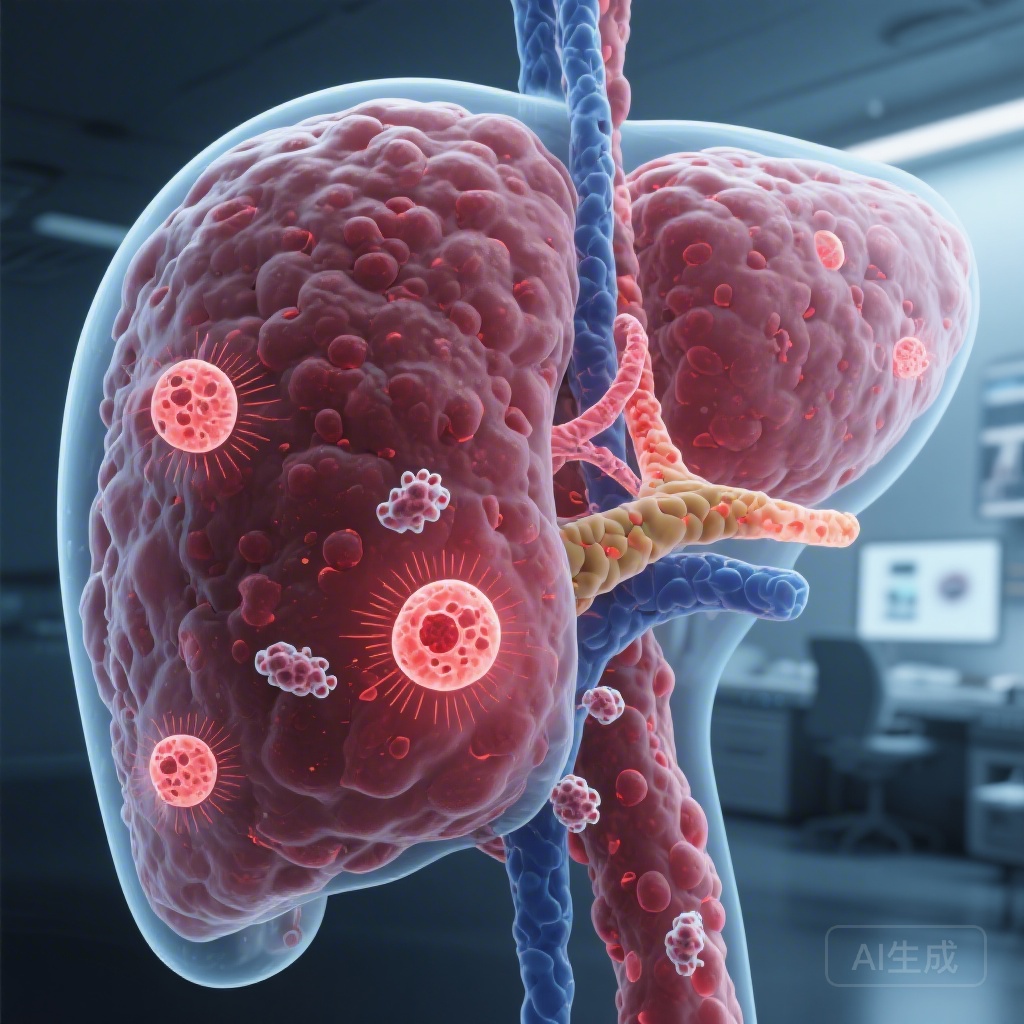
Novel Fusion Model Combines Hypoxia and Immune Signatures to Predict Survival in HCC Patients Undergoing TACE Therapy
A groundbreaking multicentre study published in Gut has developed an innovative multimodal prognostication model that combines hypoxia-related and immune phenotype-related signatures to accurately predict survival outcomes in hepatocellular carcinoma (HCC) patients treated with transarterial chemoembolisation (TACE). The clinical-radiologic model (CRM) demonstrated superior performance in stratifying patient risk compared to existing clinical models, potentially enabling more personalised treatment decision-making.
Highlights
The research team enrolled 1448 HCC patients across multiple centres, constructing deep learning and conventional radiomic models from pre-treatment contrast-enhanced CT images. The late-fusion model (LFM) outperformed early-fusion approaches, and when integrated with clinical variables, the resulting CRM effectively stratified patients’ survival across independent validation cohorts. Multi-omic analyses revealed that high-score patients exhibited activated myelocytomatosis oncogene (MYC) signaling, enhanced epithelial-mesenchymal transition (EMT), upregulated glycolysis, and activated hypoxia pathways. Single-cell transcriptomic data confirmed that virtually all cell types in high-risk patients demonstrated elevated hypoxia scores, while cytotoxic T cells showed reduced cytotoxic activity.
Background: The Clinical Challenge of TACE Prognostication
Hepatocellular carcinoma represents the most common primary liver malignancy and a leading cause of cancer-related mortality worldwide. Transarterial chemoembolisation has emerged as a cornerstone locoregional treatment for intermediate-stage HCC, particularly in patients who are not candidates for surgical resection or liver transplantation. However, survival outcomes after TACE vary considerably among patients, with response rates ranging from 35% to 70% depending on tumour characteristics, liver function, and tumour microenvironment factors.
Existing prognostic scores and imaging models for HCC patients undergoing TACE often suffer from limited generalisability across different populations and lack biological interpretability. Traditional models such as the ALBI grade, Child-Pugh score, and various imaging-based assessments provide valuable information but fail to capture the complex interplay between tumour biology, microenvironmental factors, and treatment response. This limitation highlights an urgent unmet need for robust, biologically-informed prognostic tools that can guide treatment selection and patient counselling.
Study Design and Methodology
The investigators conducted a comprehensive multicentre study enrolling 1448 HCC patients across multiple institutions. The study population included a primary TACE cohort (n=1349), a biomarker subset from a randomised trial (n=41), a single-cell RNA sequencing cohort, and The Cancer Genome Atlas (TCGA) HCC cohort (n=50). This diverse patient population provided robust datasets for model development, validation, and biological characterisation.
Pre-treatment contrast-enhanced CT images served as the foundation for constructing both deep learning and conventional radiomic models. The researchers systematically compared early-fusion and late-fusion modelling approaches. Early-fusion models combine imaging features with clinical variables at the input level, while late-fusion models maintain separate feature extraction pathways before integrating predictions at a later stage. The better-performing LFM was subsequently combined with clinical variables to create the final clinical-radiologic model.
The biological underpinnings of the model were investigated using TCGA transcriptomic data and single-cell RNA sequencing profiles. This multi-omic approach enabled detailed characterisation of differences between high-score and low-score patient groups in terms of tumour immune microenvironment composition, cellular functional states, and key signalling pathway activities.
Key Findings: Superior Risk Stratification Performance
The CRM demonstrated remarkable performance in stratifying patient survival across multiple independent cohorts. When compared with existing clinical models, the novel fusion approach achieved more granular risk stratification, identifying distinct patient subgroups with significantly different prognosis trajectories. The integration of late-fusion radiomic features with clinical variables captured both anatomical tumour characteristics and underlying biological aggressiveness.
The model successfully discriminated between patients with favourable and unfavourable outcomes, providing clinicians with actionable information for treatment planning. Validation across independent cohorts confirmed the generalisability of the approach, addressing a critical limitation of previously developed prognostic tools.
Multi-Omic Characterisation of High-Risk Patients
Comprehensive transcriptomic analyses revealed profound biological differences between high-score and low-score patient groups. In the LFM high-score group, investigators observed activation of the myelocytomatosis oncogene (MYC), a central regulator of cell proliferation and metabolism. MYC activation drives tumour growth and has been implicated in therapy resistance across multiple cancer types.
Furthermore, high-score patients demonstrated enhanced epithelial-mesenchymal transition (EMT), a cellular program associated with increased invasiveness, metastatic potential, and treatment resistance. EMT enables cancer cells to acquire mesenchymal properties that facilitate migration and colonisation of distant sites. The upregulation of glycolysis in high-risk patients reflects the Warburg effect, wherein tumours preferentially utilise aerobic glycolysis for energy production even in the presence of adequate oxygen supply.
Perhaps most notably, the hypoxia pathway was significantly activated in high-score patients. Hypoxia represents a critical microenvironmental stressor in solid tumours, driving adaptive responses that promote survival, angiogenesis, and treatment resistance. Single-cell transcriptomic data provided compelling confirmation that virtually all cell types within the tumour microenvironment of high-risk patients exhibited elevated hypoxia scores, indicating a systemic rather than tumour-cell-autonomous phenomenon.
Immune Microenvironment Alterations
The immune landscape of high-risk patients showed characteristic alterations consistent with an immunosuppressive phenotype. Cytotoxic T cells, the primary effectors of anti-tumour immunity, demonstrated reduced cytotoxic activity in high-score patients. This functional impairment may contribute to poorer treatment responses and faster disease progression following TACE.
The constellation of hypoxia activation, immune suppression, and metabolic reprogramming in high-risk patients provides a biological rationale for their inferior outcomes and suggests potential therapeutic targets for intervention.
Expert Commentary: Clinical Implications and Mechanistic Insights
The development of this hypoxia-immune fusion model represents a significant advancement in the precision medicine approach to HCC management. By incorporating biological signatures derived from imaging data, the model transcends the limitations of purely anatomical or serological assessments. The demonstration that radiomic features can capture molecular and immunological characteristics of tumours has profound implications for non-invasive tumour characterisation.
The multi-omic validation provides biological plausibility for the model’s prognostic performance. Hypoxia is a well-established driver of tumour aggressiveness through multiple mechanisms, including activation of hypoxia-inducible factors (HIFs), promotion of angiogenesis via vascular endothelial growth factor (VEGF), and induction of immune evasion. The finding that virtually all cell types in high-risk tumours exhibit elevated hypoxia scores suggests that the tumour microenvironment undergoes systemic hypoxic adaptation, creating conditions favourable to tumour progression.
The association between high scores and reduced cytotoxic T cell function aligns with established knowledge about hypoxia-mediated immunosuppression. Hypoxia inhibits T cell proliferation and cytotoxic activity through multiple mechanisms, including upregulation of immune checkpoint molecules such as PD-L1, promotion of regulatory T cell recruitment, and induction of myeloid-derived suppressor cells. These findings suggest that patients identified as high-risk by the model may benefit from combinatorial treatment approaches incorporating immunotherapy.
Study Limitations and Considerations
While the study demonstrates impressive validation across multiple independent cohorts, several considerations warrant attention. The retrospective nature of portions of the analysis introduces potential selection biases inherent to such study designs. Prospective validation in larger, more diverse populations will be essential to establish the model’s widespread clinical utility.
The model’s dependence on pre-treatment CT imaging raises questions about generalisability to centres with different imaging protocols or equipment. Standardisation of image acquisition and preprocessing will be necessary to ensure consistent performance across institutions. Additionally, the model was developed and validated specifically in the context of TACE treatment; applicability to other locoregional therapies or systemic treatments remains to be established.
The integration of the model into clinical workflow will require development of user-friendly software tools and validation of implementation feasibility. Cost-effectiveness analyses comparing model-guided versus standard treatment approaches would provide valuable information for healthcare systems considering adoption.
Conclusion and Future Directions
This multicentre study introduces a novel clinical-radiologic model that integrates hypoxia-related and immune phenotype-related signatures for non-invasive prognostication of HCC patients undergoing TACE. The model’s ability to capture underlying tumour biology through readily available CT imaging represents a paradigm shift in pretreatment risk assessment.
The biological characterisation of high-risk patients reveals a coherent picture of tumour aggressiveness characterised by MYC activation, EMT enhancement, glycolysis upregulation, hypoxia activation, and immune suppression. These findings not only explain the model’s prognostic performance but also suggest potential therapeutic vulnerabilities. Patients identified as high-risk may be candidates for intensified surveillance, alternative treatment strategies, or enrolment in clinical trials evaluating novel therapeutic approaches.
Future research directions include prospective validation studies, integration with emerging immunotherapies, and exploration of the model’s utility in other tumour types where hypoxia and immune interplay influence treatment response. The development of deep learning architectures that can automatically extract biologically relevant features from medical images holds promise for further improving model performance and clinical utility.
As the field of precision oncology continues to evolve, models that bridge imaging, molecular biology, and clinical outcomes will become increasingly essential. The hypoxia-immune fusion model represents an important step toward truly personalised management of hepatocellular carcinoma, potentially improving outcomes through better risk stratification and treatment selection.
Funding
The study received support from multiple institutional sources. Complete funding information can be found in the original publication in Gut.
References
Guo Y, Zhang G, Fu X, et al. Hypoxia-related and immune phenotype-related fusion model for non-invasive prognostication of hepatocellular carcinoma treated by TACE: a multicentre study. Gut. 2026-03-30. PMID: 41856522.