Highlights
- Real acupuncture significantly reduced monthly migraine days (MMDs) compared to sham acupuncture (median difference, -1.0; P = .02).
- Significant improvements were observed in secondary outcomes, including pain intensity (VAS), headache impact (HIT-6), and quality of life (MSQ).
- Connectome-based predictive modeling (CPM) identified distinct baseline neural signatures that predict clinical response.
- DMN-SC hypoconnectivity was a key predictor for pain relief, while SC-motor hyperconnectivity predicted reduced disability.
Introduction: The Burden of Migraine Without Aura
Migraine without aura (MWOA) is a prevalent and debilitating neurological disorder characterized by recurrent episodes of moderate-to-severe headache, often accompanied by nausea, photophobia, and phonophobia. As one of the leading causes of disability worldwide, particularly among young and middle-aged adults, MWOA imposes a substantial economic burden on healthcare systems and significantly diminishes patient quality of life. While pharmacotherapy remains the cornerstone of migraine management, many patients experience inadequate relief, intolerable side effects, or progress to medication-overuse headache. Consequently, there is growing clinical interest in non-pharmacological interventions such as acupuncture.
Despite the long-standing use of acupuncture in clinical practice, skeptics often point to the challenge of distinguishing its specific physiological effects from placebo responses. Furthermore, the high inter-individual variability in treatment response remains a hurdle for clinicians. Recent advances in neuroimaging and machine learning, specifically Connectome-based predictive modeling (CPM), offer a novel framework to address these challenges by identifying whole-brain connectivity patterns that may serve as biomarkers for treatment efficacy. This study sought to evaluate the clinical efficacy of acupuncture for MWOA and determine if baseline functional connectivity could predict which patients are most likely to benefit.
Study Design and Methodology
This single-blinded randomized clinical trial was conducted between June 2021 and June 2023 at the Beijing Hospital of Traditional Chinese Medicine. The study enrolled 120 participants aged 18 to 65 years who met the International Classification of Headache Disorders, 3rd edition (ICHD-3) criteria for MWOA. Participants were required to have experienced 2 to 8 migraine attacks per month for at least three months prior to enrollment.
Participants were randomly assigned in a 1:1 ratio to receive either real acupuncture (n = 60) or sham acupuncture (n = 60). Both groups underwent baseline clinical assessments and baseline resting-state functional magnetic resonance imaging (fMRI) scans. The treatment protocol consisted of 12 sessions (each lasting 30 minutes) administered over a 4-week period.
Intervention Protocol
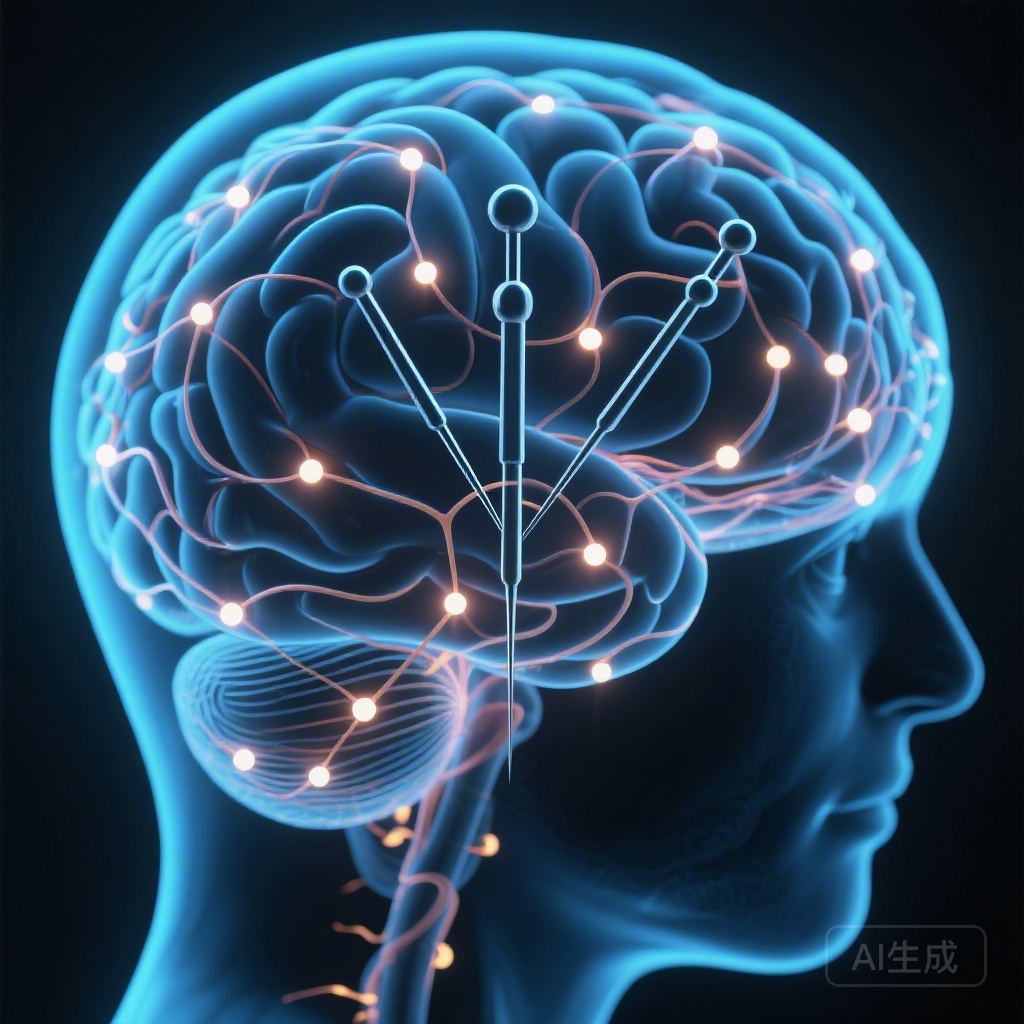
In the real acupuncture group, eight specific acupoints were utilized: GV20 (Baihui), GB20 (Fengchi), GB8 (Shuaigu), GB14 (Yangbai), LI4 (Hegu), TE5 (Waiguan), LR3 (Taichong), and GB34 (Yanglingquan). Practitioners achieved the “deqi” sensation (a subjective feeling of soreness, numbness, or heaviness) to ensure needle engagement. In the sham acupuncture group, non-acupoints were selected, and needles were inserted superficially without achieving deqi, minimizing physiological stimulation while maintaining the psychological expectation of treatment.
Clinical Efficacy: Bridging Traditional Practice and Evidence
The primary outcome measure was the change from baseline in monthly migraine days (MMDs) during the 4-week treatment period. Secondary outcomes included the 50% responder rate, monthly headache days (MHDs), acute medication use, Visual Analog Scale (VAS) scores for pain, the 6-item Headache Impact Test (HIT-6) for disability, and the Migraine-Specific Quality of Life Questionnaire (MSQ).
Primary and Secondary Results
The intention-to-treat analysis revealed that real acupuncture was superior to sham acupuncture in reducing MMDs. The median difference between the groups was -1.0 day (95% CI, -2.0 to 0; P = .02). This finding was supported by significant improvements across several secondary metrics:
- Monthly Headache Days (MHDs): Real acupuncture led to a greater reduction in total headache days (median difference, -1.0; P = .01).
- Pain Intensity: VAS scores showed a statistically significant decrease in the real acupuncture group compared to sham (median difference, -1.0; P = .02).
- Disability and Function: The HIT-6 score, which measures the impact of headaches on daily life, improved more significantly in the real acupuncture group (mean difference, -2.9; P = .02).
- Quality of Life: Significant improvements were noted across all MSQ domains, including Role Function-Restrictive (P < .001), Role Function-Preventive (P = .02), and Emotional Function (P = .001).
These results suggest that while acupuncture provides a modest reduction in attack frequency compared to sham, its impact on pain intensity and functional disability is clinically meaningful.
Neuroimaging and Connectome-based Predictive Modeling (CPM)
The most innovative aspect of this trial was the application of CPM to identify neural predictors of response. CPM uses a data-driven approach to relate whole-brain functional connectivity to behavioral or clinical measures. By analyzing baseline fMRI data, researchers sought to determine if specific “internal wiring” at the start of the study could forecast who would respond best to the 4-week acupuncture course.
Predictive Signatures of Pain Relief and Functional Improvement
The neuroimaging analysis identified distinct neural networks associated with different clinical outcomes:
1. The VAS-Predictive Network (Pain Relief)
The CPM analysis revealed that negative connectivity (hypoconnectivity) within certain networks predicted a reduction in VAS scores (r = 0.23, P = .04). Feature selection identified 12 critical connections, primarily involving the Default Mode Network (DMN) and the Subcortical-Cerebellum (SC) network. This suggests that patients with lower baseline connectivity between regions involved in self-referential processing (DMN) and pain modulation/sensory integration (SC) may be more receptive to the pain-relieving effects of acupuncture.
2. The HIT-6 Predictive Network (Functional Improvement)
For disability reduction, the model identified 120 positive connections (hyperconnectivity) as predictive of HIT-6 improvement (r = 0.29, P = .02). The key connectivity pattern involved the Subcortical-Cerebellum (SC) and Motor networks. This suggests that higher baseline integration between subcortical structures and motor regions may indicate a brain state that is primed for functional recovery and improved daily performance following neuromodulatory intervention.
Expert Commentary and Clinical Implications
The findings of Zhang et al. contribute significantly to the growing body of evidence supporting acupuncture’s role in the migraine prophylactic toolkit. While the absolute difference in MMDs between real and sham groups was one day, the broader improvements in disability and quality of life suggest that acupuncture influences the migraine experience beyond simple attack frequency.
From a mechanistic perspective, the identification of DMN and SC connectivity as predictors is highly relevant. The DMN is known to be involved in the affective and cognitive dimensions of pain, while the subcortical and cerebellar regions play critical roles in autonomic regulation and pain gating. The ability to predict a patient’s response based on baseline fMRI is a significant step toward “Precision Acupuncture.”
However, several limitations must be considered. First, the trial was conducted at a single center in China, which may affect the generalizability of the results to Western populations or different clinical settings. Second, the 4-week follow-up period is relatively short; chronic conditions like migraine require long-term data to assess the durability of the intervention. Finally, while CPM provides predictive power, the biological mechanisms through which these connectivity patterns influence acupuncture response remain partially speculative and require further longitudinal study.
Conclusion
This randomized clinical trial confirms that real acupuncture is more effective than sham acupuncture for reducing migraine frequency, pain intensity, and disability in patients with MWOA. More importantly, the study demonstrates that baseline brain connectivity patterns can predict clinical outcomes through connectome-based predictive modeling. These findings move the field closer to a personalized treatment framework where neuroimaging biomarkers could help clinicians identify the patients most likely to benefit from acupuncture, thereby optimizing resource allocation and improving patient outcomes in chronic pain management.
Funding and Clinical Trial Registration
This study was supported by various grants from the National Natural Science Foundation of China and the Beijing Municipal Administration of Traditional Chinese Medicine.
Trial Registration: Chinese Clinical Trial Registry Identifier: ChiCTR2100044251.
References
1. Zhang X, Chen Q, Liu Y, et al. Acupuncture for Migraine Without Aura and Connection-Based Efficacy Prediction: A Randomized Clinical Trial. JAMA Netw Open. 2026;9(1):e2555454. doi:10.1001/jamanetworkopen.2025.55454.
2. International Headache Society. The International Classification of Headache Disorders, 3rd edition. Cephalalgia. 2018;38(1):1-211.
3. Shen R, et al. Connectome-based predictive modeling: A review of methodology and applications in neurological disorders. NeuroImage. 2022;250:118945.