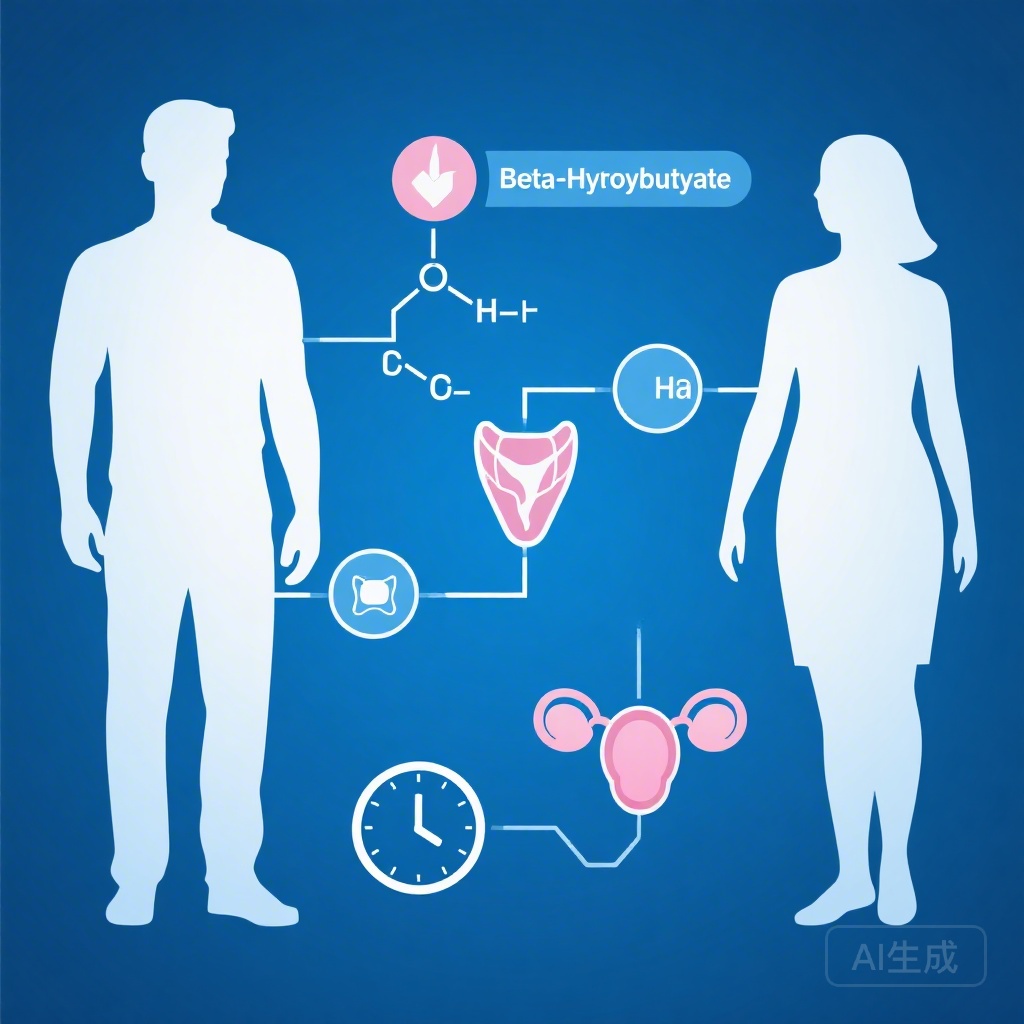
Introduction: Beyond the Ketogenic Diet
For decades, the study of ketone bodies, specifically β-hydroxybutyrate (BHB), was largely confined to the realms of diabetic ketoacidosis or the niche application of ketogenic diets for refractory epilepsy. However, a paradigm shift is underway. Modern clinical research now recognizes BHB not merely as an alternative fuel source during glucose deprivation, but as a potent signaling molecule with pleiotropic effects on inflammation, oxidative stress, and gene expression. Despite this growing interest, our understanding of what determines baseline BHB levels in the general population—outside of intentional carbohydrate restriction—has remained surprisingly thin. A landmark study titled Sex-Specific Determinants of the Ketone Body β-Hydroxybutyrate in the General Population provides critical insights into how age, sex, and hormonal status dictate our metabolic landscape.
Highlights
Significant Sexual Dimorphism
Women in the general population maintain higher circulating levels of β-hydroxybutyrate than men, a difference largely driven by the profound influence of exogenous and endogenous hormones.
The Contraceptive Effect
The use of oral contraceptives (OC) is associated with a remarkable 45% increase in plasma BHB levels, identifying hormonal birth control as a major, previously under-recognized metabolic modifier.
Aging as a Driver in Men
While hormonal status dominates the metabolic profile in women, chronological age serves as the primary determinant for BHB levels in men, with concentrations increasing steadily by approximately 1% per year.
Background and Metabolic Context
β-hydroxybutyrate is the most abundant circulating ketone body, synthesized in the liver from fatty acids during periods of low glucose availability. In the clinical setting, ketosis is often associated with positive outcomes in cardiovascular health, neuroprotection, and longevity. However, most population-based data on ketones come from studies where participants are in a state of starvation or extreme dietary intervention. There is a significant gap in knowledge regarding the physiological determinants of BHB in a stable, non-starving, general population. Understanding these determinants is essential for interpreting BHB as a biomarker and for tailoring ketone-based therapeutic interventions to individual patients.
Study Design and Methodology
To address this gap, researchers utilized data from the Prevention of Renal and Vascular End-stage Disease (PREVEND) study, a large population-based cohort in the Netherlands. The analysis included 6,102 participants who had available plasma BHB data. The study employed nuclear magnetic resonance (NMR) spectroscopy to accurately measure fasting plasma BHB concentrations. To identify the factors influencing these levels, the investigators performed comprehensive univariable and stepwise backward regression analyses, adjusting for a wide array of demographic, lifestyle, and biochemical variables.
Key Findings: A Tale of Two Sexes
The results of the study underscore a clear divergence in how male and female bodies regulate ketone production. Women exhibited significantly higher BHB levels than men (median 123 µmol/L vs. 119 µmol/L). While the absolute numerical difference might appear modest, the underlying drivers were vastly different between the sexes.
The Dominance of Hormonal Status in Women
In women, the single most powerful determinant of BHB concentration was hormonal status. The researchers observed that women using oral contraceptives had BHB levels 45% higher than premenopausal women not using them. Conversely, postmenopausal status was associated with an 11% decrease in BHB levels. This suggests that the synthetic estrogens or progestins in OCs may significantly enhance hepatic ketogenesis or reduce peripheral ketone utilization, whereas the natural decline of estrogen during menopause has the opposite effect.
The Linear Impact of Aging in Men
For male participants, the hormonal signals were less influential than the steady march of time. Age was the most significant determinant in men, with BHB levels rising by 1% for every year of life. This increase may reflect age-related shifts in fuel utilization, perhaps indicating a subtle decline in glucose metabolism efficiency or an increase in the mobilization of fatty acids as men age.
Shared Metabolic and Lifestyle Determinants
Despite the sex-specific differences, several factors influenced BHB levels consistently across both groups:
- Lower Protein Intake: Participants with lower protein consumption tended to have higher BHB levels, likely reflecting the insulinotropic nature of certain amino acids that normally suppress ketogenesis.
- Habitual Alcohol Use: Alcohol consumption was positively associated with BHB levels, a finding consistent with the known effects of ethanol metabolism on the hepatic redox state (NADH/NAD+ ratio), which can favor the production of ketone bodies.
- Thyroid Function: Higher levels of free thyroxine (fT4) were associated with higher BHB. Given that thyroid hormones stimulate lipolysis and fatty acid oxidation, this biological link is highly plausible.
- Cardiac Biomarkers: Interestingly, higher levels of N-terminal pro-B-type natriuretic peptide (NT-proBNP) were associated with higher BHB. This finding is particularly relevant to the cardiology community, as BHB is increasingly viewed as a ‘super fuel’ for the failing heart.
Expert Commentary and Mechanistic Insights
The association between oral contraceptives and elevated BHB is perhaps the most provocative finding of this study. Mechanistically, this could be attributed to the effect of exogenous estrogens on the peroxisome proliferator-activated receptor alpha (PPAR-α) pathway, which is the master regulator of ketogenesis in the liver. If OCs prime the liver for increased fatty acid oxidation, this could explain the significant rise in BHB. However, clinicians must consider whether this elevation represents a beneficial metabolic shift or a compensatory response to altered insulin sensitivity often associated with OC use.
Furthermore, the correlation with NT-proBNP suggests that the body may upregulate BHB production in response to subclinical cardiac stress. In heart failure, the myocardium shifts away from fatty acid oxidation toward ketone utilization to maintain energetic efficiency. The PREVEND data suggest that even in the general population, BHB levels might mirror cardiac strain, serving as a metabolic barometer for cardiovascular health.
Study Limitations
While the study is robust due to its large sample size and the use of NMR spectroscopy, it is cross-sectional in nature. Therefore, causality cannot be definitively established. Additionally, while the study controlled for many factors, the specific types and dosages of oral contraceptives were not detailed, which could influence the magnitude of the observed effects. Finally, the cohort was primarily of European descent, and further research is needed to determine if these sex-specific determinants hold true across diverse ethnic and racial groups.
Conclusion and Clinical Implications
The PREVEND study provides a much-needed map of the ‘baseline’ ketotic state in the general population. It demonstrates that BHB levels are not merely a reflection of what we eat, but are deeply intertwined with our biological sex, our age, and our hormonal environment. For clinicians, these findings suggest that the interpretation of ketone levels must be sex-specific. A ‘normal’ BHB level for a young woman on oral contraceptives may be significantly higher than that of a postmenopausal woman or a young man. As we move toward a future of personalized medicine, understanding these physiological nuances will be vital for utilizing BHB as both a diagnostic biomarker and a therapeutic target in metabolic and cardiovascular disease.
References
1. Knol MGE, van der Vaart A, Kieneker L, et al. Sex-Specific Determinants of the Ketone Body β-Hydroxybutyrate in the General Population. J Clin Endocrinol Metab. 2026;111(4):e995-e1005. PMID: 41159535.
2. Newman JC, Verdin E. β-Hydroxybutyrate: A Signaling Metabolite. Annu Rev Nutr. 2017;37:51-76.
3. Puchalska P, Crawford PA. Multi-dimensional Roles of Ketone Bodies in Fuel Metabolism, Signaling, and Therapeutics. Cell Metab. 2017;25(2):262-284.
4. Robinson AM, Williamson DH. Physiological roles of ketone bodies as substrates and signals in mammalian tissues. Physiol Rev. 1980;60(1):143-187.