Background: Addressing Disparities in Breast Cancer Survivorship
Despite advancements in screening and therapeutic interventions, racial disparities in breast cancer mortality remain a significant challenge in the United States. Black women are disproportionately affected, experiencing a 40 percent higher mortality rate compared to White women, even when accounting for clinical factors. While genetic and socioeconomic factors contribute to these outcomes, lifestyle factors—particularly nutrition—represent a critical but understudied area of intervention. Ultra-processed foods (UPFs), characterized by industrial formulations containing additives, sweeteners, and emulsifiers, have become a staple of the Western diet. Previous epidemiological research has linked high UPF consumption to obesity, cardiovascular disease, and increased risk of various cancers. However, evidence regarding the impact of UPFs on the prognosis of breast cancer survivors has been limited, and until now, no study has specifically examined this relationship within a cohort of Black breast cancer survivors. Understanding this association is vital for developing targeted dietary guidelines that may improve long-term survival in this vulnerable population.
Study Design: The Women’s Circle of Health Study
The study, published in EClinicalMedicine (2025), utilized data from the Women’s Circle of Health Study (WCHS) and its follow-up component (WCHS-FU). The researchers focused on 1,733 Black women diagnosed with primary breast cancer in New Jersey between 2005 and 2019. To assess dietary habits, participants underwent comprehensive home interviews where validated food-frequency questionnaires (FFQs) were used to capture food and beverage consumption during the year prior to their diagnosis.
Foods were categorized according to the NOVA classification system, which groups items based on the extent and purpose of industrial processing:
Group 1: Unprocessed or minimally processed foods (e.g., fruits, vegetables, grains).
Group 2: Processed culinary ingredients (e.g., oils, butter, sugar).
Group 3: Processed foods (e.g., canned vegetables, simple breads, cured meats).
Group 4: Ultra-processed foods (e.g., sugar-sweetened beverages, packaged snacks, reconstituted meat products).
The primary endpoints were breast cancer-specific mortality and all-cause mortality. Death outcomes were verified through linkage with the New Jersey State Cancer Registry. Researchers employed Cox proportional hazards models and competing risks models to estimate hazard ratios (HRs) and 95 percent confidence intervals (CIs), adjusting for age, stage at diagnosis, body mass index (BMI), physical activity, and socioeconomic status.
Key Findings: The Impact of Ultra-Processing on Survival
Over a median follow-up period of 9.3 years, the researchers identified 394 deaths, of which 206 were attributed specifically to breast cancer. The analysis revealed a clear and statistically significant correlation between high UPF intake and poorer survival outcomes.
Participants were divided into tertiles based on their UPF consumption. Women in the highest tertile (median of 8.1 servings per day) exhibited a 40 percent higher risk of breast cancer-specific mortality (HR = 1.40; 95% CI = 1.00-1.96; P-trend = 0.02) compared to those in the lowest tertile (median of 2.6 servings per day). Similarly, all-cause mortality was 36 percent higher in the highest intake group (HR = 1.36; 95% CI = 1.06-1.74; P-trend < 0.01).
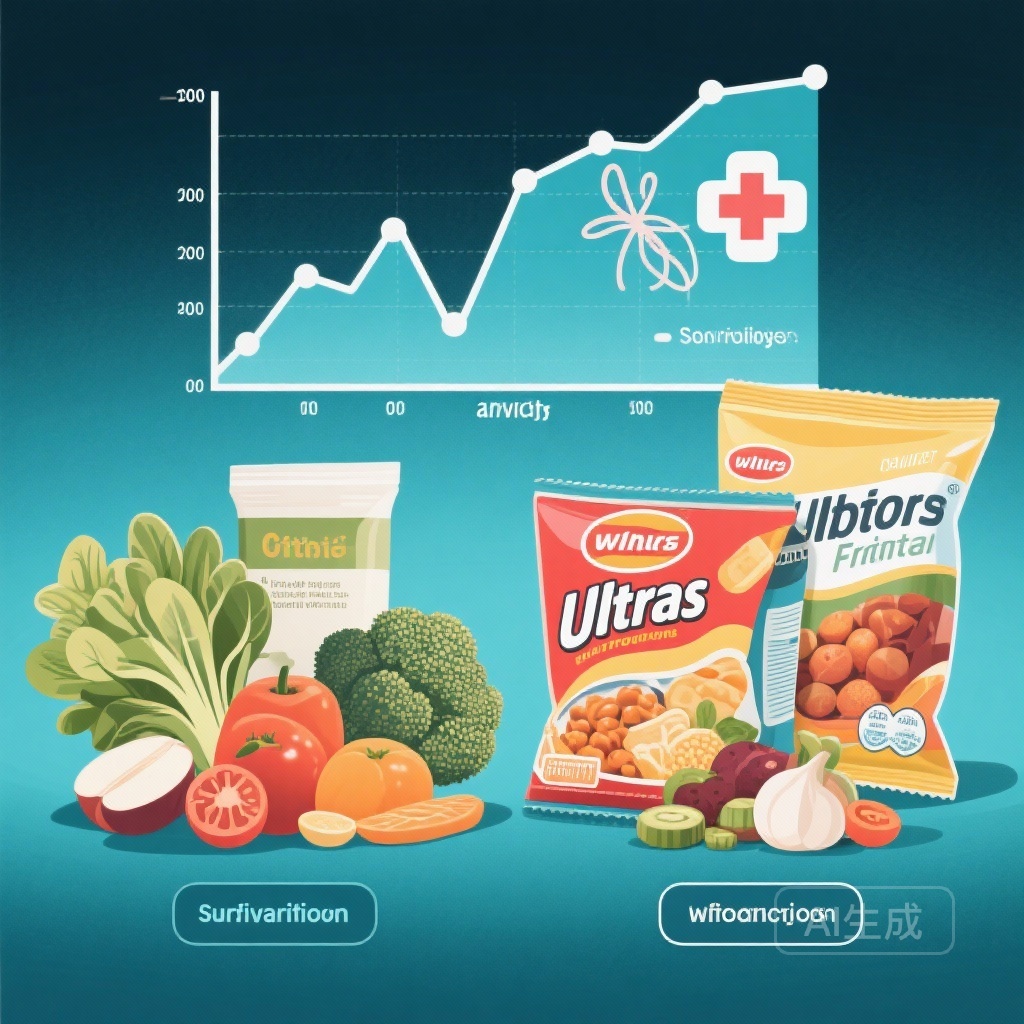
One of the most notable findings was the dose-response relationship. The researchers observed a J-shaped association, suggesting that the risk remains relatively stable at lower levels of consumption but begins to rise sharply once intake exceeds 4 servings per day. For breast cancer-specific mortality, the test for nonlinearity reached statistical significance (P = 0.01), emphasizing that even moderate increases in UPF consumption beyond a certain threshold may adversely affect prognosis.
Interestingly, the associations were somewhat attenuated after adjusting for total energy intake. This suggests that the detrimental effects of UPFs may be partially mediated by their high caloric density, which often leads to overconsumption and subsequent metabolic disturbances. However, the researchers noted that the non-nutritional components of UPFs—such as phthalates and bisphenols leached from packaging, or additives that disrupt the gut microbiome—likely play a contributing role beyond simple calorie counts.
Expert Commentary: Mechanistic Insights and Clinical Implications
The findings from this study provide a compelling argument for the role of food processing in cancer survivorship. From a biological perspective, several mechanisms may explain why UPFs are particularly harmful to breast cancer survivors. UPFs typically have a high glycemic index and are rich in trans-fats and sodium, while being deficient in fiber and micronutrients. This nutritional profile can trigger chronic systemic inflammation and hyperinsulinemia, both of which are known to promote tumor progression and recurrence in breast cancer.
Furthermore, the NOVA classification highlights that the health impact of food is not just about the nutrients it contains, but how it is prepared. The industrial processing involved in creating UPFs often destroys the physical structure of the food matrix, altering the rate of digestion and the hormonal response to ingestion. For Black women, who may face systemic barriers to accessing fresh, whole foods—such as living in food deserts or facing higher marketing exposure to processed products—these findings underscore a significant public health challenge.
While the study is robust in its longitudinal design and focus on an underrepresented population, certain limitations must be acknowledged. The dietary assessment was based on pre-diagnosis patterns, which may have shifted following a cancer diagnosis. Additionally, self-reported FFQs are subject to recall bias. Future research should aim to investigate whether post-diagnosis dietary changes toward less processed foods can actively improve survival outcomes.
Conclusion: A Shift in Survivorship Care
This investigation represents the first large-scale study to demonstrate that high consumption of ultra-processed foods is associated with increased mortality among Black breast cancer survivors. The results suggest that dietary quality, specifically the degree of food processing, is a vital determinant of long-term health in this population. For clinicians and oncology dietitians, these findings provide evidence to support counseling sessions that go beyond calorie counting, focusing instead on the reduction of ultra-processed items in favor of whole or minimally processed foods. On a policy level, addressing the availability and affordability of healthy food options is essential to reducing the disproportionate burden of breast cancer mortality faced by Black women. Moving forward, integrating nutritional equity into survivorship care plans could be a cornerstone in closing the survival gap.
Funding and Acknowledgments
This research was supported by the National Cancer Institute (R01CA185623, P30CA072720, R01CA100598, P01CA151135, R00CA267557), the American Cancer Society (RSG-23-1143513-01-CTPS), and the Breast Cancer Research Foundation. Data collection was facilitated by the New Jersey State Cancer Registry and the Rutgers Cancer Institute.