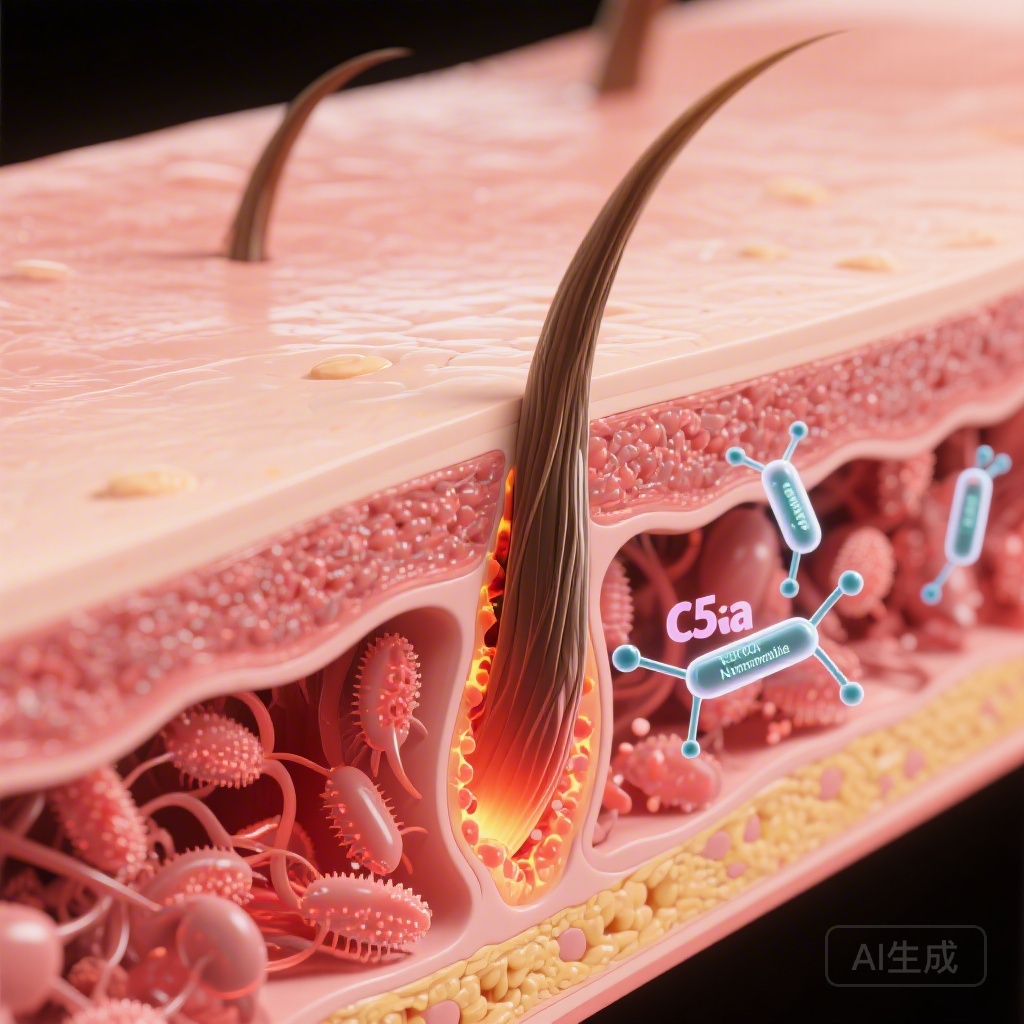
The Challenge of Refractory Hidradenitis Suppurativa
Hidradenitis suppurativa (HS) remains one of the most challenging conditions in dermatology, characterized by chronic, recurrent, painful inflammatory nodules, abscesses, and the development of draining tunnels (sinus tracts). For patients with moderate-to-severe disease, the therapeutic landscape has long been dominated by TNF-alpha inhibitors like adalimumab. However, a significant proportion of patients either fail to respond or lose response over time, particularly those with complex structural disease involving extensive tunneling. There is a critical unmet need for therapies that target different arms of the inflammatory cascade, especially the complement system, which has been implicated in the neutrophilic drive of HS pathogenesis.
The SHINE Trial: Targeting C5a in a Large-Scale Cohort
Vilobelimab (formerly IFX-1) is a first-in-class chimeric monoclonal IgG4 antibody that specifically binds to the complement split product C5a. By neutralizing C5a, vilobelimab aims to inhibit the recruitment and activation of neutrophils and monocytes without interfering with the formation of the membrane attack complex (C5b-9), thus preserving certain innate immune functions. The SHINE trial (NCT03487276) was a multicenter, double-blind, placebo-controlled phase IIb study designed to evaluate the efficacy and safety of four different dosing regimens of vilobelimab in 177 patients with moderate-to-severe HS.
Participants were randomized to receive placebo or vilobelimab at doses of 400 mg every 4 weeks, 800 mg every 4 weeks, 800 mg every 2 weeks, or 1200 mg every 2 weeks. The primary endpoint was the Hidradenitis Suppurativa Clinical Response (HiSCR) at week 16, defined as a at least a 50% reduction in inflammatory lesion count (abscesses and inflammatory nodules) with no increase in abscesses or draining tunnels.
Detailed Results: The HiSCR Paradox and Placebo Interference
The SHINE trial did not meet its primary endpoint of HiSCR at week 16. The vilobelimab groups did not show a statistically significant improvement over the placebo group in the intention-to-treat analysis. However, a closer look at the data reveals a confounding factor common in HS clinical trials: an unexpectedly high placebo response rate. In this study, the placebo HiSCR rate was 47.1%, which is substantially higher than the 25% to 30% typically observed in previous phase III trials for HS.
This high placebo response likely masked the potential therapeutic signal of vilobelimab when measured by the binary HiSCR metric. Factors contributing to such high placebo responses in HS trials often include intensive wound care provided during the trial, fluctuations in disease activity, and the subjective nature of nodule counts. Despite the failure to reach the primary endpoint, secondary and post hoc analyses provided compelling evidence of biological activity, particularly at the highest dose level.
Post Hoc Insights: The Impact on Draining Tunnels
One of the most clinically significant findings from the SHINE trial emerged from the post hoc analysis of the high-dose vilobelimab group (1200 mg every 2 weeks). While the HiSCR focuses on inflammatory nodules and abscesses, it often fails to capture the nuances of structural disease. In the high-dose group, researchers observed a significant decrease in the median draining tunnel count. Specifically, high-dose vilobelimab was associated with a 63% reduction in the International Hidradenitis Suppurativa Severity Score 4 (IHS4), a validated tool that incorporates draining tunnels into its severity assessment.
Draining tunnels are notoriously difficult to treat and often require surgical intervention. The finding that a systemic biologic could significantly reduce the number and activity of these tunnels suggests that C5a inhibition may address the deeper, more destructive aspects of HS pathology. Furthermore, among the patients who did not initially respond to treatment and were switched to a medium-dose vilobelimab open-label extension, 45.5% eventually achieved HiSCR by week 40, suggesting that longer treatment durations may be necessary for some patients to realize clinical benefits.
Mechanistic Rationale: Why C5a?
The rationale for targeting C5a in HS lies in the neutrophilic nature of the disease. C5a is one of the most potent chemoattractants for neutrophils. In HS, the rupture of the pilosebaceous unit releases keratin and bacteria into the dermis, triggering a massive complement activation. The resulting C5a gradient recruits neutrophils, which release reactive oxygen species and proteases, leading to tissue destruction and the formation of sinus tracts. By blocking C5a, vilobelimab may dampen this destructive feedback loop, potentially stabilizing the skin architecture and preventing the progression of tunnels.
Safety and Tolerability Profile
Throughout the SHINE trial, vilobelimab demonstrated a favorable safety profile. The incidence of treatment-emergent adverse events (TEAEs) was similar across the vilobelimab and placebo groups. Most adverse events were mild to moderate in severity, with no evidence of an increased risk of meningococcal infections, a theoretical concern with complement inhibitors. This safety data is encouraging, especially for a patient population that may require long-term immunomodulatory therapy.
Clinical Implications and Future Directions
The SHINE trial serves as a reminder of the complexities of clinical trial design in HS. While the primary endpoint was not met, the significant reduction in draining tunnels and IHS4 scores in the high-dose group highlights vilobelimab’s potential as an adjunctive or targeted therapy for patients with severe structural disease. Future studies should perhaps consider primary endpoints that more accurately reflect the reduction in chronic structural lesions or utilize more objective measures of inflammation like ultrasound.
For clinicians, these results suggest that while C5a inhibition might not be a ‘one-size-fits-all’ solution for every HS patient, it may hold a specific niche for those whose disease is characterized by active draining tunnels—a group that currently has very few medical options. The ongoing investigation into vilobelimab will be crucial in determining its place in the evolving HS treatment algorithm.
References
1. Giamarellos-Bourboulis EJ, Jemec GBE, Prens EP, et al. Vilobelimab to improve clinical outcomes in moderate-to-severe hidradenitis suppurativa through an adjunctive effect on draining tunnels: results of the SHINE double-blind placebo-controlled randomized trial. Br J Dermatol. 2026;194(2):254-263. doi:10.1093/bjd/ljaf398.
2. Zouboulis CC, et al. S2k Guidelines for the treatment of hidradenitis suppurativa/acne inversa. J Eur Acad Dermatol Venereol. 2015;29(4):619-639.
3. Kanni T, et al. Complement activation in hidradenitis suppurativa: a new pathway of pathogenesis? Br J Dermatol. 2018;179(2):413-419.