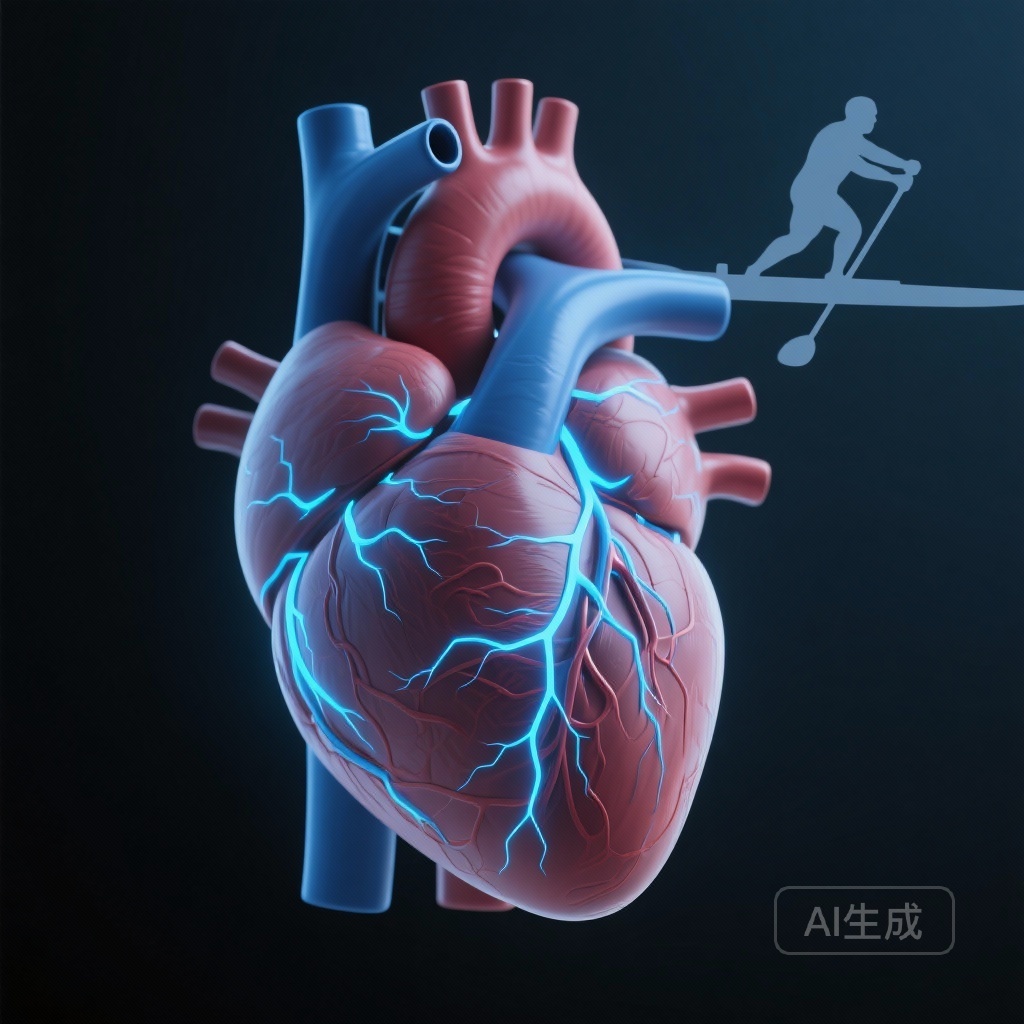
The Paradox of the Endurance Athlete’s Heart
For decades, the medical community has celebrated the profound cardiovascular benefits of regular physical activity. From reduced rates of hypertension to improved metabolic health, the ‘athlete’s heart’ was long considered the pinnacle of physiological adaptation. However, an emerging body of evidence has identified a provocative paradox: while moderate exercise is protective, lifelong exposure to high-volume, high-intensity endurance training may significantly increase the risk of atrial fibrillation (AF). This relationship, often described as a J-shaped or U-shaped curve, suggests that there is a threshold beyond which the benefits of exercise may be complicated by pro-arrhythmic structural changes.
In a comprehensive study published in the European Heart Journal, researchers investigated the prevalence and drivers of AF in a unique cohort of former world-class rowers. The study, ‘Atrial fibrillation in former world-class rowers: role of environmental and genetic factors,’ led by Flannery et al., provides a deep dive into the interplay between the environmental stress of elite sports and the underlying genetic architecture of the individual. By comparing these elite athletes with a massive control group from the UK Biobank, the study sheds light on why some of the world’s fittest individuals are disproportionately affected by this common arrhythmia.
Highlights
– Former world-class rowers exhibit a nearly 7-fold higher prevalence of atrial fibrillation compared to age- and sex-matched controls.
– Despite superior cardiovascular risk factor profiles, these athletes face a three-fold higher risk of stroke.
– High polygenic risk scores (AF-PRS) significantly amplify the risk of AF in athletes, suggesting a synergistic relationship between training and genetics.
– Structural cardiac remodeling, including increased atrial volume and electrophysiological changes, distinguishes the athletic cohort from the general population.
Study Design and Methodology: A Comparative Analysis
The researchers conducted a cross-sectional and longitudinal analysis involving 121 former elite rowers (median age 62 years, 74% male) who had competed at international championships. This cohort represented the extreme end of human endurance training. To provide a robust comparison, the study utilized a 1:100 matching strategy with 11,495 control subjects from the UK Biobank, matched specifically for age and sex.
The evaluation was exceptionally rigorous. Participants underwent 12-lead and Holter electrocardiograms (ECG) to detect current arrhythmias and evaluate heart rate variability. Cardiac magnetic resonance imaging (CMR) was employed to assess structural remodeling, focusing on chamber volumes and myocardial mass. Furthermore, the study integrated advanced genomic analysis, including the evaluation of rare pathogenic variants in cardiomyopathy-related genes and the derivation of a validated AF polygenic risk score (AF-PRS). This multi-omic approach allowed the researchers to tease apart the contributions of ‘nurture’ (elite training) and ‘nature’ (genetic heritage).
Disproportionate Prevalence and Incidence of Atrial Fibrillation
The results were stark. Among the 121 former rowers, 26 individuals (21.5%) were diagnosed with AF. In contrast, only 3.2% of the 11,495 control subjects had the condition. This translates to a prevalence risk ratio of 6.8 (95% CI 4.7-9.8). The disparity persisted when looking at new-onset (incident) AF during a 4-year follow-up period; rowers demonstrated an incident rate of 6.3% compared to 2.3% in controls, representing a hazard ratio of 2.8.
What makes these findings particularly striking is the ‘healthy survivor’ profile of the rowers. The athletes generally had fewer traditional cardiovascular risk factors, such as obesity or hypertension, than the general population. Yet, the protection usually afforded by such a profile was seemingly overridden by the long-term effects of their elite sporting careers.
The Silent Threat: Stroke Risk in Elite Performers
One of the most concerning findings of the study was the elevated stroke prevalence. Despite their high level of fitness, former rowers had a stroke prevalence of 3.3%, compared to 1.1% in the control group (risk ratio 3.0, 95% CI 1.1-7.9). This finding challenges the assumption that the high fitness levels of athletes might mitigate the clinical consequences of AF. It suggests that AF in athletes is not a ‘benign’ physiological adaptation but carries significant clinical morbidity, necessitating the same vigilance in stroke prevention and anticoagulation management as seen in non-athletic populations.
Structural and Electrophysiological Remodeling
Using CMR, the researchers identified significant structural differences. Rowers exhibited significantly larger left and right atrial volumes and increased ventricular mass compared to controls. This ‘chamber dilation’ is a hallmark of the endurance athlete’s heart, necessary to accommodate the massive cardiac output required during competition. However, this study suggests that such remodeling creates an electrophysiological substrate—characterized by increased atrial stretch and potential fibrosis—that facilitates the development and maintenance of AF.
The Role of Genetics: Beyond Monogenic Variants
A pivotal question in sports cardiology is why only a subset of endurance athletes develops AF. The researchers looked for rare, pathogenic variants in genes typically associated with cardiomyopathy (e.g., TTN, LMNA). Interestingly, these variants were rare (2.7%) and did not account for the high rates of AF observed in the athletes.
However, the story was different for common genetic variants. Using the AF-PRS, which aggregates the effects of thousands of small genetic variations, the researchers found a powerful interaction. For rowers in the highest quartile of genetic risk, the odds of developing AF were 3.7 times higher than for those with lower genetic risk. While a high PRS also increased risk in the control group (2.0-fold), the magnitude of the effect was notably higher in the athletes. This suggests that elite endurance training may act as a ‘stress test’ for the heart, unmasking a latent genetic susceptibility to atrial arrhythmias.
Expert Commentary and Mechanistic Insights
Physician-scientists suggest that the mechanism of AF in athletes is likely multifactorial. The chronic volume and pressure overload during years of training lead to atrial enlargement and inflammation. When this environmental stressor meets a high polygenic risk, the threshold for clinical AF is crossed much earlier than in the general population.
Limitations of the study include its retrospective nature and the specific focus on rowers, which may limit generalizability to other endurance sports like ultra-marathon running or cycling, though the physiological demands are often similar. Additionally, while the UK Biobank provides a massive control group, it may be subject to selection bias (the ‘healthy volunteer’ effect).
Conclusion
The study by Flannery and colleagues provides definitive evidence that former world-class rowers are at a markedly increased risk of AF and stroke, despite their otherwise favorable cardiovascular profiles. The findings underscore the importance of long-term cardiovascular monitoring for retired elite athletes. Perhaps most importantly, the research highlights the role of polygenic risk scores as a potential tool for identifying which athletes are at the highest risk, moving us closer to a personalized approach in sports medicine.
References
Flannery MD, Canovas R, Janssens K, Mitchell AM, D’Ambrosio P, Spencer LW, Rowe SJ, Paratz ED, Claessen G, Myrstad M, Ruiz-Carmona S, Young PE, Ohanian M, Soka M, Rath EM, Giannoulatou E, Johnson R, Yu C, Lacaze P, Elliott AD, Sanders P, Willems R, Heidbuchel H, Kalman JM, Fatkin D, La Gerche A. Atrial fibrillation in former world-class rowers: role of environmental and genetic factors. Eur Heart J. 2025 Dec 15;46(47):5114-5125. doi: 10.1093/eurheartj/ehaf369. PMID: 40561495.