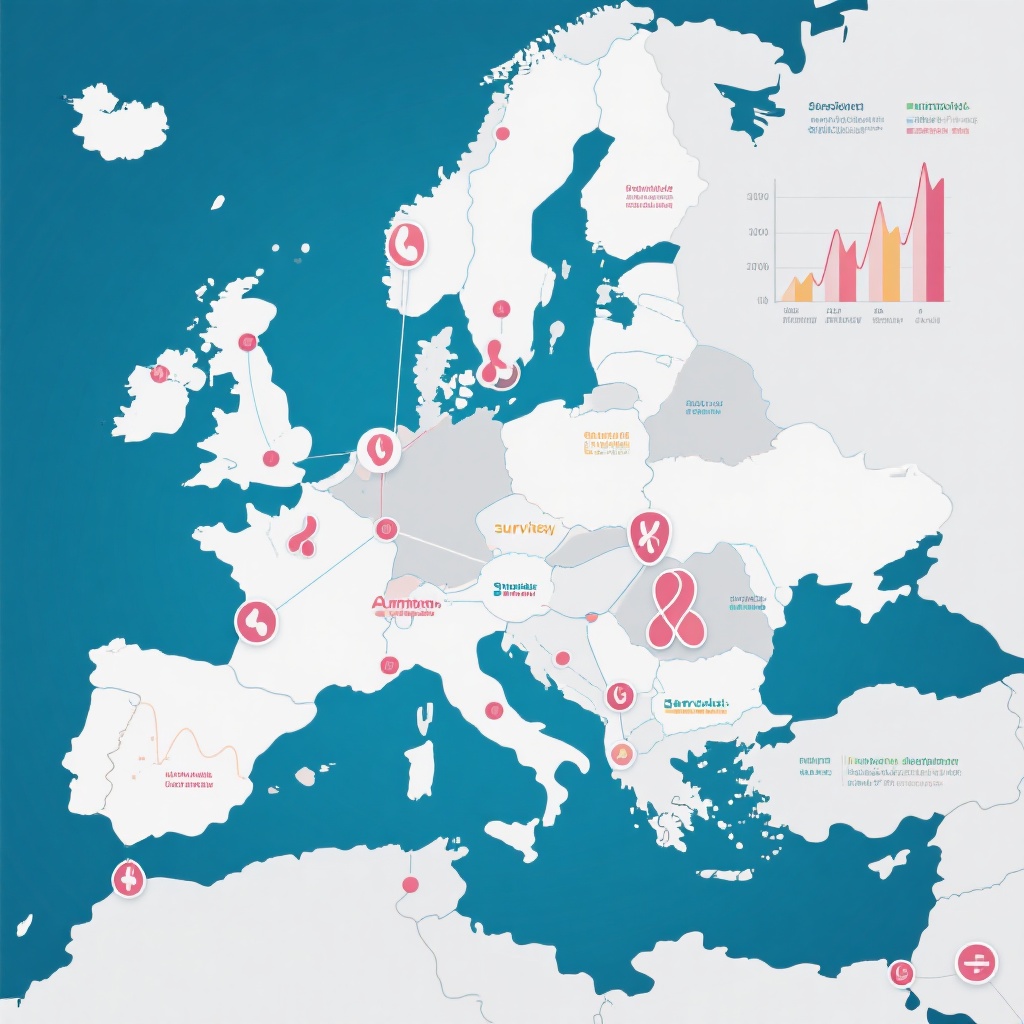
High-Resolution Mapping of European Cancer Outcomes: Insights from 1.7 Million Patients
Highlights
- Analysis of 1.7 million patients across eight European countries reveals significant heterogeneity in cancer survival and comorbidity burden.
- The study successfully utilized the Observational Medical Outcomes Partnership Common Data Model (OMOP-CDM) to federate data from 11 diverse electronic health records and registries.
- Breast and prostate cancers showed the highest 5-year survival (up to 85%), while pancreatic cancer remained the most lethal, with survival as low as 3% in some regions.
- Common comorbidities, such as anaemia in gastrointestinal cancers and COPD in lung cancer, may serve as critical early indicators or prodromes for diagnosis.
The Value of Real-World Evidence in Modern Oncology
While randomized controlled trials (RCTs) remain the gold standard for evaluating treatment efficacy, they often fail to capture the complexity of the ‘real-world’ patient—those with multiple comorbidities, varying socioeconomic backgrounds, and diverse treatment pathways. Real-world evidence (RWE) fills this gap by providing a comprehensive view of disease burden and healthcare delivery. However, the utility of RWE has historically been limited by the fragmentation of health data across different countries and systems. This study, published in The Lancet Regional Health – Europe, represents a landmark effort to harmonize these disparate data sources to provide a high-definition map of cancer care in Europe.
Methodological Framework: The Power of Federated Data
The researchers conducted a multinational cohort study involving 1,796,278 patients diagnosed with one of eight primary cancers between 2000 and 2019. The study’s strength lies in its federated approach, utilizing 11 databases across eight countries: Belgium, Estonia, Finland, France, Netherlands, Portugal, Spain, and the United Kingdom. To ensure interoperability, all data were mapped to the OMOP-CDM, allowing for standardized analysis across different languages and record-keeping traditions.
The primary focus was on overall survival (OS) at one, five, and ten years. Secondary objectives included the characterization of patient demographics, pre-existing comorbidities, and medication use prior to diagnosis. By standardizing the data, the authors could compare outcomes from highly structured cancer registries with those from primary care electronic health records (EHRs), providing a more holistic view of the patient journey.
Patient Demographics and Pre-diagnostic Comorbidities
The majority of cancer diagnoses occurred in individuals aged 60 to 79 years, a finding consistent with the known age-related incidence of most malignancies. However, the study’s deep dive into comorbidities revealed patterns that could inform early detection strategies. The researchers observed that certain conditions were disproportionately present in the months leading up to a cancer diagnosis, often referred to as ‘prodromes.’
For instance, anaemia was a frequent finding in patients with colorectal cancer (prevalence ranging from 9% to 23%) and stomach cancer (10% to 34%). In lung cancer patients, chronic obstructive pulmonary disease (COPD) was highly prevalent (18% to 34%), as was pneumonia (5% to 33%). These findings suggest that routinely collected EHR data can identify high-risk symptomatic clusters that should trigger further diagnostic investigation for underlying malignancy.
Survival Outcomes: A Spectrum of Disparity
The survival data highlighted both the successes of modern oncology and the persistent challenges of late-stage diagnoses. Breast and prostate cancers emerged as the categories with the most favorable outcomes. Five-year overall survival for breast cancer ranged from 76% to 85%, while prostate cancer survival ranged from 75% to 83%. These high rates likely reflect the impact of established screening programs and the availability of effective endocrine and targeted therapies.
Conversely, the data for pancreatic cancer remains sobering. The 5-year OS was as low as 3% in some national registries, though it reached 25% in specific database cohorts. This wide variation highlights potential differences in stage at diagnosis, surgical access, and data collection methods between registries and EHRs. Lung and stomach cancers also showed relatively poor outcomes, emphasizing the need for improved early detection and more effective systemic therapies.
Expert Commentary: Interpreting the Gaps
The significant variations in cancer survival estimates across data sources and countries warrant careful interpretation. These differences are not solely reflective of the quality of care; they are also influenced by the nature of the data sources. Cancer registries often capture more complete mortality data, whereas EHR-based databases may be subject to ‘loss to follow-up’ if a patient moves or changes providers. Furthermore, the varying prevalence of comorbidities like COPD or anaemia across regions may reflect differences in baseline population health or variations in diagnostic coding practices.
From a clinical perspective, the consistency of top medications and comorbidities across databases is reassuring. It suggests that despite regional differences, the fundamental clinical profile of these cancer patients is similar across Europe. This supports the move toward unified European clinical guidelines, while also highlighting the need for localized strategies to address specific regional survival gaps.
Conclusion: Moving Toward a Unified European Health Data Space
This study demonstrates that a federated analysis of diverse European databases is not only feasible but essential for benchmarking cancer care. By standardizing data to the OMOP-CDM, researchers have created a valuable framework for future studies. The insights gained regarding comorbidities and prodromes offer a potential pathway for improving early diagnosis through algorithmic screening of routine healthcare data.
As Europe moves toward a more integrated Health Data Space, studies like this serve as a blueprint for how large-scale RWE can be used to monitor public health, evaluate the impact of policy changes, and ultimately improve survival for the millions of citizens affected by cancer.
Funding and Disclosures
This research was supported by the European Health Data & Evidence Network (EHDEN), which has received funding from the Innovative Medicines Initiative 2 Joint Undertaking (JU) under grant agreement No 806968. The JU receives support from the European Union’s Horizon 2020 research and innovation programme and the European Federation of Pharmaceutical Industries and Associations (EFPIA). The funders had no role in the study design, data collection, or the decision to submit the work for publication.
References
López-Sánchez I, Palomar-Cros A, Claire R, et al. Comorbidities, medication use, and overall survival in eight cancers: a multinational cohort study of 1.7 million patients across Europe. Lancet Reg Health Eur. 2026 Jan 22;63:101585. doi: 10.1016/j.lanepe.2025.101585.