Highlight
– Adding neuromuscular electrical stimulation (NMES) to an early mobilization (EM) program initiated within 48 hours of ICU admission produced sustained improvements in functional status, mobility, independence, and quality of life up to 6 months after discharge compared with EM alone.
– The addition of NMES did not affect post-traumatic stress disorder (PTSD) symptoms and the study was a single-center randomized, blinded trial of 74 mechanically ventilated patients.
Background: the clinical problem and unmet need
Survivors of critical illness frequently develop intensive care unit–acquired weakness (ICU‑AW), a constellation of muscle wasting and neuromuscular dysfunction that contributes to prolonged rehabilitation, loss of independence, and reduced quality of life. Muscle atrophy begins very early during critical illness, often within the first days of mechanical ventilation, and recovery can be incomplete, with functional deficits persisting for months to years.
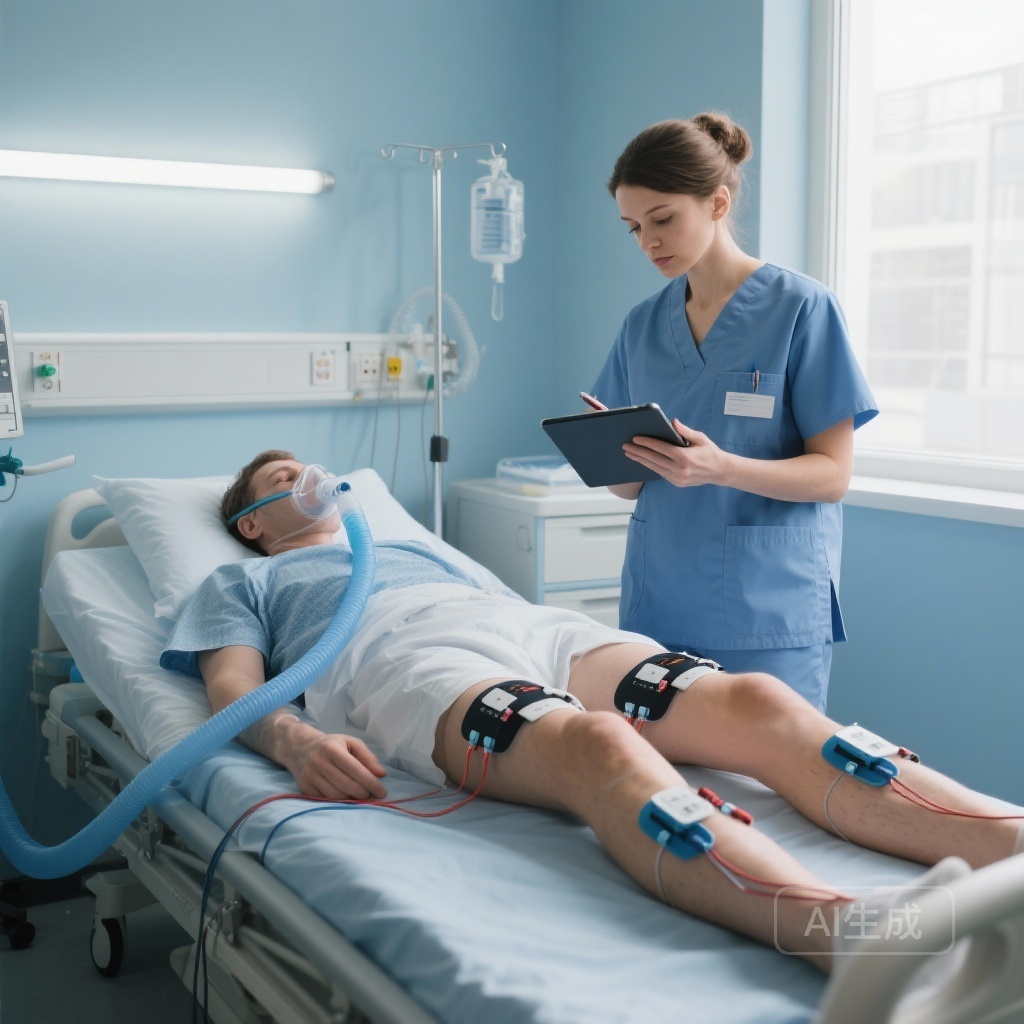
Early mobilization (EM) in the ICU has emerged as an effective strategy to preserve strength and shorten time to recovery, but practical barriers (deep sedation, severe respiratory failure, hemodynamic instability) often limit conventional active rehabilitation. Neuromuscular electrical stimulation (NMES) delivers externally applied electrical current to evoke muscle contractions and can be used even in sedated or weak patients to provide an anabolic and activity stimulus when volitional exercise is not feasible. Prior studies and physiologic data suggest NMES can attenuate muscle wasting and improve strength in critically ill patients, but data on longer-term functional and patient‑centered outcomes remain limited.
Study design
The trial by Carnevalli Bueno and colleagues (Crit Care Med. 2025) was a single‑center, randomized, controlled, blinded clinical trial conducted at Hospital das Clínicas, Ribeirão Preto Medical School, University of São Paulo. Seventy‑four mechanically ventilated adult patients were randomized within the first 48 hours of ICU admission to one of two interventions:
- EM group: daily early mobilization beginning within the first 48 hours of ICU admission.
- EM + NMES group: the same EM protocol plus adjunctive daily NMES applied 5 days per week, started within the first 48 hours and continued until ICU discharge.
Patients were followed after hospital discharge at 15 days and 6 months by telephone, and in person at 30 days and 3 months. Outcomes included measures of functional status (Barthel Index), mobility (ICU Mobility Scale), muscle strength, functional independence, health‑related quality of life, and post‑traumatic stress disorder (PTSD) symptoms. Baseline demographic and clinical characteristics were reported as similar between groups. The trial is noteworthy for early initiation of NMES/EM (within 48 hours) and planned medium‑term follow‑up to 6 months.
Key findings
The principal findings reported were:
- Patients randomized to EM + NMES had significantly higher functional status and independence compared with those who received EM alone at all measured time points (15 days, 30 days, 3 months, and 6 months), as measured by the Barthel Index (p < 0.05 at each time point).
- Mobility, assessed with the ICU Mobility Scale, was significantly better in the EM + NMES group at 15 days and at 3 and 6 months (p < 0.05).
- Health‑related quality of life was significantly higher in the EM + NMES group compared with the EM group, with benefits observed up to 6 months after discharge (p < 0.05).
- There was no significant difference in PTSD symptom scores between the two groups.
Secondary outcomes such as specific muscle strength measurements and adverse events were not described in the brief summary available here; the trial report should be consulted for detailed effect sizes, confidence intervals, absolute differences, number needed to treat, and safety data.
Interpretation and clinical relevance
These results indicate that the addition of NMES to an early mobilization program, when started very early (within 48 hours of ICU admission), can translate into clinically meaningful, durable gains in functional independence and quality of life out to 6 months. This finding is important because the principal burden of ICU‑AW is functional — prolonged dependence and reduced life participation — and approaches that preserve or restore function have high patient and health system value.
Biologically, the effect is plausible: NMES induces muscle contractions that provide mechanical load and metabolic signaling to skeletal muscle. When applied early, NMES may reduce the rapid atrophy and fiber phenotype changes described in critical illness, limit deconditioning during periods when active mobilization is not possible, and thereby facilitate earlier and more effective recovery once patients can participate in active rehabilitation.
Context with prior evidence
Early mobilization has prior randomized controlled evidence supporting improvements in delirium duration, ventilator days, and function (Schweickert et al., Lancet 2009). Observational and small controlled studies of NMES have suggested benefit for muscle mass and strength preservation, but heterogeneity in timing, dosing, patient selection, and outcomes has limited definitive conclusions. The present study provides randomized evidence that combining NMES with EM, initiated extremely early, improves medium‑term patient‑centered outcomes.
Strengths
- Randomized and blinded design reduces allocation and assessment bias.
- Early initiation of interventions (within 48 hours) is consistent with the pathophysiology of rapid muscle wasting in critical illness.
- Follow‑up to 6 months permits assessment of durable, patient‑centered outcomes (function and quality of life), which are more meaningful than short‑term physiologic surrogates alone.
Limitations and generalizability
- Single‑center study with 74 patients limits generalizability; results require replication in larger, multicenter trials with diverse ICU populations.
- The trial summary does not report detailed effect sizes, confidence intervals, or adverse event rates; clinicians should review the full manuscript for these data prior to broad protocol adoption.
- NMES dose, targeted muscle groups, session duration, and technical parameters influence effect and feasibility; implementation requires trained staff and protocols to ensure consistent dosing and monitoring.
- Blinding in rehabilitation trials is challenging; while assessors may have been blinded, treating teams were likely not, which could introduce performance biases.
- Cost‑effectiveness, staffing, and resource implications of routine NMES use in ICUs remain to be evaluated.
Practical implications for clinicians and ICU teams
For ICUs seeking to optimize early rehabilitation, this trial suggests that when feasible, integrating NMES into early mobilization protocols may yield durable improvements in function and quality of life for mechanically ventilated patients. Practical steps include:
- Identifying eligible patients early (within 48 hours), with attention to hemodynamic and respiratory stability criteria used at the study center.
- Establishing standardized NMES protocols (muscle groups, intensity titration to visible/functional contractions, session duration, frequency) and staff training to ensure safety and reproducibility.
- Monitoring for expected and potential adverse effects (skin irritation, pain, hemodynamic responses) and documenting patient‑centered endpoints.
- Embedding NMES as an adjunct, not a replacement, for progressive active mobilization whenever the patient can participate.
Research and policy priorities
Key next steps include multicenter randomized trials to confirm effect size and generalizability, head‑to‑head comparisons of NMES dosing strategies, and studies that integrate economic analyses. Additional research should examine which patient subgroups derive the greatest benefit (for example, older patients, those with high baseline comorbidity, versus younger patients), and explore mechanistic biomarkers of muscle preservation and recovery. Long‑term follow‑up beyond 6 months would clarify durability of benefit and effects on return to work and societal participation.
Conclusion
The randomized trial by Carnevalli Bueno et al. provides encouraging evidence that early adjunctive NMES combined with standard early mobilization, when started within the first 48 hours of ICU admission, improves functional outcomes and quality of life up to 6 months after discharge compared with early mobilization alone. While promising, these results should be interpreted in the context of trial size and setting and need replication in larger, multicenter studies. For ICUs already implementing early mobilization, NMES appears to be a viable adjunct to consider — particularly for patients unable to participate fully in active exercise — pending further evidence on implementation and cost‑effectiveness.
Funding and trial registration
Readers should consult the full manuscript for detailed funding disclosures and clinical trial registration information. The reference for the primary report is provided below.
References
1. Carnevalli Bueno TB, Campos DR, de Oliveira KSM, Gosselink R, de Jesus Guirro RR, Borges MC. Long-Term Effects of the Association of Early Neuromuscular Electrical Stimulation With Mobilization in Critically Ill Patients. Crit Care Med. 2025 Dec 1;53(12):e2506-e2515. doi: 10.1097/CCM.0000000000006866. PMID: 40970764.
2. Schweickert WD, Pohlman MC, Pohlman AS, et al. Early physical and occupational therapy in mechanically ventilated, critically ill patients: a randomized controlled trial. Lancet. 2009;373(9678):1874–1882.
3. Puthucheary ZA, Rawal J, McPhail M, et al. Acute skeletal muscle wasting in critically ill patients. JAMA. 2013;310(15):1591–1600.
4. Latronico N, Bolton CF. Critical illness polyneuropathy and myopathy: a major cause of muscle weakness and paralysis. Lancet Neurol. 2011;10(10):931–941.