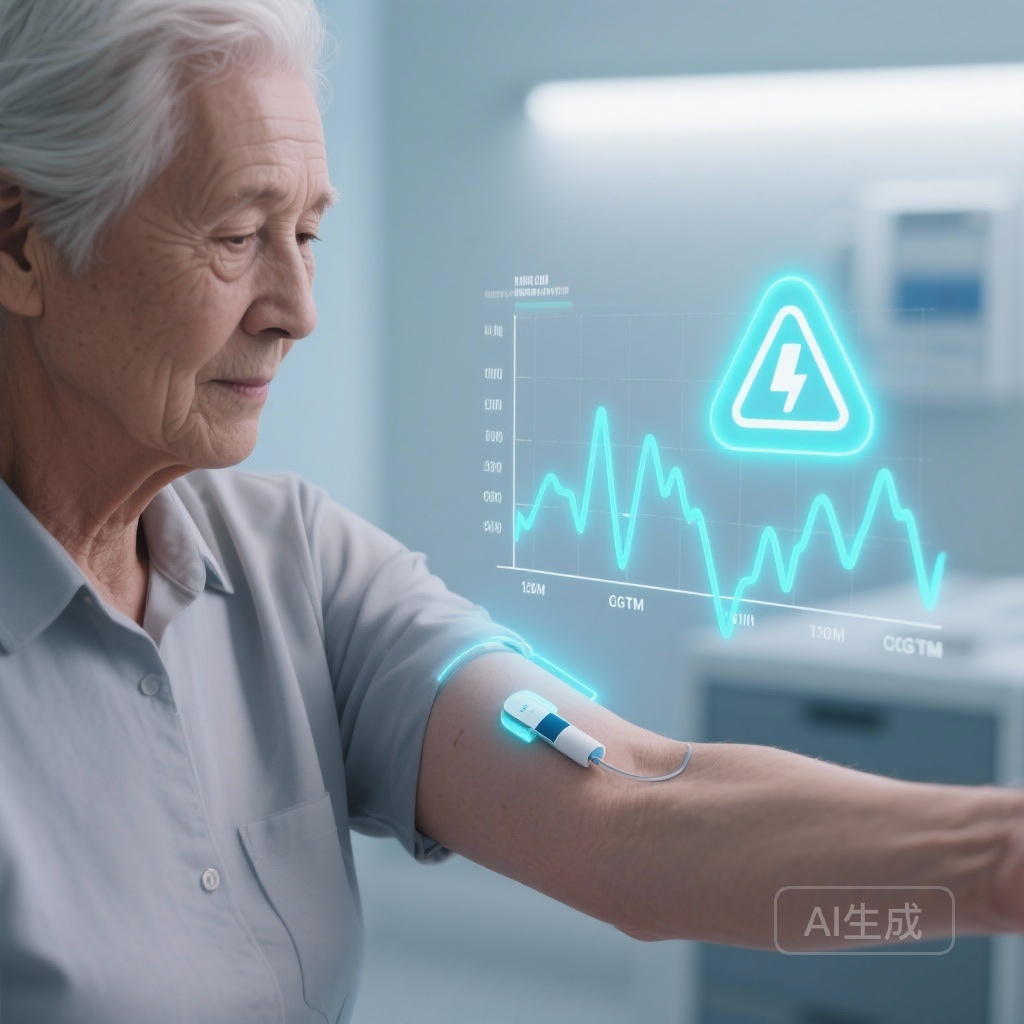
Introduction: The Growing Challenge of Hypoglycemia in Aging Populations
As the lifespan of individuals with Type 1 Diabetes (T1D) continues to increase, clinicians face the complex challenge of managing glycemic control in an aging population. Older adults are disproportionately affected by impaired awareness of hypoglycemia (IAH), a condition characterized by a diminished ability to perceive the autonomic and neuroglycopenic symptoms of falling blood glucose. IAH is a potent risk factor for severe hypoglycemic events (SHEs), which in older patients can lead to falls, fractures, cognitive decline, and cardiovascular stress. While Continuous Glucose Monitoring (CGM) has become the gold standard for reducing hypoglycemia, its ability to actually reverse or improve the underlying physiological deficit of IAH in older adults remains a subject of intense clinical debate.
Highlights
- CGM use significantly reduced the frequency of severe hypoglycemic events (Clarke-SHEF) in older adults over 52 weeks (P < 0.0001).
- Physiological hypoglycemia awareness symptoms (Clarke-HAF) did not show significant improvement, suggesting CGM functions as an external safety net rather than a biological recalibration tool.
- Improvements in global awareness scores were only observed in the subgroup with baseline IAH, highlighting the importance of targeted intervention.
- The study underscores the methodological limitations of the Clarke score and the need for more nuanced metrics in clinical trials.
Study Design: A Deeper Look at the WISDM Post Hoc Analysis
The Wireless Innovation for Seniors with Diabetes Mellitus (WISDM) study was a randomized clinical trial that demonstrated the efficacy of CGM in reducing hypoglycemia among adults aged 65 and older. This specific post hoc analysis sought to determine if prolonged CGM use (52 weeks) could improve IAH. The researchers utilized the Clarke original score, a validated tool that assesses awareness through eight questions. To gain more granular insights, the score was broken down into two distinct subscales: the Hypoglycemia Awareness Factor (HAF), which measures the symptomatic perception of low blood sugar, and the Severe Hypoglycemia Experienced Factor (SHEF), which tracks the frequency and severity of past episodes.
The analysis included 184 participants at the 26-week mark and a subset of 94 participants who completed the full 52-week follow-up. The primary endpoints were changes in the Clarke-full score and its respective subscales from baseline to the end of the study period.
Key Findings: Disconnect Between Safety and Awareness
The results of the analysis provide a nuanced view of how technology interacts with diabetic pathophysiology. After 26 weeks, there was a statistically significant decrease in the Clarke-SHEF scores (P = 0.02), a trend that became even more pronounced at 52 weeks (P < 0.0001). This indicates that CGM is highly effective at preventing the catastrophic events that define the 'severe' end of the hypoglycemia spectrum. By providing real-time alerts and trend data, CGM allows patients to intervene before glucose levels reach a critical threshold.
However, the Clarke-HAF subscale—which represents the actual ‘feeling’ of symptoms—remained essentially unchanged throughout the 52-week period. This suggests that while patients are safer, their internal biological warning systems have not been ‘reset.’ In the general cohort, the Clarke-full score also did not show a significant shift. Interestingly, in a subgroup analysis of those who entered the study with established IAH, the Clarke-full score did show improvement at 52 weeks. This discrepancy highlights that the impact of CGM on awareness may be most visible in those with the greatest baseline deficit, but even then, the improvement may be more related to behavioral changes than physiological recovery.
Expert Commentary: Interpreting the Data for Clinical Practice
This study raises vital questions about the goals of diabetes technology. For decades, the hope has been that by avoiding hypoglycemia through CGM, we might allow the body’s counter-regulatory responses to recover—a phenomenon known as the ‘reversal of hypoglycemia unawareness.’ The WISDM data suggests that in older adults with a long duration of T1D, this reversal may be partial or absent at the symptomatic level.
Clinicians must distinguish between ‘technological awareness’ and ‘physiological awareness.’ CGM provides a digital proxy for symptoms, but it does not cure the underlying autonomic failure. Furthermore, the study highlights a critical limitation of the Clarke score: the ‘full’ score can be heavily weighted by the SHEF component. If a patient stops having severe events because their CGM alarms them, their Clarke score improves, but their ability to feel a low (HAF) remains impaired. This ‘masking’ of persistent physiological unawareness by improved safety outcomes is a vital distinction for physician-scientists to consider when designing future trials or assessing patient risk.
Conclusion: Practical Takeaways for the Care of Older Adults
For older adults with T1D, CGM is an indispensable tool for harm reduction. It significantly lowers the risk of severe, life-threatening hypoglycemia as evidenced by the SHEF data. However, providers should not assume that a patient’s ‘awareness’ has returned simply because their event rate has dropped. Education must continue to emphasize that the device is a supplement to, not a replacement for, physiological vigilance. Moving forward, the diabetes community requires better standardized methods for measuring IAH that can separate behavioral success from physiological recovery. In the meantime, CGM should be viewed as a lifelong safety requirement for older adults with a history of IAH, rather than a temporary intervention intended to restore natural awareness.
Funding and ClinicalTrials.gov
The WISDM study was supported by the JDRF. The trial is registered at ClinicalTrials.gov, number NCT03240185.
References
- Bilal A, Yi F, Whitaker K, Khan ZA, Pratley RE, Casu A. Effects of Continuous Glucose Monitoring on Impaired Awareness of Hypoglycemia in Older Adults With Type 1 Diabetes: A Post Hoc Analysis of the WISDM Study. Diabetes Care. 2026 Jan 1;49(1):86-91. doi: 10.2337/dc25-0971.
- Pratley RE, Kanapka LG, Rickels MR, et al. Effect of Continuous Glucose Monitoring on Hypoglycemia in Older Adults With Type 1 Diabetes: A Randomized Clinical Trial. JAMA. 2020;323(23):2397-2406.
- Geddes J, Schopman JE, Zammitt NN, Frier BM. Prevalence of impaired awareness of hypoglycaemia in adults with Type 1 diabetes. Diabet Med. 2008;25(4):461-466.