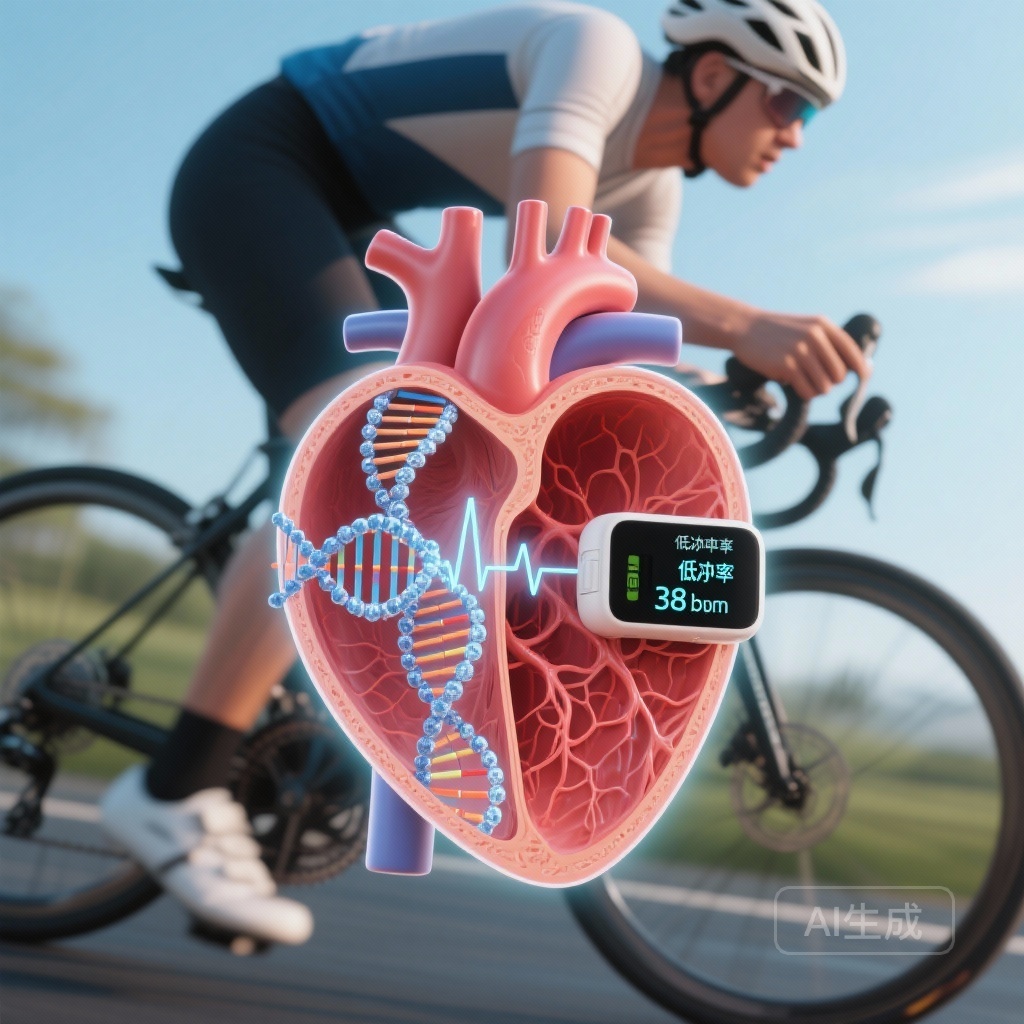
Introduction: Redefining the ‘Athlete’s Heart’
Sinus bradycardia has long been considered a hallmark of the endurance athlete’s heart. Traditionally, clinicians and physiologists have attributed this low resting heart rate (HR) to increased parasympathetic vagal modulation or structural remodeling of the sinus node. However, the wide variability in bradycardic response among athletes—even those with similar training loads—suggests that environmental factors alone do not tell the whole story. A landmark study published in Circulation by the Pro@Heart Consortium, titled ‘Bradycardia in Athletes: Prevalence, Mechanisms, and Risks,’ provides new evidence that genetic susceptibility plays a pivotal role in this physiological adaptation.
Study Highlights
- Profound resting bradycardia (minimum HR ≤40 bpm) was observed in 38% of elite endurance athletes.
- A lower polygenic risk score (HR-PRS) for heart rate was significantly associated with a higher burden of bradycardia, independent of fitness levels.
- Athletic bradycardia and pauses (up to 3 seconds) were not associated with adverse clinical outcomes over a 5.5-year follow-up period, reinforcing their status as benign physiological adaptations.
- The study suggests that genetic factors associated with lower resting heart rate may be more prevalent in elite athletes than in the general population, potentially acting as a determinant of athleticism itself.
Background: The Mechanism of Sinus Node Remodeling
The sinus node is a complex structure that serves as the heart’s natural pacemaker. In endurance athletes, chronic aerobic training leads to both electrical and structural changes. While vagal tone was historically thought to be the primary driver, recent murine and human studies have highlighted intrinsic remodeling of the sinus node, including the downregulation of ion channels such as HCN4. Despite these insights, the genetic architecture underlying why some athletes develop profound bradycardia while others do not remained largely unexplored until now.
Study Design and Methodology
The researchers utilized the Pro@Heart cohort, a multicenter study designed to phenotype the cardiovascular health of elite endurance athletes. The study included 465 current and former elite athletes (median age 23 years, 75% male). Phenotyping was rigorous, involving:
- Multimodal cardiac imaging to assess structural remodeling.
- Cardiopulmonary exercise testing (CPET) to measure peak oxygen consumption (VO2 peak).
- Holter monitoring to capture minimum HR and pauses.
A key feature of this study was the use of a validated Heart Rate Polygenic Risk Score (HR-PRS). This score aggregates the effects of multiple common genetic variants known to influence heart rate in the general population. The athletic cohort was compared against a healthy non-athletic control group from the ASPREE (Aspirin in Reducing Events in the Elderly) study to determine if athletes possess a distinct genetic profile regarding heart rate regulation.
Key Findings: The Prevalence of Bradycardia
The prevalence of what many clinicians might consider ‘pathological’ heart rates was surprisingly high in this elite cohort. Among the 465 athletes, 175 (38%) exhibited a minimum HR ≤40 bpm on Holter monitoring. Even more striking, 7 athletes (2%) had a minimum HR ≤30 bpm. Rhythm disturbances were also common:
- Pauses of ≥2 seconds were found in 25% of the athletes.
- Pauses of ≥3 seconds were seen in 3% of the cohort.
- Mobitz I second-degree atrioventricular (AV) block was observed in 3% of the participants.
Athletes with profound bradycardia (BAs) were generally younger and exhibited higher levels of fitness and more pronounced cardiac remodeling (e.g., larger indexed right atrial volumes) compared to non-bradycardic athletes.
The Genetic Link: HR-PRS and Athleticism
One of the most significant contributions of this study is the integration of genetic data. The researchers found that the mean HR-PRS was significantly lower in all athletes compared to the ASPREE non-athletic controls (P < 0.001). This suggests that elite athletes may be genetically ‘predisposed’ to lower heart rates, which may facilitate higher stroke volumes and greater aerobic capacity.
Within the athletic group, those in the bottom quartile of HR-PRS (genetically predisposed to lower HR) had a significantly lower median minimum HR (41 bpm) and a much higher bradycardia burden (14%) compared to those in the top quartile (45 bpm and 2% burden, respectively). After adjusting for age, sex, fitness, and atrial volume, the HR-PRS remained an independent predictor, doubling the odds of resting bradycardia (OR 2.2).
Safety and Clinical Outcomes
For clinicians, the most reassuring finding was the safety profile. Over a median follow-up of 5.5 years, neither the presence of profound bradycardia nor the occurrence of significant pauses was associated with adverse cardiovascular events or the need for pacemaker implantation. This provides robust evidence that these findings, while occasionally alarming on a monitor, are part of a healthy adaptive spectrum in the elite athletic population.
Expert Commentary: Nature vs. Nurture
This study challenges the traditional binary view of athletic bradycardia as purely a training effect. It introduces a ‘nature plus nurture’ model where intense training acts upon a favorable genetic substrate. The fact that elite athletes have lower polygenic risk scores than the general population raises an intriguing hypothesis: does a genetic predisposition to a lower heart rate make it easier for an individual to reach the ‘elite’ level of endurance sports? If a lower resting HR allows for a more significant increase in stroke volume during exercise, those with a lower HR-PRS may have a biological head start.
However, the study is not without limitations. The cohort was predominantly young and male, and the genetic comparisons were made against an older population (ASPREE), though the researchers controlled for these factors. Further research is needed to see if these genetic markers can predict which athletes might eventually develop symptomatic sinus node dysfunction later in life, a condition sometimes referred to as ‘sick sinus syndrome’ in veteran athletes.
Conclusion
The Pro@Heart Consortium has demonstrated that profound bradycardia and significant nocturnal pauses are standard features of the elite endurance athlete’s physiology. These adaptations are driven by a combination of high fitness levels and a specific genetic architecture. For the practicing cardiologist, these results suggest that in the absence of symptoms, even extreme bradycardia in an elite athlete should be viewed as a physiological success rather than a clinical pathology. Moreover, the study opens a new frontier in sports science, suggesting that our genetic makeup may dictate our ceiling for athletic endurance.
References
D’Ambrosio P, De Paepe J, Spencer LW, et al. Bradycardia in Athletes: Prevalence, Mechanisms, and Risks. Circulation. 2025;151. doi:10.1161/CIRCULATIONAHA.125.076170.