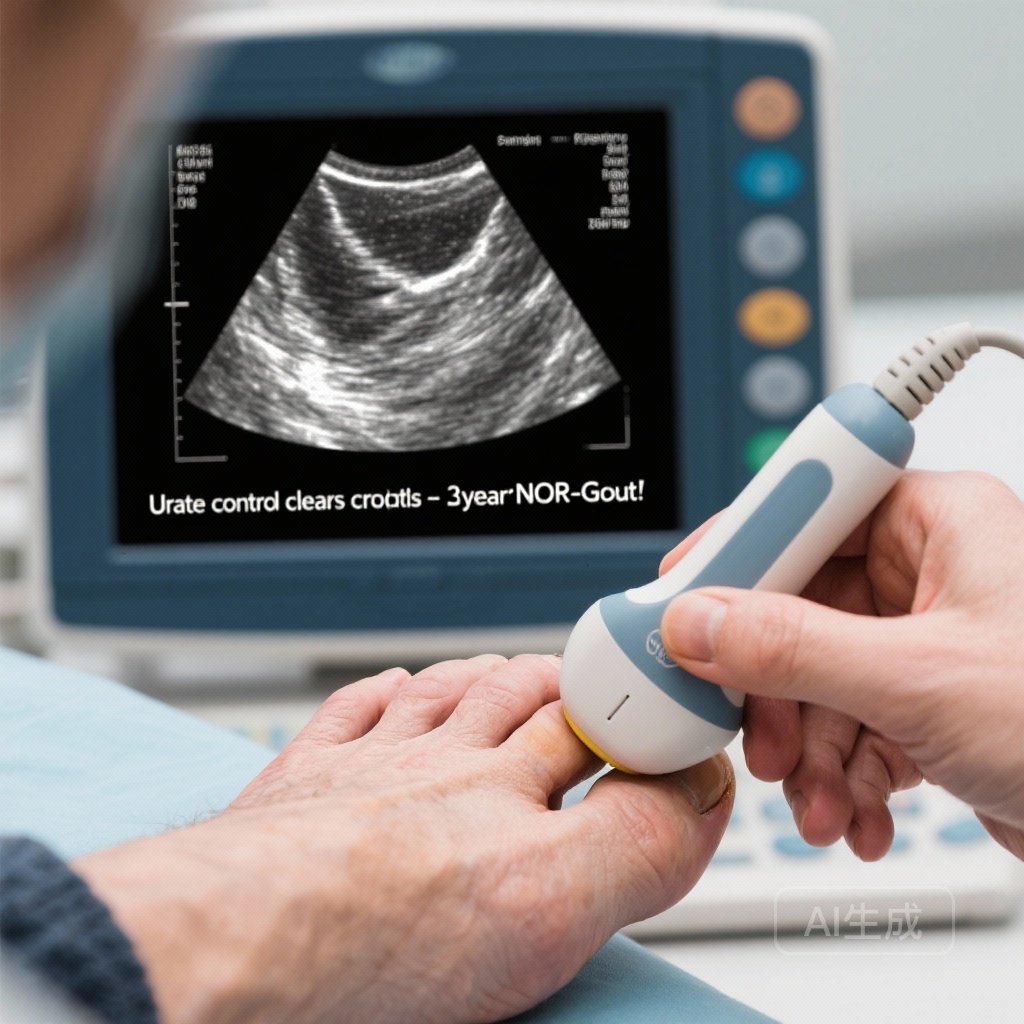
Highlights
– Five years of treat‑to‑target urate‑lowering therapy (T2T‑ULT) markedly reduced serum uric acid (sUA) and ultrasound‑detected monosodium urate (MSU) deposits in the NOR‑Gout cohort.
– At 5 years, 71.2% achieved sUA <360 μmol/L; double contour and tophi resolved in 83.4% and 63.2% of affected sites respectively, with first MTP often demonstrating the greatest change.
– Only 16% reported gout flares in the previous year; those patients had higher residual sUA and ultrasound crystal burden, reinforcing the clinical relevance of sustained low sUA.
Background
Gout is a common inflammatory arthritis caused by monosodium urate crystal deposition in joints and soft tissues. Crystal dissolution is governed by physicochemical solubility: sustained lowering of serum urate below the saturation threshold promotes MSU crystal resorption. Treat‑to‑target urate‑lowering therapy (T2T‑ULT) aims to maintain sUA below defined thresholds (commonly <360 μmol/L; lower targets for tophaceous disease) to resolve crystals, prevent flares, and limit joint damage. Imaging studies using musculoskeletal ultrasound have demonstrated features attributable to MSU deposition—double contour (DC) sign, tophi, and aggregates—that can be tracked longitudinally and may serve as surrogate markers of crystal burden beyond clinical assessment alone.
Study design
The NOR‑Gout study is a prospective treat‑to‑target cohort enrolling patients with recent gout flare and initiating T2T‑ULT. Participants were treated and followed over five years: intensive outpatient clinic management during year 1, then follow‑up in general practice during years 2–5 with protocolized visits at baseline, 1, 2 and 5 years. At each visit investigators recorded serum uric acid (sUA), performed a standardized musculoskeletal ultrasound assessment of bilateral hands, elbows, knees, ankles and feet (documenting double contour, tophi and aggregates), and recorded the number of gout flares in the preceding year. Statistical analyses included paired and independent t‑tests, ANOVA and linear regression to assess changes over time and associations between residual crystal burden, sUA and flares.
Key findings
Population and retention: 209 patients were enrolled at baseline (mean age 56.4 years, mean gout duration 7.9 years). At the 5‑year assessment 163 patients (78% of the original cohort) were examined.
Serum urate control: Median or mean sUA fell significantly from 500 μmol/L at baseline to 337 μmol/L at 5 years (P <.001). By year 5, 71.2% of patients had achieved the common target of sUA <360 μmol/L.
Ultrasound‑detected crystal burden: All three ultrasound lesion types measured—double contour (cartilage surface MSU), tophi (soft tissue deposits) and aggregates—declined significantly over the 5‑year period (all P <.001). When focusing on resolution rather than mean change, 83.4% of joints with an initial double contour and 63.2% of localized tophi demonstrated full dissolution by year 5. Notably, examination of the first metatarsophalangeal (MTP1) joints alone identified most patients with full dissolution, underscoring MTP1 as a sentinel site for MSU deposition and imaging surveillance.
Clinical flares: Only 16% of patients reported at least one gout flare in the preceding year at the 5‑year visit. Those with flares had higher residual sUA and greater residual ultrasound crystal burden compared with patients who were flare‑free (group differences statistically significant, P values reported in the primary paper ranged from .035 to .006). This association links biochemical and imaging evidence of incomplete crystal clearance to ongoing symptomatic disease.
Analytic approach and robustness: The investigators used paired comparisons and regression models to relate longitudinal changes in sUA to ultrasound outcomes and flare frequency. The consistent directionality and statistical significance across multiple lesion types strengthen the inference that sustained sUA reduction drives crystal resorption and clinical benefit.
Clinical interpretation and implications
This 5‑year prospective follow‑up provides clinically actionable evidence that a treat‑to‑target strategy for urate lowering produces durable benefits: most patients maintain sUA below target, ultrasound‑detectable crystal deposits progressively shrink and often disappear, and flares become infrequent. Key clinical messages include:
- Durable sUA control is essential. A majority achieved the commonly recommended target of <360 μmol/L, and those who did had less residual imaging evidence of disease and fewer flares.
- Imaging tracks biology. Ultrasound measures (DC, tophi, aggregates) are responsive to therapy and can document objective crystal clearance, which may be useful in patients with difficult‑to‑control disease or where adherence is uncertain.
- Clinical outcomes improve but flares are not eliminated. A small fraction of patients continued to have flares at 5 years and tended to have higher sUA and remaining deposits, arguing for reassessment of adherence, dosing escalation, or alternative strategies (e.g., combination ULT, specialist input) when targets are not sustained.
- Targeting the first MTP for ultrasound surveillance may be efficient because it commonly reflects overall articular crystal burden and captured most cases of resolution in this cohort.
Mechanistic context
MSU crystals persist while sUA remains at or above saturation levels. Lowering sUA below the solubility threshold reduces the thermodynamic drive for crystal maintenance and permits progressive resorption mediated by innate immune cells and local tissue remodeling. Imaging reflects this process: the double contour sign represents MSU deposition on cartilage and tends to resolve more rapidly than larger tophaceous aggregates, which require more prolonged exposure to sub‑saturation sUA to shrink and vanish.
Study strengths and limitations
Strengths: The NOR‑Gout manuscript reports prospective, repeated multimodal assessments over a clinically meaningful 5‑year period in a pragmatic treat‑to‑target program transitioning care from specialty to primary care—mirroring real‑world management. The use of ultrasound provides objective evidence of structural change beyond patient‑reported flares.
Limitations: The cohort was not randomized, so causal inference is limited compared with randomized controlled trials. There was attrition (≈22% not examined at 5 years), which could bias results if losses differed systematically. Ultrasound is operator dependent; although standardized assessments were used, inter‑reader variability and the limited joint set scanned may underestimate total body burden. Flare data relied on patient recall for the preceding year, which may be subject to reporting bias. Finally, the cohort characteristics (demographics, comorbidity profile) determine generalizability to other populations.
Expert commentary and guideline relevance
The NOR‑Gout 5‑year results align with the physiologic rationale and guideline recommendations that emphasize sustained urate lowering as the cornerstone of gout management. These data bolster the argument for early initiation and active titration of ULT to target, continued treatment even after symptom improvement, and consideration of imaging to monitor disease in selected patients. Clinicians should weigh ultrasound as an adjunctive tool when treatment response is uncertain, in tophaceous disease, or when joint damage is a concern.
Practical takeaways for clinicians
- Set a clear sUA target and titrate ULT to achieve it. Monitor sUA regularly and reinforce adherence, particularly after transition to primary care.
- Expect progressive ultrasound evidence of crystal reduction with successful long‑term urate lowering; use imaging selectively to document response or guide escalation.
- Recognize that residual flares point to incomplete control and should trigger reassessment: check sUA, adherence, possible triggers, and consider dose escalation or specialist referral.
- Examine MTP1 clinically (and consider ultrasound there) as a pragmatic sentinel for MSU burden.
Conclusions
The NOR‑Gout 5‑year follow‑up demonstrates that a treat‑to‑target urate‑lowering approach yields durable reductions in serum urate, meaningful and often complete resolution of ultrasound‑detected MSU deposits, and a low remaining flare rate linked to residual urate and crystal burden. These findings provide objective imaging‑supported evidence that sustained biochemical control translates into structural and clinical improvement in gout and support aggressive, sustained efforts to achieve and maintain guideline‑recommended sUA targets.
Funding and registration
Primary citation and funding details are reported in the original publication (Hammer HB et al., Ann Rheum Dis. 2025). Clinicians should consult the full report for granular methodology, funding sources, and any trial registration identifiers.
Reference
Hammer HB, Karoliussen L, Terslev L, Haavardsholm EA, Uhlig T. Ultrasound-detected crystal depositions and clinical flares dissolve during successful urate-lowering therapy: 5-year follow-up results from the treat-to-target NOR-Gout study. Ann Rheum Dis. 2025 Nov 20:S0003-4967(25)04517-0. doi: 10.1016/j.ard.2025.10.029. Epub ahead of print. PMID: 41271521.