Highlight
• A centralized population-health coordinator notification for patients with prior echocardiographic left ventricular hypertrophy (LVH) increased initiation of antihypertensive therapy (16.3% vs 5.0%; adjusted OR 3.76, 95% CI 2.09–6.75).
• The intervention also increased new hypertension diagnoses (adjusted OR 4.43, 95% CI 2.36–8.33) over 12 months; cardiomyopathy diagnoses were unchanged.
Background: clinical context and unmet need
Hypertension remains a leading modifiable risk factor for cardiovascular morbidity and mortality worldwide. Despite clear evidence that lowering blood pressure reduces the risks of stroke, myocardial infarction and heart failure, hypertension is frequently underdiagnosed and undertreated. Echocardiographic left ventricular hypertrophy (LVH) reflects cumulative exposure to elevated blood pressure and is an established marker of target-organ damage and heightened cardiovascular risk. LVH is therefore both a signal of previous or ongoing uncontrolled blood pressure and a rationale for intensifying diagnostic and therapeutic efforts.
Health systems generate large quantities of diagnostic data (including echocardiograms) that are not always leveraged to optimize preventive care. The NOTIFY-LVH randomized clinical trial asked whether harnessing preexisting echocardiographic evidence of LVH via a centralized notification and clinical support pathway could improve detection and initial treatment of hypertension within routine ambulatory care.
Study design
NOTIFY-LVH was a pragmatic, two-arm randomized clinical trial conducted within the Mass General Brigham healthcare system from March 2023 to June 2024. The trial enrolled adults with primary care affiliation in the system who had LVH documented on a prior transthoracic echocardiogram, did not have an established cardiomyopathy diagnosis, and were not receiving antihypertensive medications at baseline. Patients were randomized 1:1 to intervention or usual care and followed for 12 months.
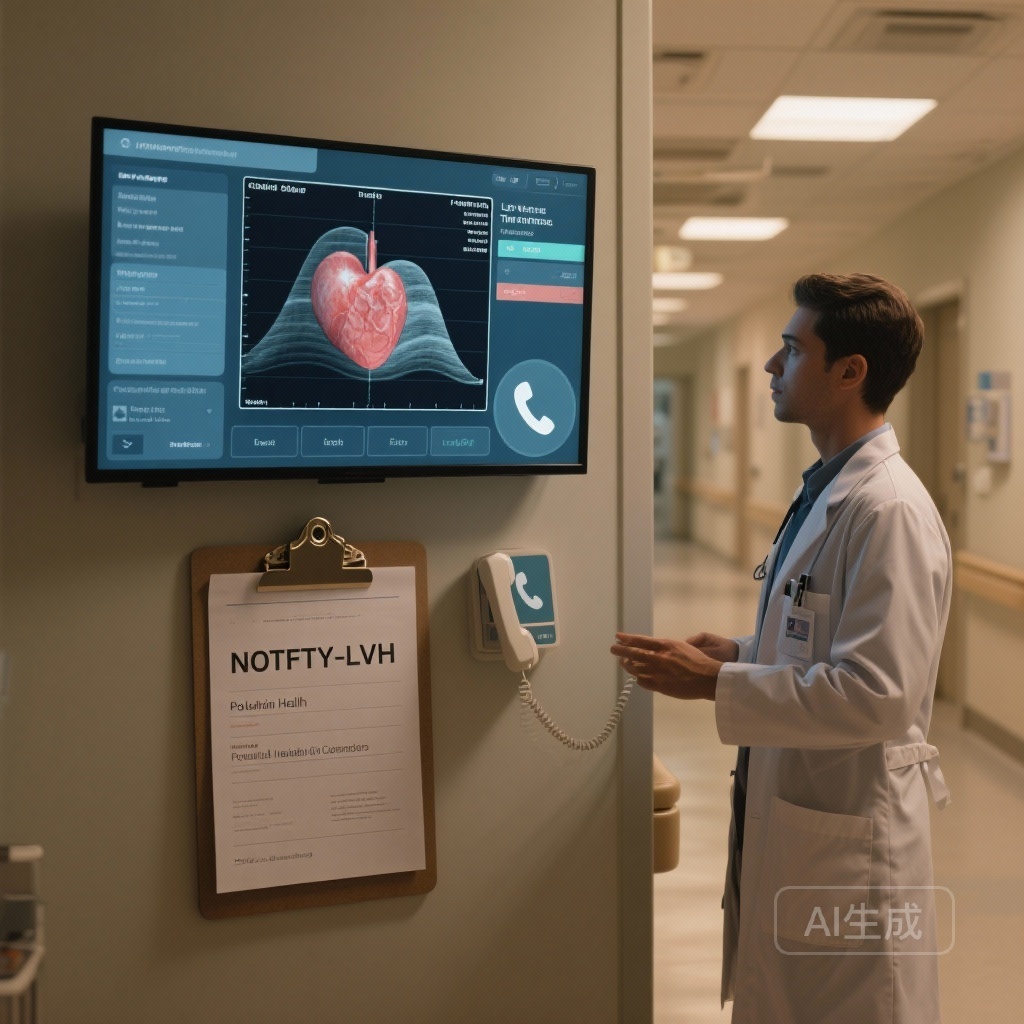
The intervention consisted of centralized population health coordinators contacting the patient’s primary clinician to notify them of the prior LVH finding and to offer assistance with follow-up care. The trial deployed a clinical support pathway that included offering 24‑hour ambulatory blood pressure monitoring (ABPM) and facilitated cardiology referral as appropriate, with nonphysician staff augmenting routine ambulatory workflows. Control-arm patients received usual care without these centralized notifications.
Primary outcome: initiation of any antihypertensive medication within 12 months. Secondary outcomes included new diagnoses of hypertension and cardiomyopathy, and other process metrics relevant to evaluation of LVH.
Key findings
Population: 648 patients were randomized (326 intervention; 322 control). Mean (SD) age was 59.4 (10.8) years; 38.3% were female. At baseline 102 patients (15.7%) had a prior diagnosis of hypertension and 109 patients (20.1%) had a mean outpatient blood pressure ≥130/80 mm Hg.
Primary outcome: antihypertensive initiation
Over 12 months, 53 patients (16.3%) in the intervention arm were prescribed an antihypertensive medication compared with 16 patients (5.0%) in the control arm. The adjusted odds ratio (OR) for antihypertensive initiation in the intervention group was 3.76 (95% CI, 2.09–6.75; P < .001), indicating a large and statistically robust effect on initial treatment uptake following the system-level notification.
Secondary outcomes
New hypertension diagnoses were also more common in the intervention group: adjusted OR 4.43 (95% CI, 2.36–8.33; P < .001). There was no significant difference between groups in new cardiomyopathy diagnoses during the 12-month follow-up.
Process measures and safety
The report highlights that the intervention leveraged nonphysician coordinators and an explicit clinical support pathway (including ABPM and cardiology referral) to convert an otherwise passive echocardiographic finding into active diagnostic and therapeutic steps. The trial did not demonstrate increased cardiomyopathy detection, suggesting the notification primarily expedited recognition and management of hypertension rather than unmasking structural cardiomyopathy in the short term. The summary does not indicate adverse events attributable to the intervention; longer-term safety and clinical outcomes were not reported in the 12-month window.
Interpretation and clinical implications
NOTIFY-LVH provides pragmatic, randomized evidence that existing imaging data can be repurposed to improve hypertension care. Echocardiographic LVH functions as a high‑yield trigger: it identifies individuals with prior or ongoing blood pressure exposure who may benefit from systematic re-evaluation. By routing information to primary clinicians and supporting them with nonphysician personnel and concrete diagnostic options (ABPM, referral pathways), the system achieved a roughly three- to fourfold increase in both new hypertension diagnoses and the initiation of antihypertensive therapy.
From a clinical standpoint, LVH on imaging is a validated marker of elevated cardiovascular risk and a guideline-consistent reason to pursue more definitive blood pressure assessment and management. Current guidelines emphasize the use of out-of-office blood pressure measurement such as ABPM to confirm hypertension and to identify white-coat or masked hypertension. The NOTIFY-LVH pathway operationalizes guideline principles by reducing workflow barriers and providing implementation support to busy clinicians.
Strengths
Key strengths include the randomized pragmatic design in a real-world multisite health system, objective prespecified primary outcomes (medication initiation), and an intervention that is scalable within electronic health record–enabled systems. The use of nonphysician coordinators leverages workforce resources and aligns with team-based models of chronic disease management.
Limitations and uncertainties
Notable limitations temper interpretation and generalizability. The trial was conducted within a single integrated healthcare system in the greater Boston area; results may differ in systems with different EHR capabilities, staffing models, or patient populations. Follow-up was limited to 12 months and focused on process outcomes (diagnosis and medication initiation) rather than long-term clinical endpoints such as incident heart failure, stroke, or cardiovascular mortality. The trial population had a modest proportion of women (38.3%) and included 15.7% with preexisting hypertension—subgroup effects are not reported here. There is potential for detection bias if clinicians in the intervention arm were more likely to document hypertension because of the alert rather than because of confirmed persistent out-of-office elevated blood pressure; however, incorporation of ABPM into the pathway mitigates this risk.
Finally, while increasing antihypertensive initiation is an important first step, durable control of blood pressure, medication adherence, and downstream outcome benefit remain to be demonstrated. There is also a theoretical risk of overtreatment if decisions are made without confirmatory out-of-office measurements; the pathway’s emphasis on ABPM is therefore an important design feature.
Mechanistic plausibility
LVH develops as a myocardial adaptation to chronic pressure overload and correlates with cumulative duration and severity of elevated blood pressure. Detecting LVH thus flags patients with prior exposure who may have undetected persistent hypertension or who might benefit from renewed diagnostic attention. Treating hypertension in this population should reduce further remodeling and cardiovascular events, a hypothesis supported by decades of trial data showing that blood pressure reduction reduces risk across multiple endpoints.
Policy, implementation, and research implications
The trial supports policies that enable health systems to systematically mine existing imaging and other diagnostic data to close care gaps—particularly where such findings represent target-organ damage. Implementation considerations include integration with electronic medical records, training and resourcing of population health coordinators, workflow design to offer ABPM, and clinician engagement strategies. Cost-effectiveness analyses, patient-centered outcomes (including medication satisfaction and adherence), and durability of blood pressure control will be important next steps.
Future research should evaluate whether this approach reduces major cardiovascular events, whether effects are consistent across sociodemographic groups, and whether similar strategies can be applied to other imaging‑identified target‑organ damage (for example, elevated coronary artery calcium, chronic kidney disease markers, or retinal findings).
Conclusion
The NOTIFY-LVH randomized trial demonstrates that a centralized, population-health coordinator–led notification with a clinical support pathway can appreciably increase initial diagnosis and treatment of hypertension among patients with previously documented echocardiographic LVH. This pragmatic approach leverages underused diagnostic information to improve care processes and suggests a scalable model for closing cardiovascular care gaps. Longer-term outcomes and broader implementation studies are warranted to confirm clinical effectiveness, equity, and cost-effectiveness.
Funding and trial registration
Trial registration: ClinicalTrials.gov Identifier: NCT05713916. Funding details and disclosures are reported in the original publication (Berman AN, et al. JAMA Cardiol. 2025).
References
1. Berman AN, Hidrue MK, Ginder C, et al. Leveraging Preexisting Cardiovascular Data to Improve the Detection and Treatment of Hypertension: The NOTIFY-LVH Randomized Clinical Trial. JAMA Cardiol. 2025 Jul 1;10(7):686-695. doi:10.1001/jamacardio.2025.0871.
2. Whelton PK, Carey RM, Aronow WS, et al. 2017 ACC/AHA/AAPA/ABC/ACPM/AGS/APhA/ASH/ASPC/NMA/PCNA Guideline for the Prevention, Detection, Evaluation, and Management of High Blood Pressure in Adults. Hypertension. 2018;71(6):e13–e115.
3. Levy D, Garrison RJ, Savage DD, Kannel WB, Castelli WP. Prognostic implications of echocardiographically determined left ventricular mass in the Framingham Heart Study. N Engl J Med. 1990;322(22):1561–1566.
Author note
This article summarizes and interprets the published NOTIFY-LVH trial. Readers should consult the full manuscript for complete methods, subgroup analyses, author disclosures, and funding details.