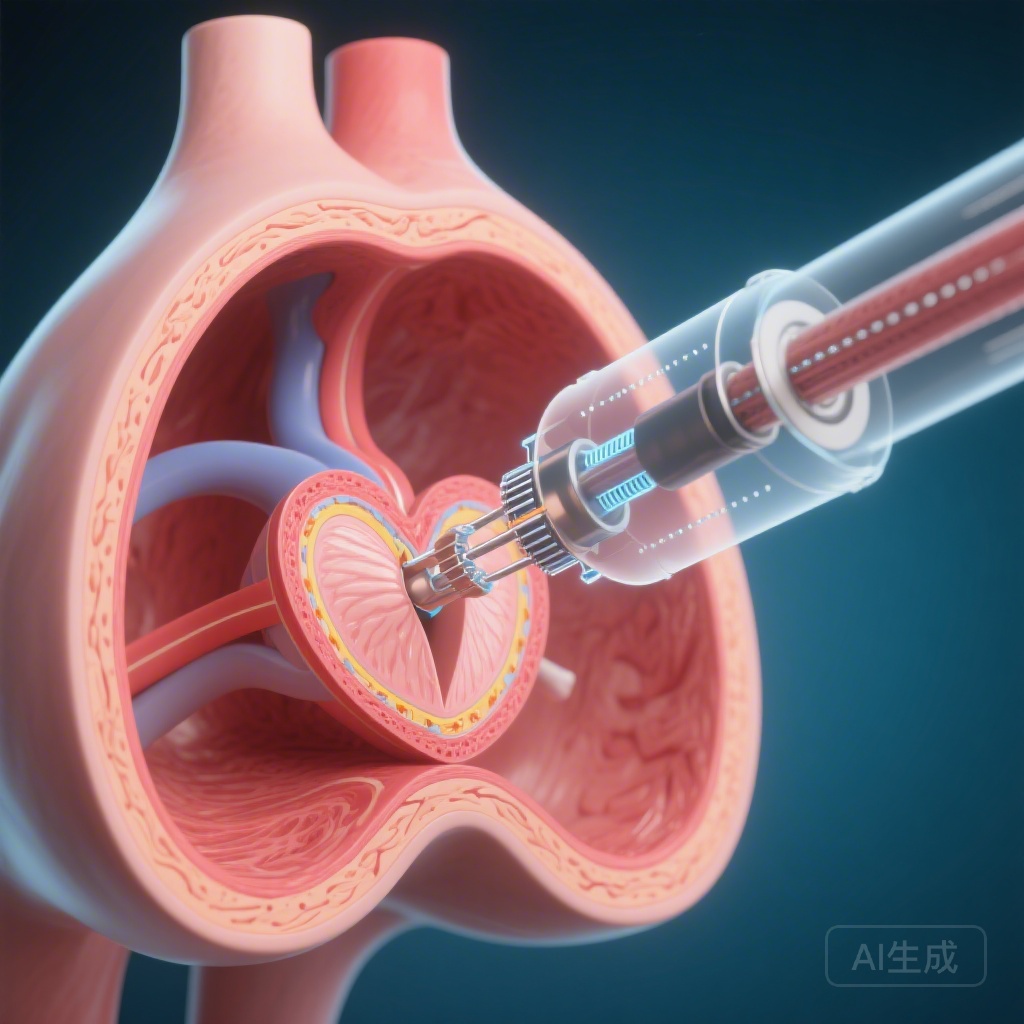
The Rising Challenge of Atrial Functional Mitral Regurgitation
Atrial functional mitral regurgitation (AFMR) has emerged as a distinct and increasingly prevalent clinical entity, particularly among the aging population. Unlike secondary mitral regurgitation (MR) driven by left ventricular dysfunction, AFMR is characterized by left atrial enlargement and mitral annular dilation, often in the setting of long-standing atrial fibrillation (AF) and preserved left ventricular ejection fraction.
Patients with AFMR are typically elderly, frail, and burdened with multiple comorbidities, making them high-risk candidates for traditional surgical interventions. While medical management remains the cornerstone of therapy, its efficacy in altering the natural history of AFMR has been suboptimal. Transcatheter edge-to-edge repair (TEER) has revolutionized the treatment of primary and ventricular functional MR, but its role in AFMR has remained less clear until now.
Highlights of the OCEAN-Mitral and REVEAL-AFMR Comparison
1. TEER significantly reduces the composite risk of all-cause mortality and heart failure (HF) hospitalization by 35% compared to medical therapy in patients with AFMR.
2. The survival benefit of TEER is substantial, with a 42% reduction in all-cause mortality observed in the treated group.
3. Procedural success is paramount: the clinical benefits of TEER are primarily realized when residual MR is reduced to mild or less.
4. These findings provide much-needed evidence for the use of transcatheter interventions in a population that is often excluded from aggressive surgical strategies.
Study Design and Methodology: A Robust Multi-Registry Analysis
The study utilized data from two significant Japanese registries: the OCEAN-Mitral registry, which tracks patients undergoing TEER, and the REVEAL-AFMR registry, which monitors patients managed with medical therapy. By using an identical definition for AFMR across both cohorts, the researchers ensured a high degree of comparability.
Patient Population
The analysis included 1,081 patients with a mean age of 80.1 years. The cohort was predominantly female (60.5%), reflecting the demographic most affected by AFMR. All participants presented with moderate or severe AFMR. Of these, 441 underwent TEER, while 640 received medical treatment.
Statistical Rigor: Propensity Score Weighting
To account for the non-randomized nature of the registries, the investigators employed overlap weighting based on propensity scores. This method created well-balanced groups, effectively neutralizing baseline differences in age, frailty, and comorbidities (standardized mean differences <0.01). Sensitivity analyses, including inverse probability of treatment weighting and propensity score matching, were performed to ensure the consistency and reliability of the results.
Key Findings: Clinical Superiority of TEER
The primary endpoint was a composite of all-cause mortality and heart failure hospitalization. The secondary endpoint focused solely on all-cause mortality.
Primary and Secondary Outcomes
Over the follow-up period, TEER was associated with a significantly lower incidence of the primary composite endpoint (Hazard Ratio [HR] 0.65, 95% Confidence Interval [CI] 0.43-0.99, P = .044). Even more striking was the impact on the secondary endpoint, where TEER demonstrated a clear survival advantage (HR 0.58, 95% CI 0.35-0.99, P = .044). These results suggest that TEER does not just improve quality of life by reducing hospitalizations but may also extend the lifespan of these high-risk patients.
The Threshold for Success: Residual MR
An exploratory subgroup analysis revealed a critical nuance in the data. The favorable outcomes associated with TEER were most pronounced in patients who achieved a residual MR grade of mild or less after the procedure. In contrast, patients who were left with moderate or greater residual MR experienced event rates comparable to those in the medical therapy group. This underscores the technical necessity of achieving optimal leaflet coaptation during the TEER procedure to derive clinical benefit in AFMR.
Expert Commentary: Mechanistic Insights and Clinical Implications
From a physiological standpoint, the benefit of TEER in AFMR likely stems from the interruption of the ‘AF-begets-MR’ cycle. By reducing the regurgitant volume, TEER decreases left atrial pressure and volume overload, which may slow or even partially reverse atrial remodeling.
Experts note that while the COAPT trial established the benefit of TEER in ventricular functional MR, the OCEAN-Mitral and REVEAL-AFMR data fill a critical gap for the AFMR phenotype. The study highlights that even in very elderly patients (mean age 80), the less invasive nature of TEER offers a favorable risk-benefit profile compared to conservative management.
However, limitations must be considered. As an observational study, there remains the possibility of unmeasured confounding. Furthermore, the medical therapy group was not standardized across a single protocol, reflecting ‘real-world’ practice rather than a controlled pharmacological intervention. Future randomized controlled trials (RCTs) are necessary to definitively confirm these findings, though the current data provides a strong impetus for considering TEER in symptomatic AFMR patients.
Conclusion: A Shift in the Treatment Paradigm
The comparison between the OCEAN-Mitral and REVEAL-AFMR registries marks a significant milestone in the management of atrial functional mitral regurgitation. For elderly and frail patients who have historically had limited options, TEER offers a pathway to reduced hospitalization and improved survival. As our understanding of AFMR pathophysiology deepens, the emphasis must remain on early identification and high-quality procedural execution to ensure that patients achieve the ≤mild residual MR threshold required for optimal clinical outcomes.
References
1. Kaneko T, Kagiyama N, Okazaki S, et al. Transcatheter edge-to-edge repair vs medical therapy in atrial functional mitral regurgitation: a propensity score-based comparison from the OCEAN-Mitral and REVEAL-AFMR registries. European Heart Journal. 2026;47(11):1304-1314. PMID: 40629531.
2. Grayburn PA, Sannino A, Packer M. Proportionate and Disproportionate Functional Mitral Regurgitation: A New Conceptual Framework That Refines the Interpretation of COAPT and MITRA-FR. JACC: Cardiovascular Imaging. 2019.
3. Gertz ZM, Herrmann HC, Lim DS, et al. Atrial functional mitral regurgitation: mechanisms and multicenter experience with transcatheter edge-to-edge repair. Catheterization and Cardiovascular Interventions. 2021.