Introduction and Context
Mental fatigue (MF)—the transient psychobiological state produced by prolonged or intense cognitive effort—has become a major topic in movement science because of its documented effects on decision-making, technical skill and endurance performance. Yet, as Schampheleer and colleagues (2025) make clear in the new Sports Medicine consensus-style review, the literature on MF is hampered by wide methodological heterogeneity: researchers use many different induction tasks, varied durations and disparate outcome measures. That variability complicates synthesis, makes replication difficult, and limits translation to applied settings such as elite sport, military training, rehabilitation or occupational health (Schampheleer et al., 2025).
The SPeCIFY initiative (Settings, Protocol establishments, Confounders, Individuals, Framework, Yield) is not a treatment guideline but a practical reporting and design framework to raise the methodological floor for MF studies in movement science. Its purpose: make induction tasks, manipulation checks and outcome measures transparent, comparable, and reproducible.
This article summarizes the core recommendations from Schampheleer et al. (2025), explains why the guidance was issued now, and provides actionable takeaways for researchers, clinicians and practitioners who measure or manage MF in applied and laboratory settings.
Why this guidance now?
– Growing evidence that MF can meaningfully change physical and cognitive performance (Marcora et al., 2009; Van Cutsem et al., 2017), but also growing debate about effect sizes and publication bias (Holgado et al., 2020; Holgado et al., 2023).
– Large methodological heterogeneity across studies (different cognitive tasks, durations, control conditions and outcome measures) undermines meta-analytic clarity and practical translation.
– Newer physiological tools (EEG, HRV, fNIRS, pupil metrics) create both opportunities and pitfalls—greater objectivity but also increased complexity and inconsistent findings.
– Practitioners (coaches, clinicians) increasingly ask how to monitor, prevent or reverse MF in real-world settings, yet evidence remains difficult to interpret.
In short: the field needs consensus about how to design, measure and report MF studies so that findings can be trusted and compared.
New Guideline Highlights (Key takeaways)
– Use a principled task-design framework for MF induction centred on three interacting properties: duration, difficulty and nature of the cognitive task (the “Three Task Properties”).
– Quantify MF via a multi-method approach: at minimum two of the three domains (subjective, behavioral, and (neuro)physiological); ideally all three.
– Select and pilot control tasks carefully; controls should match duration/arousal but minimize cognitive load and emotional content to avoid boredom confounds.
– Individualize induction difficulty where study context requires comparable subjective strain across participants (e.g., elite athletes vs. novices).
– Record and report key contextual variables using the SPeCIFY checklist—covering environmental settings, protocol details, confounders, participant characteristics, measurement framework, and the anticipated translational yield.
– Promote transparency: preregistration, pilot data, full reporting of manipulations and manipulation checks, and open data where possible.
Updated Recommendations and Key Changes from Typical Past Practice
Past studies often (a) varied induction tasks arbitrarily, (b) relied on single subjective measures (e.g., VAS) alone, or (c) used poorly matched control tasks. SPeCIFY upgrades standard practice by making four changes:
1) Design: Move from unstructured choice of cognitive tasks to a structured Three Task Properties framework (duration, difficulty, nature). This forces researchers to justify parameter selection relative to context and participants (Schampheleer et al., 2025).
2) Quantification: Shift from single-method checks to multimodal manipulation checks. SPeCIFY recommends at least two domains—subjective ratings (M-VAS or Likert), behavioral checks (performance drop on cognitive or motor tasks), and objective (EEG/HRV/fNIRS/pupil metrics)—to triangulate MF.
3) Reporting: Introduce a concise SPeCIFY checklist for study methods and context (e.g., room temperature, time-of-day, hardware/software, participant sleep, caffeine intake, baseline mental load). The checklist complements standard reporting tools (CONSORT, STROBE).
4) Control Tasks: Emphasize the importance of carefully designed, pilot-tested control tasks that avoid boredom and underarousal while remaining low cognitive load (e.g., preferred neutral documentary with controlled duration) because inappropriate controls can mask or mimic MF effects (Mangin et al., 2021).
These changes reflect accumulated evidence that (a) task parameters interact in complex ways, (b) subjective scales are sensitive but vulnerable to bias, and (c) physiological signals offer objectivity but are not yet standalone validators (Tran et al., 2020; Csáthó et al., 2023).
Topic-by-Topic Recommendations
1. Induction of Mental Fatigue — The Three Task Properties
Recommendations:
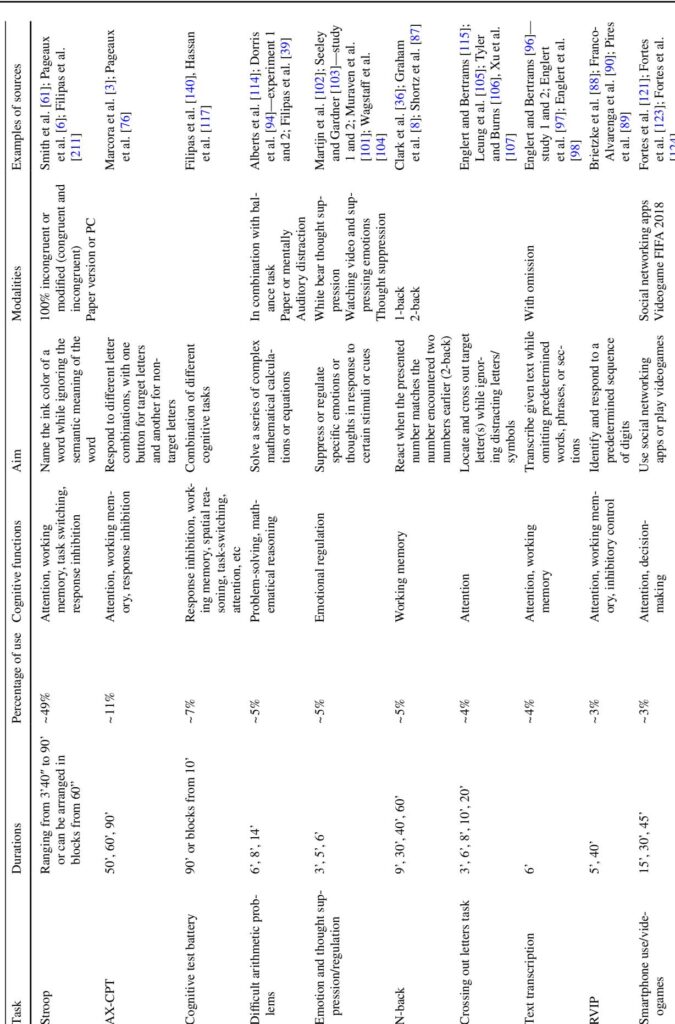
– Duration: Balance task length with ecological and experimental needs. There is no universal minimum; short, highly demanding tasks (<30 min) can induce MF in some contexts, while more typical lab protocols are 30–90 minutes. Consider the subsequent performance test when choosing duration—whole-body endurance tasks may require longer induction to show effects (Van Cutsem et al., 2017; Dallaway et al., 2022).
– Difficulty: Individualize where appropriate. Use familiarization sessions and adaptive procedures (e.g., Stroop-max, TloadDback) so each participant is challenged but not demotivated (O’Keeffe et al., 2020; Hassan et al., 2023).
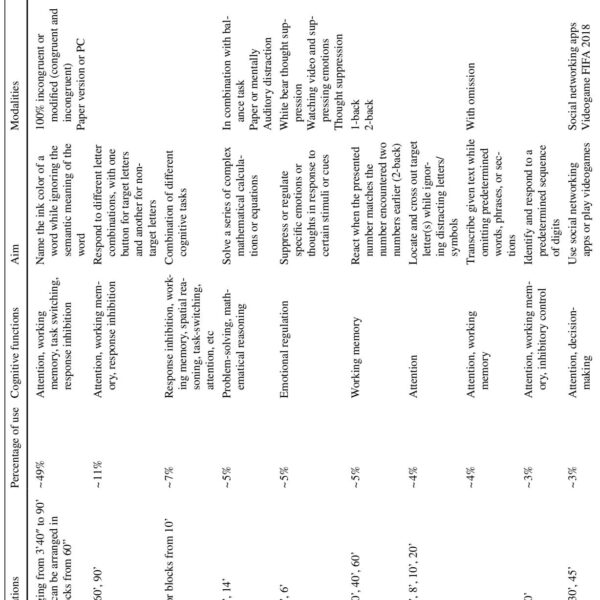
– Nature: Include tasks taxing executive control, especially response inhibition and attention. Combined or battery tasks can better simulate real-world cognitive load but require careful piloting to avoid unintended reductions in MF via task-switching effects (Smith et al., 2019; Hassan et al., 2023).
Practical checklist for induction tasks:
– State clearly which cognitive functions are targeted (e.g., response inhibition, working memory, sustained attention).
– Report exact task parameters (congruency rate, stimulus presentation time, ISI, blocks, breaks).
– Report pilot data showing the induction reliably increases subjective MF and (if available) behavioral/physiological markers.
2. Control Conditions
Recommendations:
– Use control tasks that match duration and setting but minimize cognitive demand and emotional change. Allow participant autonomy where feasible (choice of neutral documentary) to minimize boredom-induced underarousal (Schampheleer et al., 2025).
– Avoid using a congruent Stroop or other simplified versions without pilot testing; such tasks can paradoxically increase perceived exertion in follow-up physical tests (Schücker & MacMahon, 2016; Mangin et al., 2021).
3. Quantification — Manipulation Checks and Outcomes
SPeCIFY recommends triangulation across domains. Practical guidance:
Subjective (use in almost all studies):
– Primary tools: Mental-fatigue visual analogue scale (M-VAS) or short Likert scales. Report exact wording and whether participants received a definition of MF.
– Complement with brief mood (BRUMS), sleepiness (Karolinska or Epworth) and workload (NASA-TLX) measures as confounder checks rather than direct MF measures.
Behavioral (recommended):
– Include a cognitive performance check (during or immediately after induction) and at least one performance outcome sensitive to MF (e.g., decision-making accuracy, time-trial performance).
– Where possible, use a separate short cognitive task post-induction to avoid ambiguity around time-on-task effects.
(Neuro)physiological (use when feasible):
– EEG: track alpha/theta changes and ERP components (e.g., P300), but report preprocessing pipelines and movement-artifact mitigation methods (Tran et al., 2020; Gorjan et al., 2022).
– HRV: report time-domain indices and LF/HF cautiously—evidence is mixed; standardize recording windows.
– fNIRS: useful for prefrontal oxygenation changes but findings are variable—report optode placement and signal quality control.
– Eye metrics and salivary biomarkers (cortisol, α‑amylase): promising but currently supportive rather than definitive.
Minimum manipulation-check recommendation: include at least one subjective rating (M-VAS or Likert) plus a behavioral measure. Add physiological markers for objective triangulation where resources allow.
4. Confounders that must be measured and reported
SPeCIFY mandates reporting (and, where feasible, controlling for):
– Sleep and sleepiness (Pittsburgh Sleep Quality Index for chronic quality; Karolinska/Epworth for acute sleepiness).
– Caffeine and medication intake, recent meals, and hydration.
– Baseline mental load and burnout screening (e.g., Multidimensional Fatigue Inventory, Burnout Assessment Tool) when relevant.
– Motivation measures and task engagement indices (e.g., motivation VAS; Situational Motivation Scale).
5. Special Populations and Contexts
– Athletes: Individualize difficulty for elite athletes; verify that induction tasks are ecologically relevant (e.g., soccer passing drills to simulate cognitive pressure) and control for training load and season phase.
– Clinical populations: Screen for mood and cognitive disorders (BDI-II, MoCA) and acknowledge that baseline fatigability may confound MF measurement.
– Older adults: Expect different neurophysiological signatures and slower recovery; tailor tasks to avoid ceiling/floor effects.
6. Reporting: The SPeCIFY Checklist (core items)
At a minimum, manuscripts should report the following (adapted from Schampheleer et al., 2025):
– Settings: room temperature, humidity (if relevant), time of day, presence/number of researchers, hardware and wearables used.
– Protocol establishments: operational definition of MF used; task specifics (duration, difficulty parameters, breaks), familiarization procedures, blinding and randomization methods, software and hardware versions.
– Confounders: caffeine, medications, supplements, prior sleep (quantity/quality), motivation scores, hydration, mood.
– Individuals: training/caliber, occupation, baseline fatigue or workload, inclusion/exclusion criteria.
– Framework: explicit mapping of induction task’s nature/duration/difficulty and the chosen quantification methods (subjective/behavioral/physiological).
– Yield: statement of anticipated translational impact and recommended future protocols.
Expert Commentary and Insights
Schampheleer and colleagues emphasize pragmatism: SPeCIFY is a flexible reporting and design tool, not a rigid prescription. During panel discussions summarized in the paper, experts highlighted several tensions and open questions:
– Duration vs. intensity: Some experts argued that extremely long tasks (>60 min) risk conflating MF with boredom or underarousal; others noted that very short but demanding tasks can produce MF-like behavioral effects. The consensus: choose the combination of duration and difficulty that matches the research question and pilot it.
– The role of response inhibition: Response inhibition tasks (e.g., incongruent Stroop, Go/NoGo) appear to produce more robust MF effects, perhaps because they engage effortful control. Still, including only inhibition may reduce ecological validity; batteries may better mimic real-world pressure but need careful piloting.
– Physiological markers: There is optimism about EEG and HRV but caution about overinterpreting single markers. Experts recommend rigorous preprocessing and transparent pipelines; physiological measures should be corroborative rather than standalone indicators.
– The ego-depletion debate: Some authors note that ego-depletion literature (short tasks, self-control framing) and MF literature (longer cognitive load) may overlap but are not identical. SPeCIFY avoids prescriptive alignment with any single theoretical model and focuses on operational transparency instead.
– Replicability and open science: Panelists strongly recommended preregistration, sharing code and stimuli, and publishing manipulation-check data—even when negative—so the field can converge on reliable induction protocols.
Practical Implications: How to apply SPeCIFY in daily practice
For researchers:
– Before data collection, fill out a SPeCIFY-formatted protocol appendix: list setting variables, tasks with parameters, manipulation checks, and planned confounder measures. Include it in preregistration and as a supplement to publications.
– Pilot induction and control tasks with a small sample that mirrors study participants (e.g., similar athletic level) and report pilot results.
– Use at least one behavioral and one subjective measure in all studies; add physiological monitoring when practical and properly validated.
For clinicians and applied practitioners (coaches, strength & conditioning staff):
– Understand that short, intense cognitive bouts (e.g., phone/email triage, decision-heavy meetings) can produce MF that may alter subsequent technical or endurance performance—monitor subjective MF and adjust practice if needed.
– Consider quick subjective checks (M-VAS, task-specific motivation VAS) before critical training or competition; if MF is high, modify session demands or recovery strategies.
For funders and journal editors:
– Encourage SPeCIFY-style reporting and require reporting of key confounders and manipulation checks; this will make published studies more interpretable and comparable.
Applying SPeCIFY: A brief vignette
Sarah, a 27-year-old collegiate cyclist, volunteers for a lab study examining whether 30 minutes of a demanding Stroop task reduces a 10-km time-trial. The research team:
– Uses the Three Task Properties framework to justify 30 minutes: short enough to fit into participant schedules but combined with high incongruency and reduced stimulus presentation time to ensure sufficient cognitive load.
– Pilots the Stroop with four teammates and adjusts difficulty so average accuracy remains ~85% (individualization step).
– Chooses a control: 30-minute neutral documentary of participant choice (duration-matched) with pre-specified options and measures boredom post-task.
– Collects M-VAS and BRUMS scores before and after the induction, runs a short flanker task post-induction for behavioral check, and records heart rate and HRV during rest periods.
– Reports all SPeCIFY items in the methods, preregisters the protocol, and uploads anonymized manipulation-check data to a repository.
This approach yields clearer interpretation: if Sarah’s subjective M-VAS increases, flanker RT slows and HRV changes, the study can more confidently assert MF induction and relate it to any 10-km time-trial differences.
Limitations and controversies
– There is no single gold-standard induction or biomarker for MF; SPeCIFY is about transparency and convergence, not claiming to definitively diagnose MF.
– Physiological measures are promising but sensitive to artifact and interindividual variability; costly equipment and analysis expertise limit field deployment.
– The relationship between subjective MF and objective performance outcomes is complex and moderated by motivation, task type, and individual differences.
Future directions and research priorities
– Develop and validate standardized, brief MF induction paradigms across populations and settings with openly shared stimuli.
– Large replication studies using SPeCIFY-style reporting to quantify true effect sizes for common outcomes (time-trial, decision-making accuracy, technical skill measures).
– Further methodological work on physiological markers (standardized pre-processing and reporting for EEG/HRV/fNIRS) and validation of wearable metrics for field monitoring.
– Research on recovery and countermeasures (caffeine, short exercise breaks, strategic naps) with SPeCIFY-compliant measurement to build robust, actionable recommendations (see Proost et al., 2022 for countermeasure review).
Conclusions
The SPeCIFY guidance from Schampheleer et al. (2025) is a pragmatic step toward higher-quality, more comparable mental fatigue research in movement science. Its strengths lie in encouraging structured task design (Three Task Properties), requiring multi-method manipulation checks, controlling for confounders, and standardizing reporting with a concise checklist. Researchers who adopt SPeCIFY will produce findings that are easier to synthesize, more reproducible, and potentially more useful for coaches, clinicians and policymakers.
Selected References
– Schampheleer E, Habay J, Proost M, Arenales Arauz YL, Russell S, Roose M, Bian C, Meeusen R, De Pauw K, Roelands B. Current Practices for Mental Fatigue Quantification and Induction in Movement Science: Introducing the SPeCIFY Guidelines. Sports Med. 2025 Oct;55(10):2387–2413. doi:10.1007/s40279-025-02286-3.
– Marcora SM, Staiano W, Manning V. Mental fatigue impairs physical performance in humans. J Appl Physiol. 2009;106(3):857–64. doi:10.1152/japplphysiol.91324.2008.
– Van Cutsem J, Marcora S, De Pauw K, Bailey S, Meeusen R, Roelands B. The effects of mental fatigue on physical performance: a systematic review. Sports Med. 2017;47(8):1569–88. doi:10.1007/s40279-016-0672-0.
– Tran Y, Craig A, Craig R, Chai R, Nguyen H. The influence of mental fatigue on brain activity: evidence from a systematic review with meta-analyses. Psychophysiology. 2020;57(6): e13554. doi:10.1111/psyp.13554.
– O’Keeffe K, Hodder S, Lloyd A. A comparison of methods used for inducing mental fatigue in performance research: individualised, dual-task and short duration cognitive tests are most effective. Ergonomics. 2020;63(1):1–12. doi:10.1080/00140139.2019.1687940.
– Smith MR, Chai R, Nguyen HT, Marcora SM, Coutts AJ. Comparing the effects of three cognitive tasks on indicators of mental fatigue. J Psychol. 2019;153(8):759–83. doi:10.1080/00223980.2019.1611530.
– Proost M, Habay J, De Wachter J, De Pauw K, Rattray B, Meeusen R, Roelands B. How to tackle mental fatigue: a systematic review of potential countermeasures and their underlying mechanisms. Sports Med. 2022;52(9):2129–58. doi:10.1007/s40279-022-01678-z.
– Csáthó A, Van der Linden D, Matuz A. Change in heart rate variability with increasing time-on-task as a marker for mental fatigue: a systematic review. Biol Psychol. 2023;185:108727. doi:10.1016/j.biopsycho.2023.108727.
– Mangin T, André N, Benraiss A, Pageaux B, Audiffren M. No ego-depletion effect without a good control task. Psychol Sport Exerc. 2021;56:102033. doi:10.1016/j.psychsport.2021.102033.
(For a full reference list including methodological and primary studies cited in the SPeCIFY review, see Schampheleer et al., 2025.)