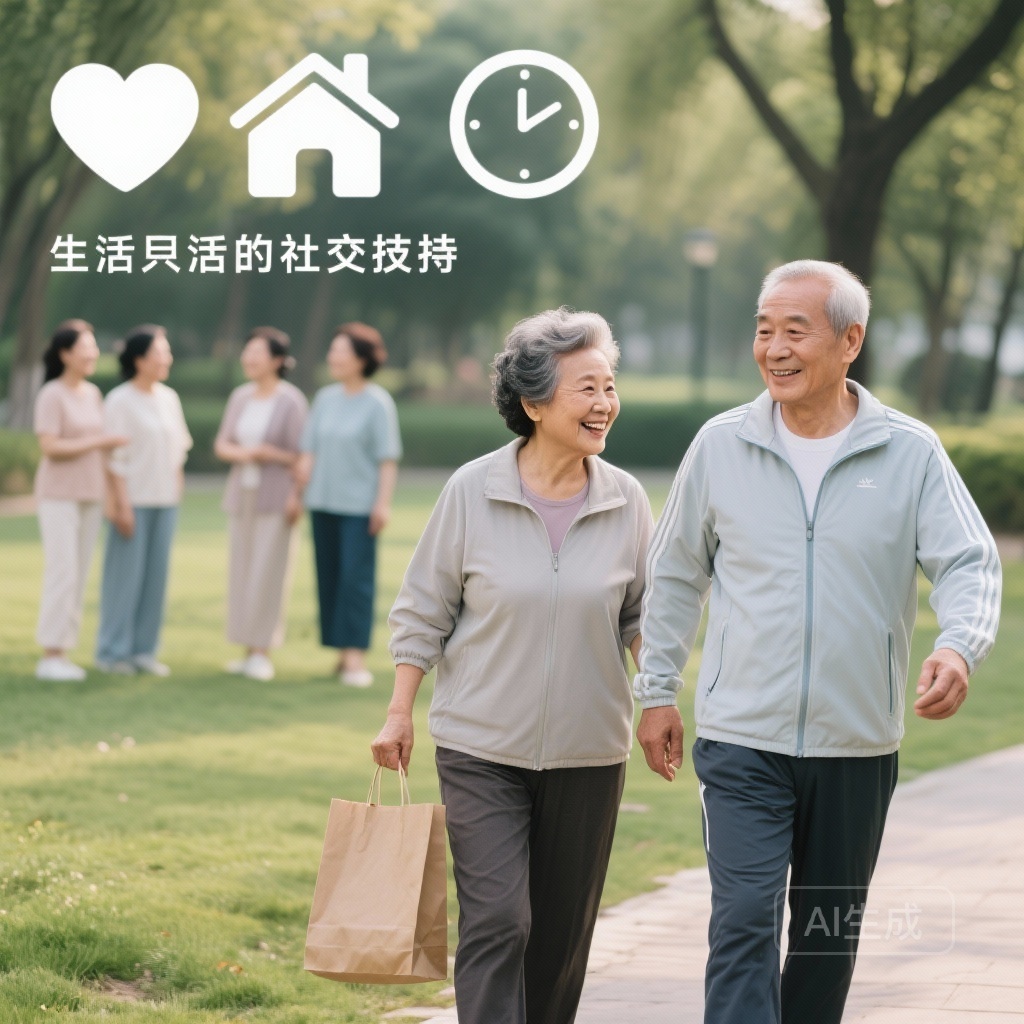
Highlight
– Over 13 years in a nationally representative Chinese cohort, favourable lifestyles and social determinants independently and additively increased independent life expectancy (years lived without dependence).
– At age 65, women lived longer overall but fewer years independently than men; men derived larger independent-life gains from healthy behaviours, women from supportive social determinants.
– Combining multiple healthy lifestyle factors with positive social conditions produced nearly four extra years of independent life for both sexes.
Background
Functional independence—ability to perform activities of daily living (ADLs) and instrumental activities of daily living (IADLs) without assistance—is a cornerstone of healthy ageing and quality of life for older adults. As populations age rapidly worldwide, and particularly in China, extending not just lifespan but healthspan (years lived free of disability) has become a public health priority. Determinants of independent life expectancy are multifactorial: individual behaviours (diet, physical activity, smoking, alcohol), socioeconomic resources, health-care access, the built environment, and social context all influence trajectories toward dependence and death. However, how these factors interact to shape independence over time, and whether effects differ by sex, remains incompletely characterised.
Study design
Ren and colleagues used data from the Chinese Longitudinal Healthy Longevity Study (CLHLS), a nationally representative cohort, to evaluate associations between healthy lifestyle factors, social determinants of health (SDoH), and transitions between independence, dependence, and death over 2008–2021. The analytic sample included 11,804 participants aged 65–100 years with at least one follow-up or death record. Baseline exposures comprised four lifestyle behaviours (diet, physical activity, smoking, alcohol use) and five SDoH indicators (financial status, education, health-care access, built environment, social context).
Functional independence was measured at each wave based on self-reported need for assistance with ADLs and IADLs. The authors employed a continuous-time three-state Markov model estimating transition hazards across the states (independence → dependence → death, and independence → death), adjusted for covariates, to compute total and independent life expectancy by sex and exposure strata.
Key findings
Overall life expectancy and independent life expectancy
At age 65, women had greater total life expectancy than men (18.18 vs 15.50 years), but fewer years lived independently (10.35 vs 11.29 years). This reproduces the well-described paradox in ageing epidemiology: women live longer but spend more of those extra years with disability.
Impact of healthy lifestyles
Participants were grouped by number of healthy lifestyle factors. Men accrued larger absolute gains in independent life expectancy from having 3–4 healthy lifestyle factors compared with 0–1 factors (gain 2.45 years; 95% CI 2.24–2.67). Women also benefited, but the gain was smaller (2.09 years; 95% CI 1.90–2.29). The sex difference in the lifestyle-related gain was statistically significant (p = 0.015). This suggests behavioural risk modification has a greater marginal impact on men’s independent life years in this population.
Impact of social determinants
Indicators of favourable social determinants (4–5 positive SDoH vs 0–1) were associated with larger independent life expectancy gains for women (1.95 years; 95% CI 1.74–2.16) than for men (1.67 years; 95% CI 1.49–1.85), with a significant sex interaction (p = 0.047). In other words, improvements in socioeconomic and social conditions produced larger independent-life benefits for women.
Joint effects
The combination of multiple healthy lifestyle behaviours and supportive social conditions yielded the largest improvements. Men with both favourable lifestyles and SDoH gained 3.94 years (3.73–4.15) of independent life; similarly, women gained 3.89 years (3.68–4.11). The near-equality of combined gains suggests that interventions addressing both domains are synergistic and can substantially extend independent life expectancy for both sexes.
Additional findings and statistical considerations
The study derived hazards from a multi-state model, allowing estimation of time spent in independence and dependence separately. Estimates were adjusted for covariates and stratified by sex. Confidence intervals were narrow given the large sample and long follow-up. The authors reported significant sex-by-exposure interactions for lifestyle and social determinant domains, highlighting differing pathways to healthy ageing.
Expert commentary: interpretation, biological plausibility, and context
Why might men gain more from lifestyle change?
In China, as in many settings, unhealthy behaviours such as smoking and high alcohol consumption are more prevalent among men. Therefore, men may have greater absolute risk attributable to these behaviours and thus greater potential benefit from changing them. Physical inactivity and cardiometabolic risk factors also cluster more in certain male subpopulations; modifying those risks can delay disability onset. Behavioural change that reduces cardiovascular disease, chronic obstructive pulmonary disease, and frailty will therefore materially extend years lived independently.
Why might women benefit more from social determinants?
Women in older Chinese cohorts often have lower educational attainment and accumulate socioeconomic disadvantage across the life course. They are also more reliant on informal social networks and community supports. Improvements in financial security, health-care access, built environment (walkability, access to services), and social context (social participation, support networks) may therefore disproportionately improve women’s ability to remain independent. Additionally, caregiving roles, widowhood and living arrangements differ by sex and can moderate the effect of SDoH on functional trajectories.
Strengths of the study
Key strengths include a large, nationally representative sample, long follow-up (13 years), repeated functional assessments, and use of a continuous-time three-state Markov model to separate time spent independent from time with dependence. The combined consideration of lifestyle and multiple SDoH indicators, and explicit estimation of sex differences, provides useful granularity for policy and program design.
Limitations and cautions
Several limitations warrant attention. Lifestyle and SDoH exposures were measured at baseline; changes over follow-up might attenuate or amplify effects. Many measures were self-reported and subject to misclassification. Residual confounding by unmeasured variables (e.g., early-life disadvantage, quality of healthcare, detailed comorbidity burden) may remain. Reverse causation is possible: early undetected functional decline could have influenced baseline behaviours. Finally, the CLHLS cohort reflects the Chinese population and certain generational experiences; extrapolation to other countries or younger cohorts should be cautious.
Implications for clinicians and policymakers
Sex-specific strategies are supported by these findings. For men, intensified primary prevention targeting smoking cessation, reduction of harmful alcohol use, promotion of regular physical activity, and dietary improvements could yield disproportionate gains in independent life expectancy. For women, policies that bolster financial security in older age, improve access to affordable health care, enhance neighbourhood safety and mobility, and expand social participation opportunities may be particularly effective at extending years lived independently.
That combined improvements in both lifestyle and social conditions yielded almost 4 additional independent years for both sexes underscores the importance of integrated approaches. Health systems and ageing policies should therefore combine individual-level behaviour-change programs with structural investments in social determinants: pension security, community-based services, age-friendly environments, and accessible primary care.
Research and practice gaps
Unanswered questions include the extent to which interventions targeting these domains can produce the projected gains when implemented prospectively, and whether there are critical periods across the life course when modifying behaviour or circumstances yields the largest returns. Randomised or quasi-experimental evaluations of community-level social interventions, and trials of multi-component lifestyle programs with functional endpoints, would strengthen causal inference. Better measurement of SDoH dynamics and inclusion of biomarkers or objective activity measures would improve mechanistic understanding.
Conclusion
Ren et al. provide compelling evidence that both modifiable lifestyles and social determinants shape independent life expectancy among older adults in China, with important sex differences: men benefit more from healthy behaviours, whereas women benefit more from favourable social conditions. The findings support a dual approach to healthy ageing that combines behavioural risk reduction with policies that improve socioeconomic and psychosocial environments, tailored by sex. Such strategies can substantially increase the years older adults live without dependence, improving wellbeing and potentially reducing long-term care needs.
Funding and registration
The study was funded by the National Natural Science Foundation of China and the Chinese Academy of Medical Sciences Innovation Fund. (Original article: Ren L et al., Lancet Public Health. 2025.)
References
Ren L, Zhou Y, Liu K, et al. The effect of healthy lifestyles and social determinants on independent life expectancy and sex differences in China: evidence from a 13-year cohort study. Lancet Public Health. 2025 Dec;10(12):e1016-e1024. doi:10.1016/S2468-2667(25)00253-1.
World Health Organization. World report on ageing and health. Geneva: WHO; 2015.